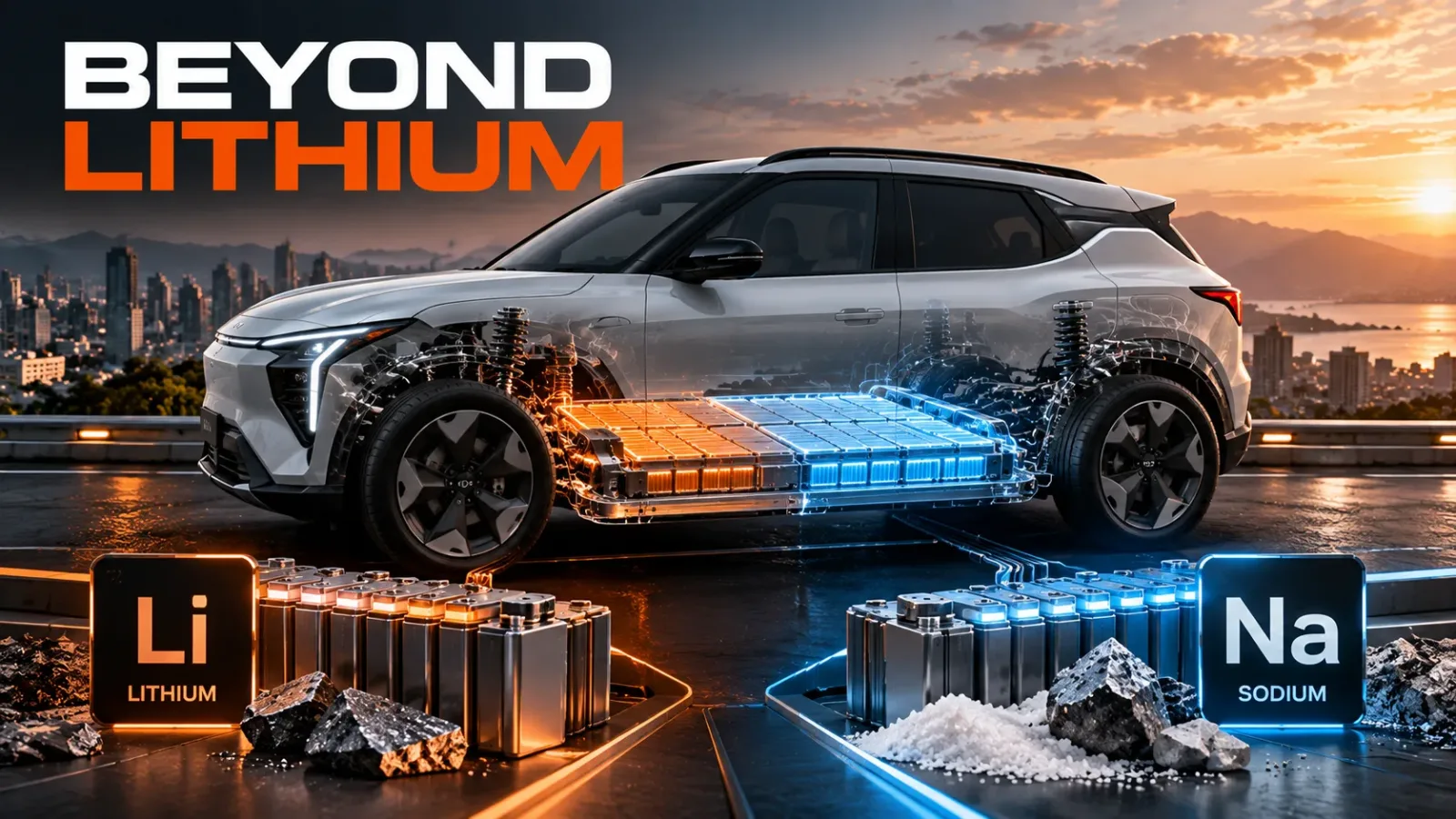
For years, one battery technology has dominated discussions about the future of electric vehicles.
- Solid-state batteries.
Automakers and battery manufacturers have invested billions trying to develop batteries capable of storing more energy, providing longer driving ranges and potentially improving safety. But while the industry waits for solid-state batteries to reach large-scale production, another battery technology is moving much more quietly toward real cars. And instead of lithium, it uses something considerably more abundant.
- Sodium.
Sodium-ion batteries aren't a distant laboratory experiment anymore. In February 2026, CATL and Changan unveiled what they described as the world's first mass-production passenger vehicle equipped with sodium-ion batteries. CATL is also moving its Naxtra sodium-ion technology toward full-scale production. The age of the sodium-ion EV may finally be beginning. But that doesn't mean lithium-ion batteries are about to disappear. The real story is considerably more interesting.
What Exactly Is a Sodium-Ion Battery?
At a basic level, sodium-ion and lithium-ion batteries work in remarkably similar ways. Both move charged ions between the positive and negative sides of a battery cell during charging and discharging. In a lithium-ion battery, those ions are lithium. In a sodium-ion battery, they are sodium. That seemingly simple change has potentially significant consequences. Lithium is an important resource for modern battery production, and demand has increased dramatically with the growth of electric vehicles and stationary energy storage. Sodium, by comparison, is extremely abundant. That gives battery manufacturers another potential chemistry to work with and reduces dependence on lithium alone. It doesn't mean EV batteries are literally being filled with table salt. The chemistry is considerably more sophisticated than that. But the underlying element is one of the most common on Earth.
Why Are Battery Companies Interested in Sodium?
One reason is diversification. The modern EV industry is heavily dependent on lithium-ion batteries. Even different lithium chemistries including LFP and nickel-rich batteries still rely on lithium. That means changes in lithium supply and pricing can affect much of the battery industry at the same time. Sodium-ion provides another option. The International Energy Agency notes that sodium-ion batteries could help manufacturers reduce exposure to lithium price volatility. That could become strategically important as global demand for batteries continues increasing. Instead of betting everything on one battery chemistry, manufacturers could eventually choose different batteries for different vehicles. Long-range premium EV? A high-energy-density lithium chemistry may make more sense. Affordable urban EV? Sodium-ion could become interesting. Stationary energy storage? Again, sodium-ion may have advantages. The future of batteries may therefore look less like one technology defeating another and more like different chemistries being selected for different jobs.
CATL's Naxtra Shows How Far the Technology Has Come
The most significant recent development comes from CATL, the world's largest EV battery manufacturer. Its latest Naxtra sodium-ion battery reaches an energy density of approximately 175 Wh/kg. That number matters. Earlier sodium-ion batteries suffered from considerably lower energy density, making them difficult to use in passenger vehicles where weight and space are extremely important. CATL says its latest technology can support more than 400 km of pure-electric range in its first mass-production automotive application. The company believes future improvements could eventually push sodium-ion EV ranges toward 500 to 600 km. Those figures begin putting sodium-ion into territory that ordinary motorists could realistically use. But there is still an important limitation.
Lithium-Ion Still Stores More Energy
Energy density remains sodium-ion's biggest disadvantage. According to the International Energy Agency, the latest sodium-ion cells can reach around 175 Wh/kg. Modern LFP batteries can reach approximately 205 Wh/kg, while NMC lithium-ion cells can reach around 265 Wh/kg. That difference affects everything. If two batteries weigh the same, the lithium-ion battery can generally store more energy. Alternatively, achieving the same battery capacity with sodium-ion may require a larger or heavier pack. For an electric vehicle, additional weight and size aren't trivial problems. They affect range, efficiency, handling, packaging and potentially vehicle cost. This is why sodium-ion isn't automatically a better battery simply because sodium is more abundant. Battery engineering is always a compromise.
Sodium-Ion May Not Need 700 km of Range
There is another way to look at the energy-density disadvantage. Not every electric vehicle needs an enormous battery. Consider a compact city EV. If the vehicle is primarily used for commuting, shopping, school runs and other daily journeys, a 300- to 400-km driving range may already be more than sufficient. Installing an expensive battery capable of 700 km might provide impressive specifications, but the owner could spend years carrying battery capacity that is rarely needed. That is where sodium-ion could make sense. The IEA expects the technology to be particularly suitable for shorter-range electric cars, urban commercial vehicles, two- and three-wheelers and stationary energy storage. Instead of competing directly with the longest-range EV batteries, sodium-ion could occupy a different part of the market. And that could eventually become very important for affordable electric transportation.
There Is Another Advantage: Temperature
Sodium-ion batteries also perform particularly well in extreme cold. CATL says its Naxtra battery retains more than 90% usable capacity at -40°C and can operate across temperatures ranging from approximately -40°C to 70°C. The IEA similarly identifies low-temperature performance as one of sodium-ion's major advantages over lithium-ion batteries, particularly LFP. That is obviously much more important in northern China, Europe and other cold climates than it is in the Philippines. Filipino EV owners are unlikely to wake up to a -30°C morning. But temperature performance still demonstrates something important about battery technology: There is no single battery chemistry that is best at everything. One chemistry may provide higher energy density. Another may cost less. Another may perform better in extreme temperatures. Another may prioritize cycle life. Choosing an EV battery is increasingly about selecting the correct combination of characteristics for the vehicle.
Could Sodium-Ion Make EVs Cheaper?
This is probably the question that matters most to consumers. Potentially but it isn't guaranteed. Sodium itself is abundant, and sodium-ion batteries can reduce reliance on lithium and graphite. However, battery cost isn't determined by one raw material. Factories, cathode materials, anodes, electrolytes, manufacturing yields, supply chains and production scale all influence the final price. And this is where lithium-ion currently has an enormous advantage. Lithium-ion battery manufacturing has been optimized over decades. Factories operate at enormous scale. Supply chains already exist. Manufacturers know how to produce the cells efficiently. Sodium-ion doesn't yet have that advantage. The IEA estimates that current sodium-ion cell manufacturing capacity is only a little over 1% of lithium-ion capacity. So although sodium-ion has the potential to become inexpensive at scale, it shouldn't automatically be described as a cheaper battery today. The economics will depend heavily on how quickly production grows and what happens to lithium prices.
China Is Moving First
There is another familiar pattern emerging. China is moving aggressively. CATL has developed Naxtra. BYD has invested in sodium-ion manufacturing. HiNa Battery has also been developing automotive sodium-ion technology. And in February 2026, CATL and Changan unveiled their first mass-production sodium-ion passenger vehicle, with CATL supplying batteries across Changan brands including AVATR, Deepal, Qiyuan and UNI. CATL says it has invested years of development into sodium-ion technology, producing hundreds of thousands of test cells before reaching automotive deployment. By April 2026, the company said it had reached GWh-level industrialization and was preparing Naxtra for full-scale mass production by the end of the year. That is a significant transition. Sodium-ion is moving from research papers and prototypes toward industrial manufacturing.
The First Cars Won't Necessarily Be Premium EVs
Don't expect sodium-ion batteries to immediately appear in the most expensive long-range electric vehicles. That isn't necessarily where the technology makes the most sense. A premium EV buyer may expect 600 or 700 km of range, enormous power and maximum energy density. Lithium-ion remains better suited to those requirements. But consider a small electric hatchback designed primarily for city driving. Or a delivery vehicle traveling predictable routes every day. Or an inexpensive commuter EV. For those vehicles, maximum energy density may be less important than cost, safety, durability and sufficient everyday range. That is where sodium-ion could find its place. The technology doesn't need to beat the best lithium-ion battery. It only needs to be better suited to a particular job.
Could Sodium-Ion Make Sense in the Philippines?
This is where things become interesting for our market. The Philippines doesn't particularly benefit from sodium-ion's exceptional cold-weather performance. But we could benefit from something else: more affordable electric vehicles. Vehicle price remains one of the biggest barriers to EV adoption in the country. Battery costs account for a significant part of an electric vehicle's manufacturing cost. If sodium-ion eventually allows manufacturers to produce less expensive short- and medium-range EVs, the technology could become relevant here. Imagine a compact EV designed for Metro Manila, Cebu or Davao. It doesn't necessarily need 700 km of range. It needs enough range for several days of typical urban driving, predictable charging and a price competitive with conventional cars. For that kind of vehicle, sodium-ion could eventually become an interesting option. But there is an important catch. Charging infrastructure still matters. A 300- or 400-km EV can work extremely well when drivers have convenient charging. The same vehicle becomes much less attractive when charging locations are scarce. Battery technology and charging infrastructure therefore have to develop together.
Sodium-Ion Could Also Matter Outside Cars
Perhaps sodium-ion's biggest impact in the Philippines may not initially be inside an electric vehicle. It could be connected to the electricity grid. Solar and wind generation create electricity when environmental conditions allow it not necessarily when consumers need it. Large battery-storage systems can capture some of that electricity and release it later. In stationary storage, weight and physical size are much less important than they are inside a vehicle. A battery sitting beside a solar farm doesn't need to be lightweight. That reduces one of sodium-ion's biggest disadvantages. CATL has already expanded the technology into stationary energy storage, including a major 60 GWh sodium-ion supply agreement announced in 2026. For a country expanding renewable generation, sodium-ion could eventually become relevant to both transportation and electricity storage.
What About Solid-State Batteries?
This brings us back to the technology everyone has been waiting for. Solid-state batteries promise something very different. Their attraction is primarily the possibility of substantially higher energy density and improved safety. That could eventually mean EVs capable of traveling farther without simply installing larger and heavier battery packs. But the IEA notes that solid-state battery advantages still need to be demonstrated at manufacturing scale and under realistic operating conditions. Sodium-ion is attacking the battery problem from almost the opposite direction. It isn't trying to store the maximum possible amount of energy in the smallest possible space. Instead, it offers another chemistry based on abundant materials, strong temperature performance and potentially attractive economics as manufacturing scales. These technologies therefore don't necessarily compete for exactly the same vehicles.
The Future May Be Multi-Chemistry
For years, the EV industry has often discussed batteries as though one technology would eventually emerge victorious. First lithium-ion. Then LFP. Then solid-state. Now sodium-ion. Reality may turn out to be much less dramatic and much more useful. There may not be one perfect EV battery. Instead, manufacturers could increasingly select battery chemistry according to the vehicle.
- NMC for vehicles requiring maximum energy density.
- LFP for affordable mainstream EVs requiring durability and competitive cost.
- Sodium-ion for shorter-range vehicles, cold-weather applications and energy storage.
- Solid-state potentially for future applications where very high energy density justifies the technology and cost.
Manufacturers are even developing battery packs that combine different chemistries inside the same vehicle. That may ultimately be the real battery revolution. Not replacing lithium. Not waiting for one miraculous technology. But learning to use the right battery for the right job.
Sodium-Ion Doesn't Need to Replace Lithium to Matter
Lithium-ion batteries aren't going anywhere anytime soon. They have decades of development behind them, enormous manufacturing capacity and an established global supply chain. Sodium-ion still has major challenges to overcome, particularly energy density and manufacturing scale. But something important has changed. We are no longer asking whether a sodium-ion battery can power an electric car. It already can. The question now is whether manufacturers can produce those batteries at sufficient scale, at the right cost, and put them into vehicles where their advantages actually matter. If they can, the next generation of electric vehicles may not all be powered by the same chemistry. Some will use lithium. Some may eventually use solid-state batteries. And increasingly, some could run on sodium. The future of the EV battery may not belong to a single winner. It may belong to choice.
Comments
No comments yet. Be the first to join the discussion.