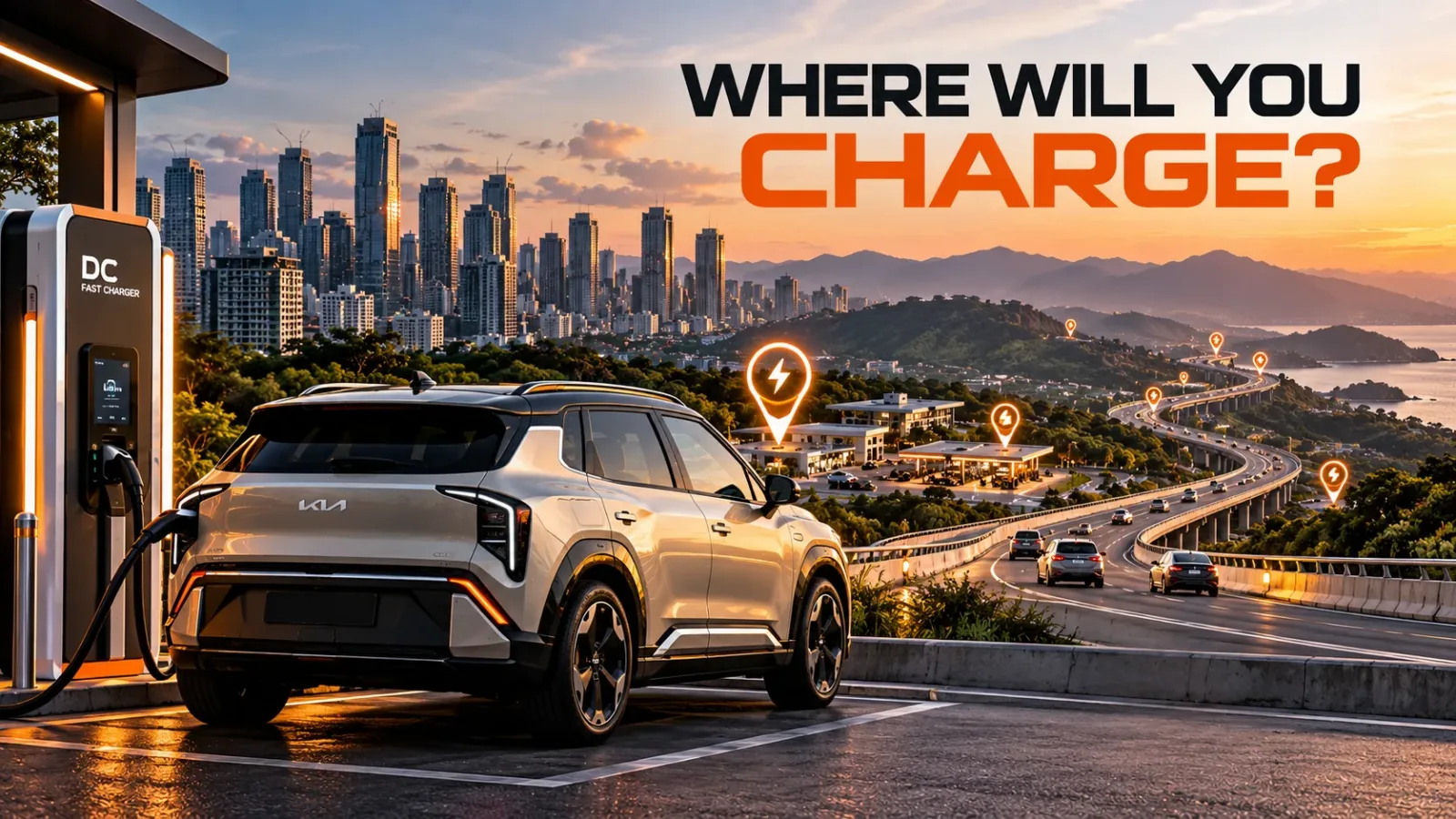
The Philippines Has More EV Chargers Than Ever But Are They Where Drivers Need Them?
The Philippines now has more electric vehicle charging infrastructure than at any point in its history. As of the end of August 2026, the Department of Energy reported 1,876 registered EV charging points nationwide. That number is growing quickly. At the end of March, the country had 1,569 charging points. In just five months, more than 300 additional charging points were added to the national count. On paper, that's encouraging. Electric vehicles are becoming more common, manufacturers are introducing new models, and charging infrastructure is expanding alongside them. But counting chargers only tells us part of the story. For an EV driver, the more important questions are much simpler:
- Where are those chargers?
- How fast are they?
And perhaps most importantly:
- Are they located where drivers actually need them?
1,876 Charging Points Sounds Like a Lot
The growth of the Philippine charging network shouldn't be underestimated. Public charging was extremely limited during the early years of EV adoption in the country. Today, charging stations can increasingly be found in shopping malls, hotels, dealerships, offices, parking facilities, fuel stations and along major travel corridors. The industry supporting those chargers is growing as well. According to the DOE, there were 422 accredited EV charging-station providers as of August 31, 2026. These include charging-station operators, service providers and equipment suppliers. That's important because an EV ecosystem requires much more than installing chargers. Equipment has to be supplied, installed correctly, maintained, connected to payment systems and kept operational. The growing number of companies participating in the sector suggests that EV charging itself is becoming a legitimate infrastructure business in the Philippines. But there is another side to those numbers.
A Charger in Metro Manila Doesn't Help You in the Province
Charging infrastructure isn't particularly useful simply because it exists somewhere in the country. Location matters. A large concentration of the country's charging infrastructure remains in Luzon, particularly around Metro Manila and surrounding urban areas. That makes sense from a business perspective. Metro Manila contains a large concentration of vehicles, commercial establishments, offices and consumers who can afford newer electric vehicles. Shopping malls and commercial centers also provide convenient locations because cars remain parked for extended periods. For an EV owner living and working within Metro Manila, the charging network can therefore look surprisingly developed. Drive farther away from the country's major urban centers, however, and the experience can change dramatically. The challenge becomes particularly visible in parts of Visayas and Mindanao. Recent figures from the DOE's Mindanao Field Office, for example, indicate that the Davao Region has only 16 registered charging stations.
- Fourteen are in Davao City.
- Tagum City has one.
- Digos City has one.
That illustrates one of the biggest challenges facing Philippine EV infrastructure. The country doesn't simply need more chargers. It needs chargers distributed across a geographically complicated archipelago.
Not Every Charger Is the Same
There's another problem with looking only at the national total. A charging point isn't necessarily a fast charger. An AC charger and a high-powered DC fast charger perform very different jobs. AC charging is perfectly useful when a vehicle will remain parked for several hours. Think of locations such as: shopping malls, workplaces, hotels, condominiums and overnight parking facilities. A driver can plug in, continue with other activities and return later with additional range. But road trips are different. When someone is traveling hundreds of kilometers, waiting several hours to replenish a battery isn't particularly practical. That's where DC fast charging becomes important. Depending on the vehicle and charger, a modern EV may be able to recover a significant amount of battery capacity in around 20 to 40 minutes. For long-distance travel, therefore, the important question isn't simply:
- Is there a charger along the route?
It is:
- Is there a fast charger along the route?
That distinction will become increasingly important as more Filipinos begin using EVs outside their normal daily commute.
Expressways Could Become the Backbone of EV Travel
For Philippine EV owners, some of the most valuable charging locations may eventually be the same places motorists already stop during long journeys.
- Expressway service areas.
- Fuel stations.
- Restaurants.
- Tourist destinations.
- Hotels.
- Large provincial shopping centers.
These locations naturally fit the way people already travel. A driver heading from Metro Manila toward northern or southern Luzon doesn't necessarily need hundreds of chargers scattered randomly across the route. What the driver needs is confidence that reliable fast charging will be available at predictable intervals. That is how charging infrastructure can begin replacing range anxiety with something much simpler: route planning. The difference is important. Drivers of gasoline vehicles rarely think about whether there will be another fuel station hundreds of kilometers away. Eventually, EV charging needs to provide a similar level of confidence.
Home Charging Changes Everything
There is another part of the charging discussion that often receives less attention. For many EV owners, the most important charger in the country may be the one inside their own garage. An EV doesn't necessarily work like a gasoline vehicle. A gasoline vehicle is normally driven until the fuel level becomes low, then taken somewhere specifically to refuel. An EV can operate differently. If an owner can reliably charge at home, public charging may only become necessary during longer trips. This dramatically changes the infrastructure requirement. Instead of replacing every gasoline station with an EV charging station, part of the country's charging network can effectively exist inside homes. But that advantage isn't available to everyone.
Condominiums May Be the Bigger Challenge
Consider someone living in a condominium. They may have a dedicated parking space, but that doesn't necessarily mean an electrical connection is available there. Installing a charger can involve property-management approval, electrical upgrades, metering arrangements, installation costs and questions about who pays for the electricity. Apartment residents may face an even larger problem. Some don't have dedicated parking at all. Others park on streets or in shared spaces where installing a private charger simply isn't possible. For these motorists, public charging isn't an occasional convenience. It may be essential to owning an EV. This is why the next stage of Philippine charging infrastructure cannot focus only on shopping malls and commercial charging hubs. Residential charging needs to become part of the discussion as well.
The Government Knows Infrastructure Has to Grow
The expansion is part of a much larger national strategy. The Electric Vehicle Industry Development Act, or EVIDA, established the policy framework for accelerating EV adoption and charging infrastructure in the Philippines. The Comprehensive Roadmap for the Electric Vehicle Industry, or CREVI, goes further by setting long-term targets for electric mobility. Under the government's Clean Energy Scenario, the Philippines is targeting a 50% electric-vehicle fleet share by 2040. Reaching anything close to that level would require a charging network dramatically larger than what exists today. It would also require charging demand to be incorporated into electricity-distribution planning. EV adoption doesn't simply add more vehicles. It creates a new category of electricity demand. And as thousands eventually become millions, when and where those vehicles charge will matter to the power grid.
Reliability Matters as Much as Quantity
There is also a more basic issue. A charger only helps if it works. An EV driver planning a long-distance journey needs confidence that a charging station listed on a map will actually be available upon arrival. That means charging networks increasingly need accurate information about: charger availability, operating status, connector compatibility, charging speed and pricing. Ideally, drivers should be able to see this information before reaching the station. As the Philippine EV market matures, charger uptime could become just as important a measurement as the number of chargers installed. Ten reliable chargers may ultimately be more useful than twenty stations that drivers cannot confidently depend on.
Charging Speed Is Becoming More Important
The vehicles themselves are changing too. New EVs entering the Philippine market increasingly support higher DC charging speeds. That creates another infrastructure challenge. An EV capable of accepting 150 kW, 200 kW or even more cannot take advantage of that capability when connected to a much slower charger. The vehicle and charger work together. As EV battery capacity increases and charging technology improves, Philippine infrastructure will have to evolve with it. Installing chargers is only the first step. Eventually, the network must become faster as well.
The Philippines Has a Unique Problem
Building an EV charging network in the Philippines isn't the same as building one in a geographically continuous country. We have more than 7,000 islands. Vehicles move between some of them through roll-on/roll-off ferries, while other islands operate largely as separate automotive markets. That means the country isn't building one charging network. In many ways, it is building multiple interconnected regional networks. Luzon needs strong highway corridors. Metro Manila needs dense urban charging. Cebu and other major Visayan cities need their own networks. Mindanao requires charging corridors connecting major population centers. Tourist destinations need charging infrastructure for motorists traveling beyond their normal daily routes. And residential areas need solutions for people who cannot simply install a charger inside a private garage. The challenge isn't only scale. It's geography.
More Chargers Are Coming But Placement Will Matter More
The increase to 1,876 registered charging points is unquestionably progress. It shows that charging infrastructure is growing alongside EV adoption. But the next phase will be more difficult. The Philippines doesn't simply need another thousand chargers. It needs the right chargers in the right places. Fast chargers along major highways. Reliable chargers between provincial cities. Destination charging at hotels and tourist areas. Workplace charging. Condominium charging. Residential solutions. And enough redundancy that finding one broken or occupied charger doesn't ruin a journey. That's when EV charging begins to feel like infrastructure rather than a collection of individual stations.
The Real Question Isn't How Many Chargers We Have
For years, EV discussions have focused heavily on driving range. How far can the vehicle travel? Can it reach 400 kilometers? 500 kilometers? 600 kilometers? Those numbers matter. But as EV ranges continue increasing, another question may become more important for Filipino motorists: Where will you charge? A 500-kilometer EV with reliable charging every 150 kilometers can be considerably easier to travel with than a 600-kilometer EV operating in an area with almost no charging infrastructure. That is why the Philippine EV transition cannot be measured by vehicle sales alone. Nor can charging progress be measured simply by counting plugs. The real test will come when a Filipino driver can leave Metro Manila, Cebu, Davao or any other major city and travel confidently without building an entire journey around the battery gauge. The Philippines now has more EV chargers than ever. The next challenge is making sure they're where drivers actually need them.
Comments
No comments yet. Be the first to join the discussion.