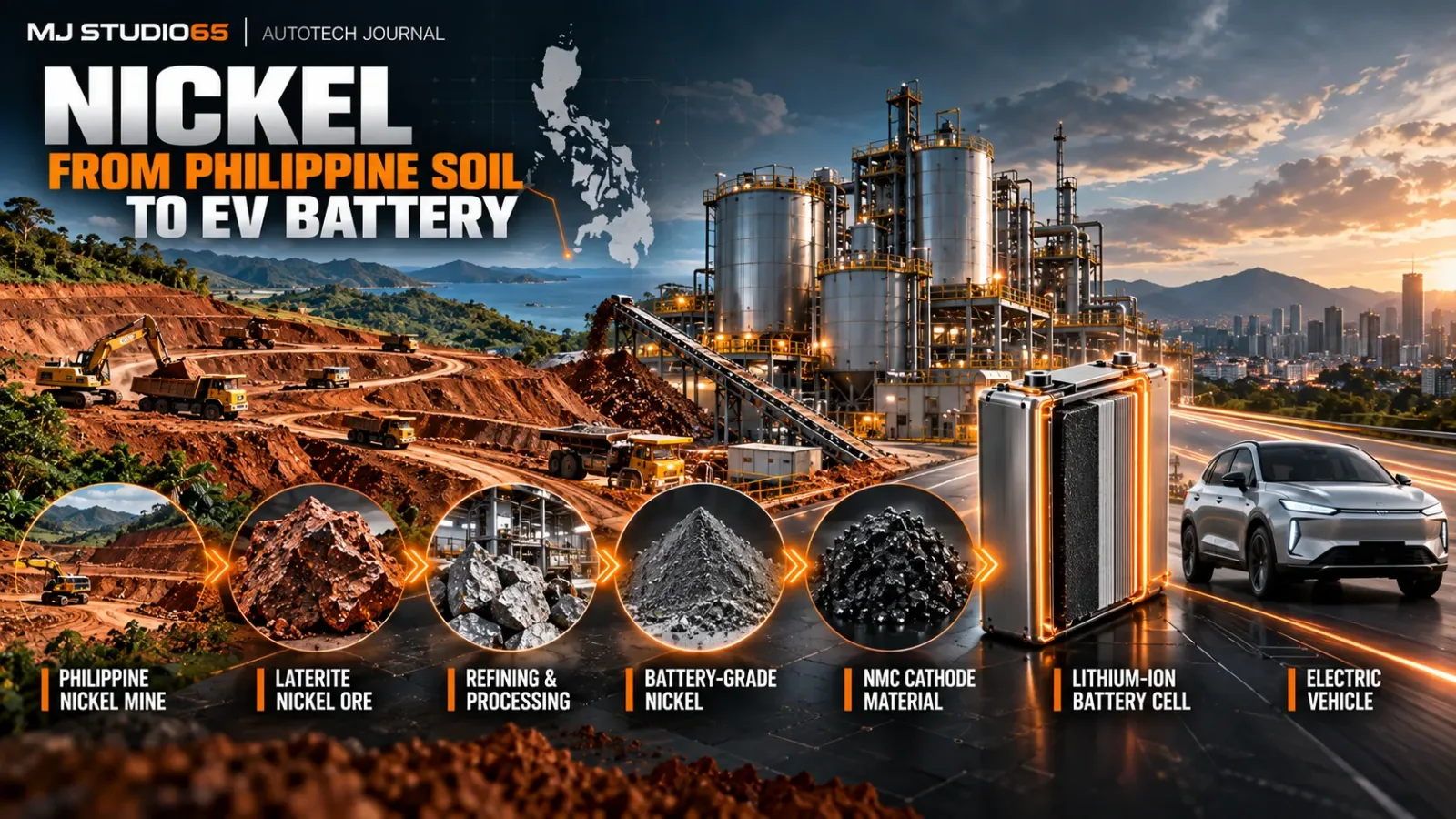
The Philippines Has a Major Role in the Nickel Behind EV Batteries
Electric vehicles are often discussed in terms of batteries, charging speed and driving range. But beneath those specifications is a global supply chain built around materials extracted from the earth. For many long-range electric vehicles, one of the most important of those materials is nickel. Nickel helps battery manufacturers produce lithium-ion cells capable of storing large amounts of energy without making the battery excessively heavy. That makes it particularly valuable for electric vehicles where range and performance are priorities. But the nickel inside a battery does not begin as a clean powder inside a factory. Its journey starts underground or within mineral-rich layers of soil, passes through mining and intensive processing, and can travel thousands of kilometers before becoming part of an EV. For the Philippines, this story is especially relevant. The country was the world's second-largest nickel producer in 2024, accounting for about 9.5 percent of global mine production. Philippine nickel therefore connects something happening on our own islands with one of the largest technological transitions taking place in the global automotive industry. Understanding nickel means looking at both sides of that story: what makes the material useful for EV batteries, and what extracting and processing it can mean for the environment and the people living and working around the industry.
Why Nickel Matters to an EV Battery
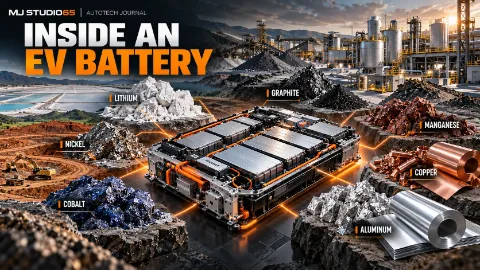
Nickel does not generate electricity by itself, nor is it present in every electric-vehicle battery. Its importance comes primarily from its role in the cathode of certain lithium-ion battery chemistries. One of the most familiar is NMC, or lithium nickel manganese cobalt oxide. Variations of NMC use different proportions of those metals, and manufacturers have increasingly developed nickel-rich versions to increase energy density while reducing reliance on cobalt. Another nickel-containing chemistry is NCA, or lithium nickel cobalt aluminum oxide. The attraction of nickel is largely energy density. In simplified terms, increasing the nickel content of certain cathodes can allow a battery to store more energy for a given mass. That can help engineers build an EV with longer range without simply making its battery pack much larger and heavier. The latest International Energy Agency comparison shows why this remains attractive. Leading NMC cells can reach around 265 Wh/kg, compared with roughly 205 Wh/kg for the latest LFP cells. But there is an important distinction. Not every electric vehicle needs nickel. Lithium iron phosphate, or LFP, batteries use iron and phosphate instead of nickel and cobalt in their cathodes. LFP has grown dramatically and accounted for more than half of global EV battery deployment in 2025. So when we say nickel is important to electric vehicles, we should really say it is important to many high-energy-density EV batteries, rather than all EV batteries. That distinction will become increasingly important as battery chemistry continues to evolve.
Where Does Nickel Come From?
Before nickel becomes part of a sophisticated battery cell, it begins as a naturally occurring element contained within ore. Most known terrestrial nickel resources fall into two broad geological categories: laterite deposits and magmatic sulfide deposits. According to the U.S. Geological Survey, roughly 54 percent of identified global nickel resources occur in laterites, while around 35 percent occur in magmatic sulfide deposits. Sulfide deposits generally occur underground and historically supplied much of the world's high-grade nickel. They can contain minerals from which nickel can be concentrated before further processing. Laterite deposits are very different. They develop over extremely long periods as tropical and subtropical weathering breaks down nickel-bearing rock. Rainwater and chemical weathering gradually redistribute minerals through layers of soil and rock, eventually creating zones enriched with nickel. This geology helps explain why Southeast Asia has become so important to the modern nickel industry. Indonesia is now by far the world's largest nickel producer, while the Philippines remains another major source. And unlike the metallic nickel we see in finished industrial products, Philippine nickel ore can look surprisingly ordinary often appearing as reddish or brown earth and rock. Inside that material, however, is a metal increasingly connected to the global battery industry.
The Philippine Connection
The Philippines occupies an important position in the global nickel supply chain. According to the U.S. Geological Survey, the country was the world's second-largest nickel producer in 2024, accounting for approximately 9.5 percent of global production. Philippine mines produced about 33.4 million metric tons of laterite nickel ore during the year, containing an estimated 354,000 metric tons of nickel. Much of the country's nickel industry is concentrated in mineral-rich areas such as Caraga. During the first half of 2025, the Philippine Mines and Geosciences Bureau reported 12.12 million dry metric tons of nickel direct-shipping ore production nationwide. Caraga alone contributed about 4.43 million dry metric tons, representing 36.6 percent of the total. This is where the global EV story suddenly becomes local. A modern electric vehicle may be assembled in China, Korea, Europe or elsewhere. Its battery cells may come from another country entirely. Yet part of the mineral supply chain feeding nickel industries can begin in places such as Surigao, Palawan or other Philippine mining regions. But there is another important distinction.
Not every tonne of Philippine nickel ore eventually becomes an EV battery. Nickel has many industrial applications, and stainless steel remains a major use. In 2024, USGS reported that Philippine exports of nickel ore and concentrates went primarily to China and Indonesia. What happens after export depends on the ore grade, processing route, buyer and eventual industrial application. The path from a Philippine nickel mine to an electric-car battery is therefore possible and increasingly relevant, but it is not a simple one-to-one relationship.
What Does a Nickel Mine Actually Look Like?
Laterite nickel mining can look dramatically different from underground mining. Because laterite deposits occur relatively close to the surface, they are commonly extracted using open-pit methods. Before ore can be removed, vegetation and topsoil may need to be cleared or relocated. Excavators then expose and remove different layers of material. The reddish soil visible at many tropical nickel operations is part of this weathered geological profile. Different layers can contain different concentrations and mineral compositions. Limonitic material closer to the surface tends to contain more iron, while deeper saprolitic material can contain higher nickel concentrations and more magnesium and silicate minerals. Mining companies therefore do not simply excavate everything and place it into one pile. Ore characterization and grade control determine where material goes and how it may eventually be processed. Heavy equipment moves the ore from mining areas to stockpiles, processing areas or ports. In direct-shipping operations, ore may undergo relatively limited processing at the mine before being transported by sea to another country for further treatment. That means a seemingly simple step digging nickel-bearing earth from the ground is actually the beginning of a much longer industrial chain.
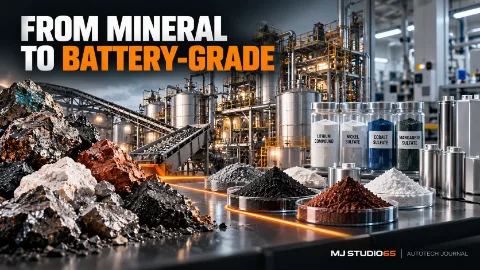
From Red Earth to Battery-Grade Nickel
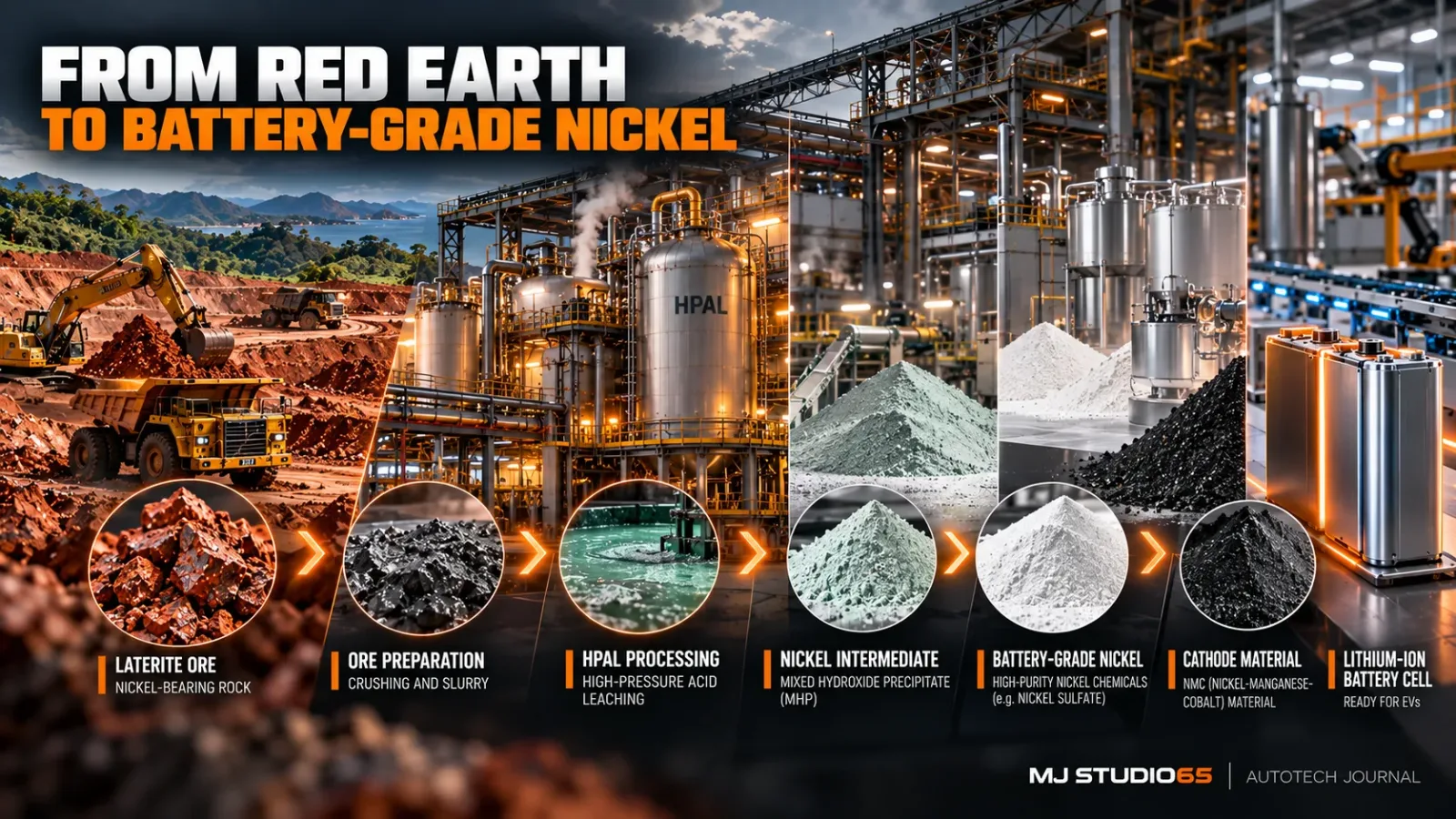 The material leaving a nickel mine cannot simply be placed inside a battery. Battery manufacturers require highly controlled chemical materials with extremely low levels of unwanted impurities. Transforming nickel-bearing laterite into something suitable for battery production therefore requires several processing stages. The exact route depends heavily on the type of ore. One traditional route for higher-grade saprolite laterites uses high-temperature processing to produce ferronickel or nickel pig iron, materials closely associated with stainless-steel production. Other processing routes can convert nickel into intermediate products that can eventually enter battery-material supply chains. One of the most important technologies for battery-oriented laterites is high-pressure acid leaching, better known as HPAL. In an HPAL plant, finely prepared laterite ore is mixed into a slurry and treated with sulfuric acid at elevated temperatures and pressures. Nickel and cobalt are dissolved into solution, separated from much of the unwanted material and then recovered through subsequent chemical processing. The result may eventually be converted into products such as mixed hydroxide precipitate and, after further refining, high-purity nickel chemicals used in cathode-material production. This transformation is remarkable. At one end of the process is reddish tropical earth containing a relatively small percentage of nickel. At the other is precisely manufactured battery material destined for one of the most technologically advanced components in a modern vehicle. But every step between those two points requires infrastructure, chemicals, water, energy and waste management. And that is where the environmental story becomes more complicated.
What Happens to the Land?
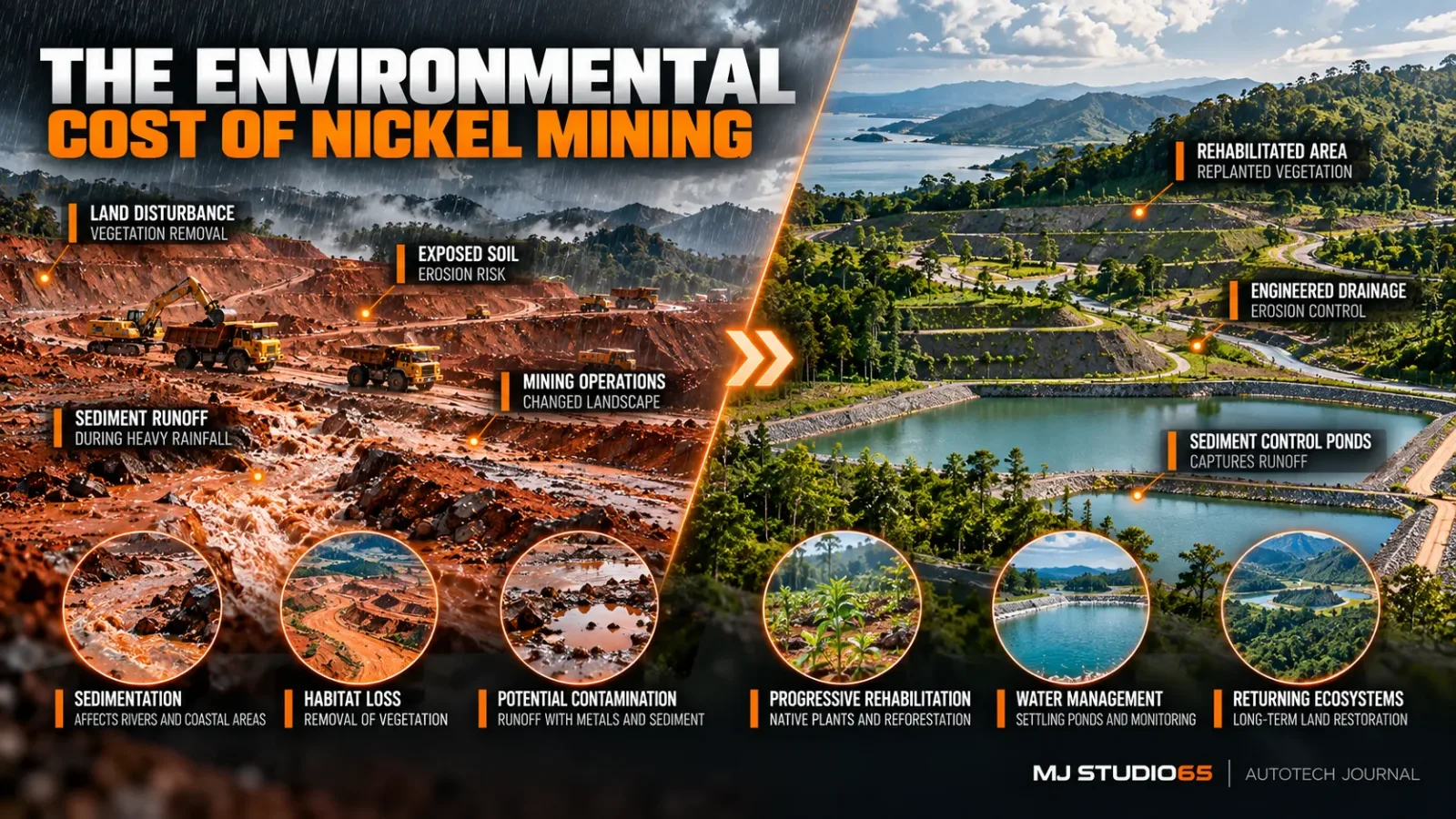
Open-pit mining physically changes the landscape. Vegetation may have to be removed, roads constructed, drainage systems installed and soil excavated to reach ore-bearing layers. The scale varies enormously between operations, but any large surface mine inevitably creates a visible footprint. In tropical environments, land disturbance creates an additional challenge: rainfall. Once vegetation and topsoil have been removed, exposed soil can become vulnerable to erosion. Intense rain can carry fine sediment downhill unless drainage systems, settling ponds and erosion controls prevent it from reaching rivers, streams and coastal environments. This matters particularly in countries such as the Philippines, where mining regions can experience intense seasonal rainfall and tropical storms. The environmental issue is therefore not simply that a hole is created in the ground. It is what happens to the entire surrounding system once soil, vegetation and natural drainage patterns are disturbed. Responsible mine management consequently involves much more than extracting ore. It includes erosion control, water management, progressive rehabilitation, monitoring and eventually restoring mined areas as operations move elsewhere. How effectively those measures are implemented can determine whether the environmental footprint remains controlled or spreads beyond the mine itself.
The Water Question
Water is one of the most sensitive issues surrounding mineral extraction. At a laterite mine, rainfall can flow across exposed surfaces and carry sediment. Mining operations therefore require drainage networks and sediment-control structures designed to capture runoff before water leaves the site. Processing introduces additional challenges. Hydrometallurgical facilities use water and chemical solutions to separate valuable metals from ore. Those systems generate process streams and residues that have to be contained and managed appropriately. The environmental risk is not simply the presence of nickel. Laterite ores and processing residues contain mixtures of different minerals and metals, and their behavior depends on their chemistry, concentration and surrounding environmental conditions. This is why containment systems, water treatment and long-term monitoring matter. A modern battery may appear exceptionally clean when installed underneath an EV, but producing the refined materials inside it can involve large industrial systems whose environmental performance depends heavily on how carefully water and waste are managed.
The Waste We Don't See Inside the Battery
One kilogram of refined nickel does not mean only one kilogram of material was moved. Nickel laterites can contain relatively low concentrations of nickel, meaning much larger quantities of earth and rock have to be handled to recover the desired metal. Mining generates overburden and lower-grade material. Processing generates additional residues after nickel and other valuable metals have been extracted. High-temperature processing can produce large quantities of slag. Hydrometallurgical routes such as HPAL generate leach residues that require storage and management. Recent technical reviews of laterite processing emphasize that these routes carry different environmental tradeoffs. Pyrometallurgical processes can be highly energy intensive, while hydrometallurgical processing introduces challenges associated with acids, process residues and impurity management. There is therefore no single environmental footprint for “nickel.” The ore body, energy source, processing technology, mine design, waste-management practices and environmental regulation can all substantially change the impact of producing the same metal.
What About the People?
 Mining is not only a geological and environmental issue. It is also a human one. For communities near mining areas, impacts can include changes in land use, road traffic, noise, dust, water conditions and access to areas previously used for farming, fishing or other activities. At the same time, mines can provide employment, local business opportunities, infrastructure and government revenues. Both realities can exist at the same time. That is why describing a mining community only as either a beneficiary or a victim oversimplifies the situation. The effects can vary between communities and even between households within the same area. Questions about consultation, land rights, compensation, environmental monitoring and how mining revenues are distributed can become just as important as the geology underneath the mine. For the Philippines, these issues deserve particular attention because mineral deposits can occur near rural communities and environmentally sensitive landscapes. The transition to cleaner transportation does not remove those questions. In some cases, it moves them upstream—from the city where an electric vehicle operates to the community where its materials originate.
The People Working With Nickel
Workers face another category of risk. Mining involves heavy machinery, moving vehicles, unstable terrain, dust, noise and other occupational hazards familiar across the mining industry. Processing and refining introduce additional chemical and industrial exposures. Nickel exposure itself also requires context. The International Agency for Research on Cancer has classified nickel compounds as carcinogenic to humans, with occupational exposure historically associated particularly with certain refining and industrial environments. Metallic nickel has been classified separately as possibly carcinogenic to humans. But that statement needs to be interpreted correctly. It does not mean that driving an EV containing nickel presents the same exposure risk as working in a nickel-processing environment. The chemical form of nickel, concentration, method of exposure and duration all matter. Occupational concern is particularly relevant where workers can inhale nickel-containing dusts, fumes or aerosols during mining, smelting, refining or metal processing. That is why ventilation, dust suppression, personal protective equipment, exposure monitoring and industrial hygiene standards are important parts of responsible nickel production. The finished battery pack underneath an EV is a very different exposure environment from the industrial processes used to manufacture its raw materials.
Nickel Mining Isn't Going Away Just Because LFP Is Growing
The battery industry itself is changing quickly. LFP batteries have expanded rapidly because they can offer lower cost, long cycle life and good thermal stability while eliminating nickel and cobalt from the cathode. According to the IEA, LFP represented more than 55 percent of EV batteries deployed globally in 2025. That sounds like bad news for battery nickel. But the picture is more complicated. Nickel-rich chemistries still offer an energy-density advantage, making them attractive for vehicles where weight, packaging and long driving range are priorities. Outside China, the IEA reports that almost 80 percent of EV battery deployment in 2025 still used nickel-containing chemistries such as NMC and NCA. And batteries are only one source of nickel demand. Nickel remains important for stainless steel, specialty alloys and other industrial applications. The IEA's 2026 critical-minerals outlook still projects strong growth in nickel demand through 2040 as clean-energy technologies expand alongside traditional industrial uses. So LFP may reduce how much nickel the EV industry would otherwise require, but it does not make nickel irrelevant. Instead, we may be moving toward a more diversified battery market. Some vehicles will prioritize inexpensive and durable LFP batteries. Others will continue using nickel-rich chemistries where energy density is particularly valuable. Sodium-ion batteries may eventually occupy another part of the market. There may not be one battery chemistry that wins everywhere.
Can Nickel Be Recycled?
There is one major difference between nickel inside a battery and fuel inside a combustion-engine vehicle. Fuel is consumed. Nickel is not. After an EV battery reaches the end of its useful automotive life, much of the material inside it still physically exists. That creates an opportunity to recover nickel, cobalt, lithium, copper and other valuable materials and return them to the industrial supply chain. Battery recycling can use combinations of mechanical, thermal and hydrometallurgical processes. Packs are discharged and dismantled or processed, cells are broken down, and valuable battery materials can be concentrated into what is often called black mass. That material can then undergo further processing to recover individual metals. Nickel-rich batteries are particularly interesting to recyclers because nickel and cobalt have significant economic value. But recycling cannot eliminate new mining immediately. The global EV fleet is still growing rapidly. Most batteries being installed in new vehicles today will remain in service for years, which means there are not yet enough end-of-life EV batteries available to supply all the material required for new battery production. The IEA expects production scrap to remain an important recycling feedstock until end-of-life EV batteries become the dominant source around the mid-2030s. Over time, however, recycling could fundamentally change the nickel supply chain.
Instead of nickel following a one-way path:
MINE → REFINERY → BATTERY → VEHICLE → WASTE
the objective becomes increasingly circular:
MINE → REFINERY → BATTERY → VEHICLE → RECYCLING → NEW BATTERY
A tonne of nickel recovered and reused is material that potentially does not have to be extracted again.
The Real Cost of More Range
Nickel illustrates one of the most important realities behind electric vehicles. Electrification does not eliminate environmental impact. It changes where some of that impact occurs. An EV can drive through Manila without producing exhaust from a tailpipe, but the materials that make that possible may have begun their journey thousands of kilometers away or perhaps within the Philippines itself. For nickel-containing batteries, part of that journey can begin in tropical laterite deposits, where vegetation, soil and rock must be managed before nickel can be extracted. The material may then cross oceans, enter energy- and chemical-intensive refining processes, become battery-grade material, enter a cathode factory, become a battery cell and finally be installed underneath an electric vehicle. That does not automatically make the technology environmentally unsound. Neither does the role of nickel in electrification automatically make mining environmentally beneficial.
The important questions come earlier in the supply chain.
- Where did the nickel come from?
- How was the land managed?
- Were waterways protected?
- How were processing residues handled?
- Were workers adequately protected?
- Did surrounding communities participate meaningfully in decisions affecting them?
- How much energy was required to refine the material, and where did that energy come from?
And eventually:
- Can that nickel be recovered and used again?
These questions matter because the transition from combustion engines to electric vehicles is not simply a transition from gasoline to electricity. It is also a transition toward a transportation system increasingly dependent on minerals and the industrial supply chains that transform them. For the Philippines, nickel puts us directly inside that story. The red laterite soil excavated from a Philippine mining region may look far removed from the sophisticated battery pack underneath a modern electric vehicle. Yet the two can belong to the same global material chain. The range displayed on an EV dashboard therefore begins long before electricity enters the battery. For some electric vehicles, part of that journey begins with nickel being taken out of the ground.
Comments
No comments yet. Be the first to join the discussion.