Europe’s EV Market Is Accelerating Can Its Automakers Keep Up?
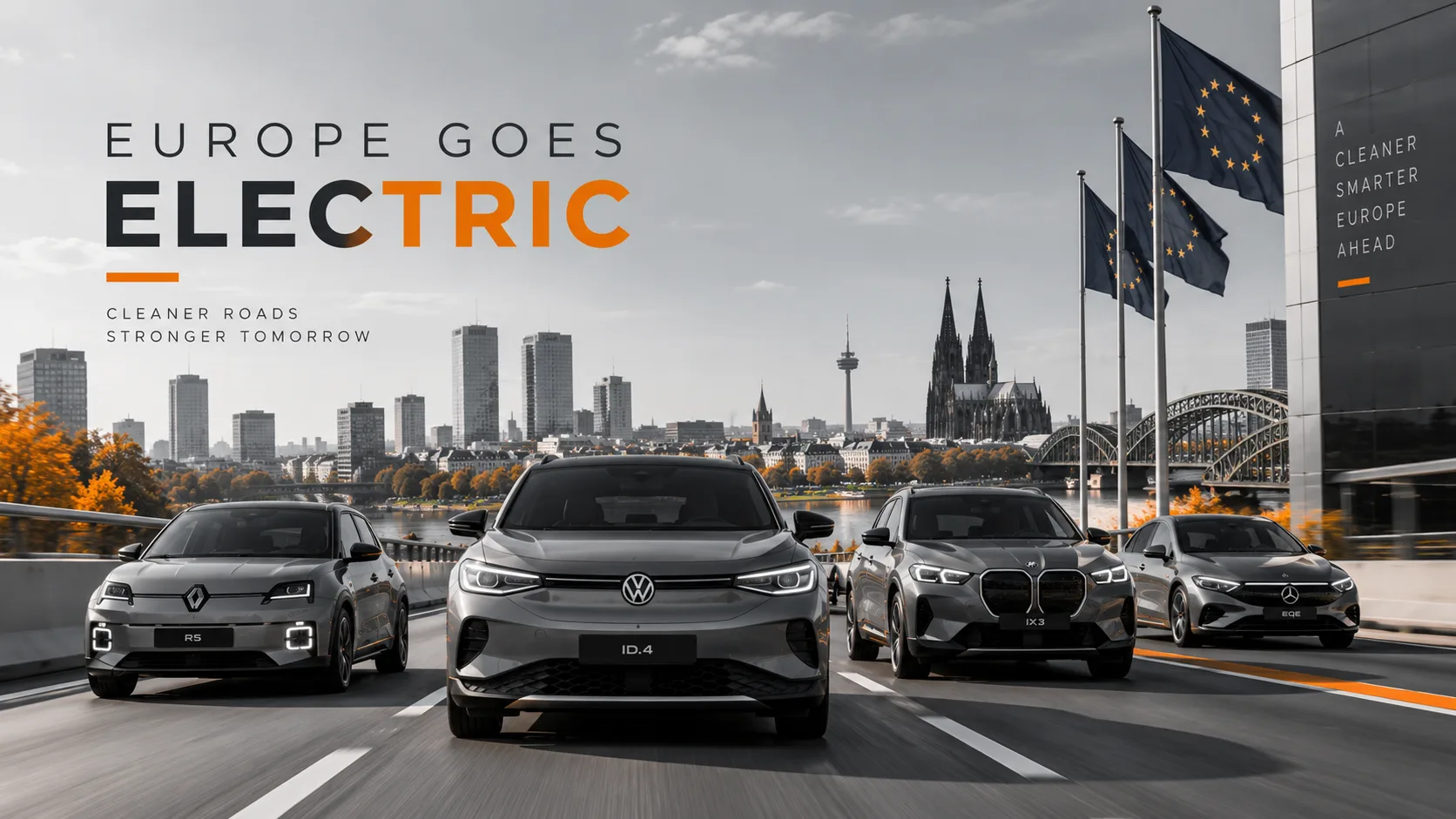
For years, Europe's transition to electric vehicles appeared to be moving forward in fits and starts. EV sales grew rapidly, slowed in some markets, recovered in others, and remained heavily influenced by government incentives, charging infrastructure and the availability of affordable models. But in 2026, something appears to be changing. Battery-electric vehicle registrations across 16 major European markets reached 202,833 vehicles in August, an increase of 54.2% compared with the same month last year. More importantly, fully electric vehicles accounted for 30.5% of new-car registrations across those markets. Nearly one out of every three new cars registered was fully electric. More than 1.67 million BEVs had already been registered across those markets during the year, 33.1% more than during the same period in 2025. Europe's electric transition isn't simply continuing. It is beginning to accelerate. And that creates another question: Can Europe's own automotive industry keep up with the market it helped create?
Europe's EV Transition Suddenly Accelerates
The August numbers didn't appear out of nowhere. During the first half of 2026, 1,220,890 battery-electric cars were registered across the European Union. BEVs represented 20.7% of EU new-car registrations, compared with 15.6% during the same period of 2025. Meanwhile, traditional combustion vehicles continued losing ground. Petrol's share fell to 22.2%, while diesel accounted for only 7.5%. Hybrids remained Europe's most popular powertrain category at 37.3%, showing that the transition isn't happening through battery-electric vehicles alone. But the direction of the market is becoming increasingly difficult to ignore. By July, BEVs represented around a quarter of registrations across a group of major European markets. Then August pushed the figure above 30%. The speed of that change has moved ahead of several forecasts made earlier in the year. Europe may be reaching the point where electric vehicles are no longer simply an alternative part of the new-car market. In some countries, they are becoming the mainstream.
But There Is No Single European EV Market
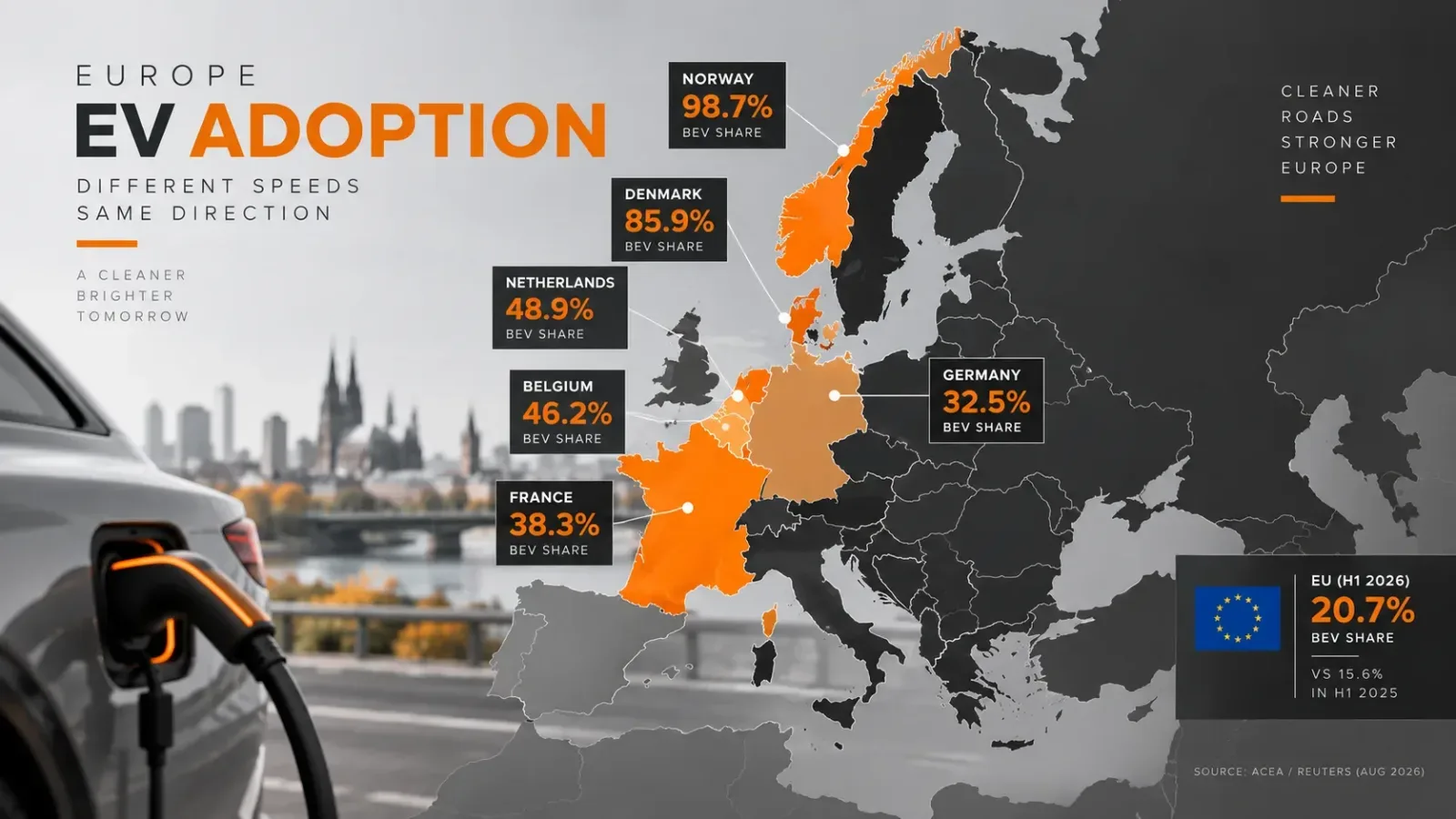 Looking at Europe as one market can be misleading. The differences between countries remain enormous. Norway is effectively approaching a fully electric new-car market, with BEVs accounting for 98.7% of registrations in August. Denmark reached 85.9%. Finland stood at 52.3%, the Netherlands at 48.9% and Belgium at 46.2%. Even Europe's largest automotive markets are moving rapidly. France reached a 38.3% BEV share in August, while Germany reached 32.5%. But other parts of Europe remain considerably further behind. Charging availability, income levels, taxation, purchase incentives, electricity prices, housing patterns and consumer preferences differ dramatically from one country to another. Someone living in a house with a private driveway and inexpensive overnight electricity faces a very different EV ownership experience from someone living in an apartment without dedicated parking. That means Europe's EV transition will not happen at the same speed everywhere. But the countries at the front of the transition may offer a preview of where the rest of the market could eventually be heading.
Why Are More Europeans Buying EVs?
There isn't one explanation. Several developments are happening simultaneously. The European EV market was once dominated by relatively expensive vehicles. That is gradually changing. An increasing number of electric models are becoming available below €30,000, opening the market to buyers who previously could not justify the price difference between an EV and a comparable combustion vehicle. Cars such as the Renault 5 demonstrate how manufacturers are beginning to rethink the affordable electric car. Instead of simply building expensive technology showcases, automakers increasingly need EVs that ordinary buyers actually want and can afford. Renault is also moving further down market with the electric Twingo, targeting a price below £20,000 in the UK. That competition at the lower end of the market could become one of the most important developments in Europe's EV transition. Purchase incentives, tax policies and programs such as France's social-leasing scheme continue to influence demand. That also means EV growth remains sensitive to policy changes. Remove an incentive and sales can slow. Introduce a strong incentive and demand can accelerate rapidly. The European EV market therefore remains partly a product of both technology and public policy. High and volatile oil prices during 2026 have also strengthened the economic argument for electric vehicles for some consumers. When fuel becomes more expensive, the lower energy cost of driving an EV becomes more visible. But fuel prices can change. The longer-term test will be whether buyers continue choosing EVs when the immediate pressure from petrol and diesel prices becomes less severe.
European Carmakers Are Fighting Back
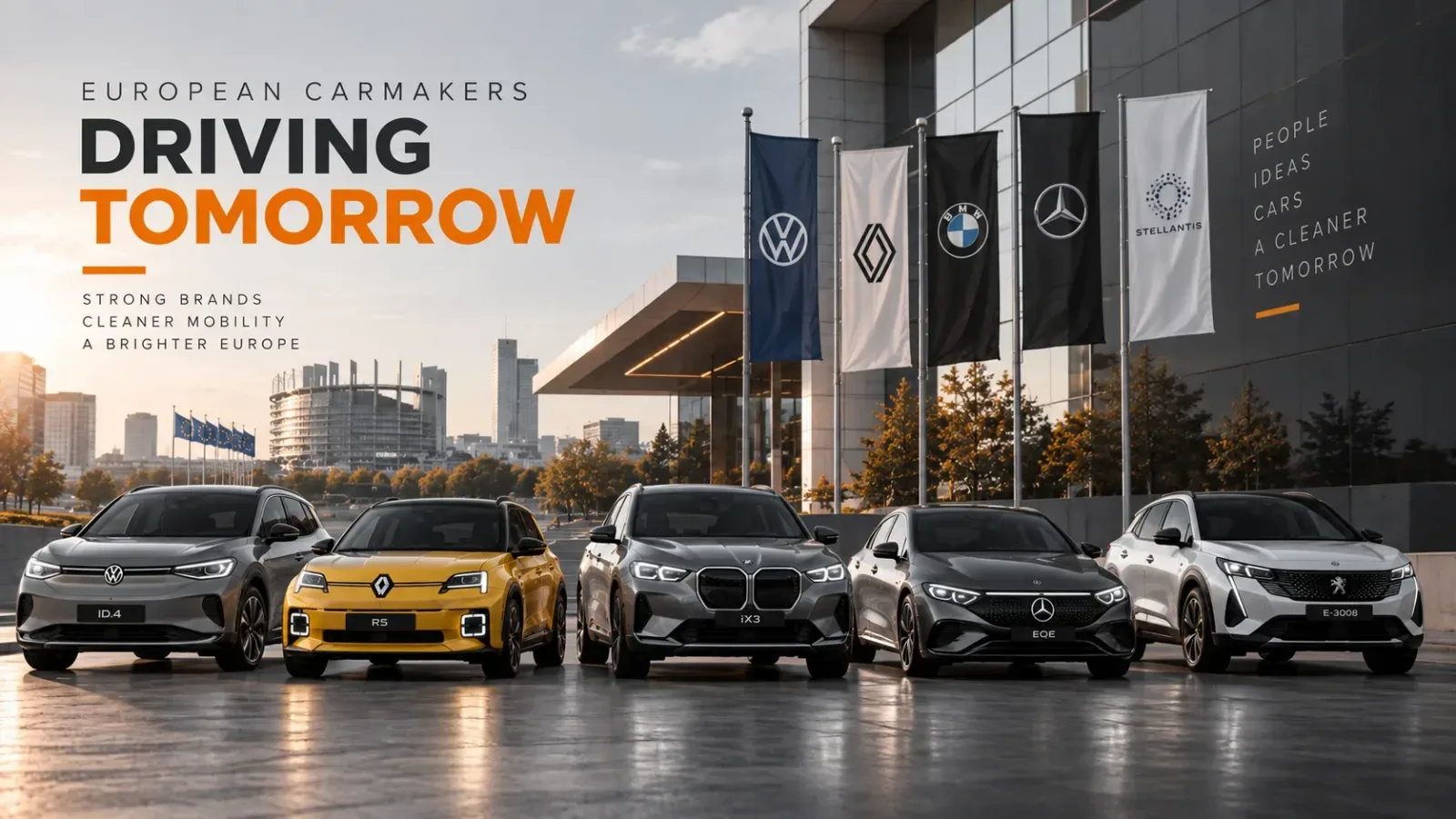
European manufacturers aren't standing still. Volkswagen Group, Renault, BMW, Mercedes-Benz and Stellantis are all investing heavily in electrification. And the products are becoming increasingly competitive. The first generation of European EVs often competed primarily on technology and environmental credentials. The next generation needs to compete on something much harder: European manufacturers need electric cars with attractive designs, useful real-world range, efficient drivetrains, competitive charging speeds and good software while simultaneously bringing prices closer to combustion vehicles. Renault's revival of the Renault 5 illustrates one approach. Rather than making the car look like an anonymous technology product, Renault took one of its recognizable historic designs and reimagined it for the electric era. Volkswagen is similarly working to expand its electric lineup beyond its early ID models and toward more accessible vehicles. BMW and Mercedes-Benz are attacking the transition from another direction, using next-generation EV platforms and electrical architectures to improve efficiency, range, charging performance and software. The technology is improving. But technological capability isn't Europe's only challenge.
China Has Arrived in Europe
The competitive environment surrounding European automakers has changed dramatically. BYD, MG and other Chinese brands are no longer distant competitors operating primarily inside China. They are selling cars in Europe. Chinese-branded vehicles accounted for around 9% of EU car sales during the first half of 2026. That number includes more than just battery-electric vehicles, but it demonstrates how quickly the competitive landscape is changing. Companies such as BYD entered the market with one major structural advantage: They developed inside the world's largest EV market. That gave Chinese manufacturers enormous domestic production volumes, rapidly developing battery supply chains and intense competition between dozens of brands. BYD goes even further because it manufactures many of its own batteries and major vehicle components. MG, owned by SAIC Motor, has also used competitive pricing to establish itself across European markets. Other Chinese manufacturers are following. And import tariffs may not completely stop that expansion. Some Chinese manufacturers are establishing or planning manufacturing operations inside Europe itself. Once that happens, the distinction between a “European-built” and “Chinese” vehicle becomes increasingly complicated. The competition is no longer simply Europe versus China. It is becoming a competition between different manufacturing systems, supply chains, technologies and business models.
The Battle Is Moving Beyond Driving Range
A few years ago, EV conversations frequently centered on one number:
Range still matters. But once many EVs can comfortably handle normal daily driving, other factors become increasingly important.
- How quickly does the car charge?
- How efficient is it?
- How much does it cost?
- How reliable is the software?
- How good is the navigation and charging integration?
- How much battery does the manufacturer need to achieve a given range?
And perhaps most importantly:
- How cheaply can the vehicle be manufactured?
A company that requires a 90-kWh battery to achieve the same useful range that another manufacturer delivers with 70 kWh has more than an efficiency problem. It potentially has a cost problem. Battery efficiency affects vehicle weight, material requirements, charging time and manufacturing cost. Software is becoming equally important. Modern EVs increasingly rely on software for battery management, route planning, charging, energy optimization, driver assistance and vehicle functions. Building an excellent electric car therefore requires much more than replacing an engine with a battery and electric motor.
Europe's Difficult Question: Can It Build EVs Cheaply Enough?
 This may ultimately be the central issue facing European manufacturers. Europe knows how to build excellent cars. Its automotive industry has spent more than a century developing manufacturing expertise, engineering talent, suppliers and some of the world's strongest automotive brands. But EV competition introduces a different economic equation. Battery cells represent a major portion of an electric vehicle's cost. Software requires enormous investment. Factories designed around combustion engines must be converted or replaced. At the same time, manufacturers must continue supporting millions of existing combustion vehicles while investing billions in the technology intended to replace them. European manufacturers also face relatively high labor, energy and manufacturing costs. That creates enormous pressure. Volkswagen, Stellantis and Renault aren't simply competing to build better EVs. They are competing to manufacture them profitably at prices consumers will accept. And that is much harder. A technologically impressive €50,000 EV doesn't solve the industry's biggest problem if mass-market buyers are looking for something closer to €25,000. The real battleground may therefore be the affordable electric car.
Charging Infrastructure Is Growing But Not Fast Enough Everywhere
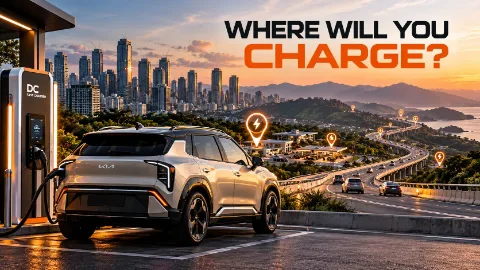
More EVs require more chargers. Europe is making progress. By mid-2026, public charging capacity across the EU had reached approximately 41.6 GW, around 29% higher than a year earlier. The EU had roughly 1.2 million public charging points. That sounds enormous. But the European Commission's target is around 3.5 million charging points by 2030. More importantly, those chargers aren't evenly distributed. Countries including Italy, Czechia, Poland, Spain, Greece and Bulgaria continue to show larger infrastructure gaps. This matters because home charging isn't available to everyone. Millions of Europeans live in apartments or dense urban environments where installing a private charger may be difficult or impossible. For those buyers, public charging isn't simply something used during a road trip. It may be their primary source of energy. EV adoption can therefore eventually run into an infrastructure ceiling if vehicle sales grow significantly faster than accessible charging.
The Next Battle Is the Affordable EV
The premium EV market helped establish electric vehicles. The mass market will determine how far they spread. Europe's next stage of electrification will increasingly depend on vehicles that don't require buyers to pay a large premium simply to choose electric. That changes the competitive landscape. Range alone won't win. Neither will acceleration. The successful mass-market EV needs enough range, sufficiently fast charging, reasonable insurance costs, useful interior space, reliable software and above all an attainable purchase price. European manufacturers understand this. So do Chinese manufacturers. And that is why the coming wave of smaller EVs could be more important to Europe's transition than another 600-horsepower electric SUV. The industry's next breakthrough may not be a vehicle capable of travelling 800 kilometers. It may be an EV that an average family can comfortably afford.
Europe Isn't Simply Switching Engines
The transformation underway in Europe is bigger than replacing petrol and diesel cars with battery-powered equivalents. The architecture of the automobile is changing. Battery manufacturing is becoming strategically important. Software is becoming a core part of vehicle development. Supply chains are being reorganized. New competitors are entering markets that European brands dominated for decades. And factories built around combustion engines are being asked to manufacture an entirely different type of vehicle. Europe's rapidly growing EV sales show that consumers are increasingly willing to make the transition. Now the pressure shifts toward the companies building the cars. Volkswagen, Renault, BMW, Mercedes-Benz, Stellantis and Europe's wider automotive supply chain have enormous engineering experience and established brands. BYD, MG and other Chinese manufacturers bring different strengths, particularly in batteries, vertically integrated production and experience competing in China's enormous EV market. Neither side's future success is guaranteed. What is becoming clearer is that Europe's EV transition has entered a new phase. The question is no longer simply whether Europeans will buy electric cars. Increasingly, they are. The bigger question is who will build the electric cars they choose to buy.
Comments
No comments yet. Be the first to join the discussion.