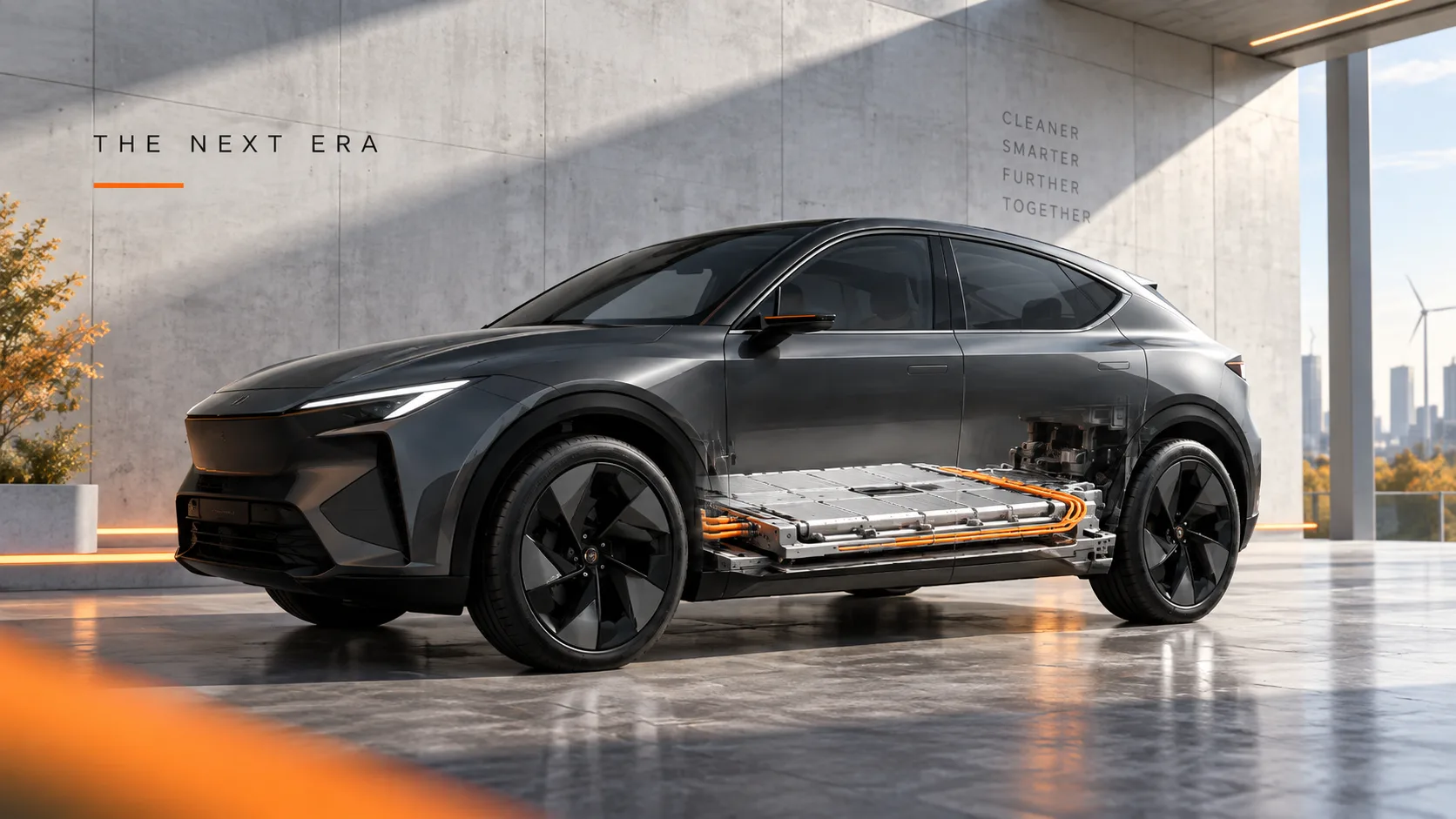
For years, solid-state batteries have been described as one of the technologies that could transform electric vehicles. The promise sounds almost too good: longer driving range, shorter charging times, smaller and lighter battery packs, higher power output, and potentially improved safety compared with today's conventional lithium-ion batteries. But solid-state batteries have also spent years seemingly just over the horizon. That may finally be starting to change. Toyota continues to target 2027–2028 for the commercialization of its all-solid-state battery technology, while Nissan is working toward an EV powered by its own all-solid-state battery in fiscal 2028. Meanwhile, reports from China indicate that battery giants CATL and BYD are preparing for small-scale or pilot production around 2027. The important question is therefore changing. It is no longer simply: Can solid-state batteries work? Increasingly, the question is: Can manufacturers build them reliably, affordably, and by the millions? A conventional lithium-ion battery uses a liquid electrolyte, while an all-solid-state battery replaces it with a solid electrolyte.
What Exactly Is a Solid-State Battery?
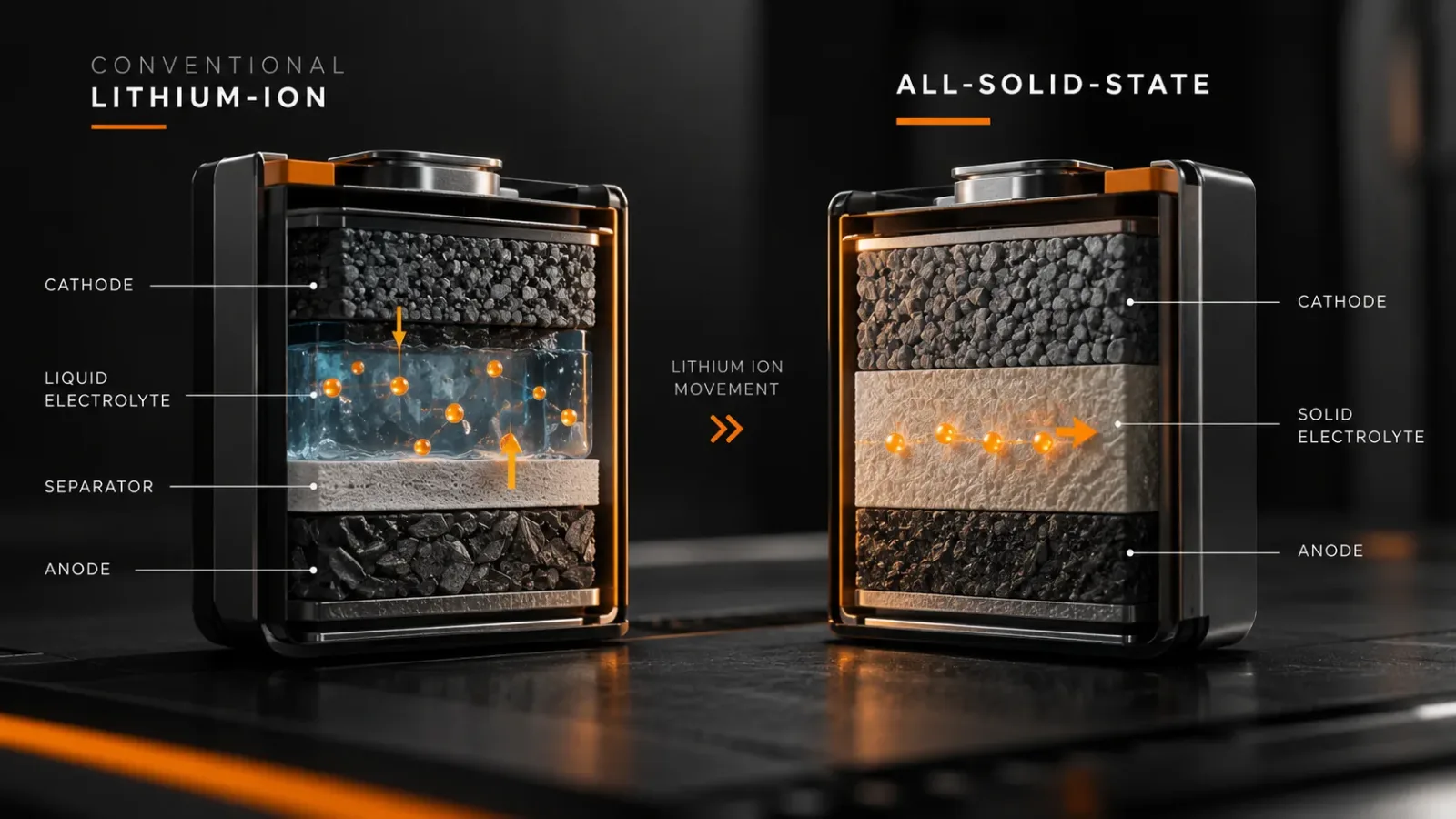 Despite the futuristic name, the basic idea is relatively straightforward. A battery needs a way for ions to travel between its positive and negative electrodes while charging and discharging. Most lithium-ion batteries used in today's electric vehicles accomplish this using a liquid electrolyte. A solid-state battery replaces that liquid electrolyte with a solid electrolyte. That seemingly simple change has major implications. Solid electrolytes can potentially allow battery designers to use different electrode materials and battery structures while supporting higher energy density and greater resistance to heat. However, replacing a liquid with a solid also creates an entirely new set of engineering problems. Liquids naturally fill tiny gaps and maintain contact with surrounding surfaces. Solids do not. Inside a battery that repeatedly charges, discharges, expands, contracts and experiences vibration, maintaining good contact between solid materials becomes much more difficult. That is one reason why turning promising laboratory cells into automotive batteries has taken so long.
Why Are Automakers So Interested?
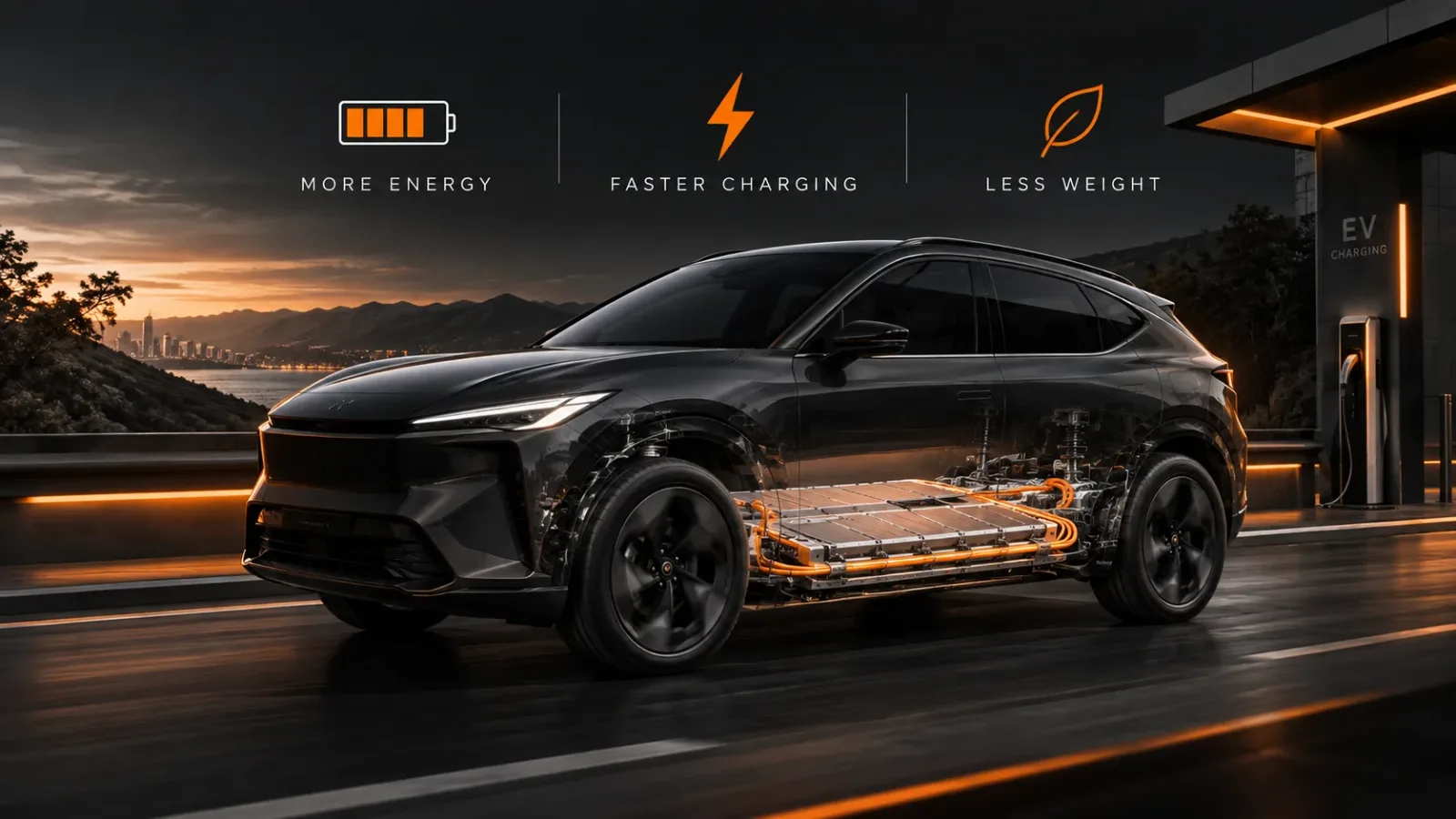
Electric vehicles have improved dramatically over the past decade, but several fundamental challenges remain. A larger battery can increase driving range, but it also increases weight and cost. Faster charging is possible, but excessive heat and battery degradation must be controlled. Reducing battery size saves weight, but usually means sacrificing range. Solid-state technology potentially changes some of these compromises.
Higher Energy Density
One of the biggest potential advantages is energy density essentially how much energy can be stored for a given amount of battery mass or volume. A battery capable of storing more energy without becoming physically larger could allow manufacturers to build EVs with greater driving range. But there is another possibility that may ultimately be even more important. Instead of building a 1,000-kilometer EV, manufacturers could use the technology to produce a vehicle with today's driving range using a smaller and lighter battery pack. Reducing battery size could improve efficiency, handling and packaging while potentially reducing the amount of battery material required per vehicle.
Faster Charging
Solid-state batteries also have the potential to support very high charging rates. Toyota, for example, has previously said its development target for an all-solid-state battery includes charging from approximately 10% to 80% in 10 minutes or less. That remains a development target rather than a specification for a production vehicle, but achieving anything close to it would significantly change long-distance EV travel. A charging stop could begin approaching the amount of time drivers normally spend taking a short break rather than requiring a lengthy stop.
Potential Safety Advantages
 Conventional lithium-ion batteries require sophisticated thermal management and protection systems. Replacing flammable liquid electrolytes with solid materials could potentially reduce some battery fire risks and improve resistance to high temperatures. However, describing solid-state batteries as simply “fireproof” would be misleading. An EV battery contains much more than its electrolyte, and factors such as electrode chemistry, cell design, manufacturing defects, mechanical damage and thermal management still matter. Solid-state technology could improve certain aspects of battery safety, but it does not eliminate the need for careful engineering.
If Solid-State Batteries Are So Good, Why Don't We Already Have Them?
This is where the story becomes more complicated. Building a successful laboratory battery cell and manufacturing hundreds of thousands eventually millions of automotive battery packs are completely different challenges. An automotive battery must survive years of charging cycles, temperature changes, vibration and occasional high-power operation while maintaining predictable performance. Solid-state batteries introduce difficult problems involving the interfaces where different solid materials meet. As the battery repeatedly charges and discharges, materials can expand and contract. Maintaining consistent physical contact between the electrolyte and electrodes becomes critical. Manufacturers must also develop production processes capable of producing these cells quickly and consistently with extremely low defect rates. Then comes cost. A battery technology may deliver extraordinary laboratory performance, but if producing it costs several times more than conventional lithium-ion cells, its usefulness in affordable mass-market EVs becomes limited. This is why manufacturing may ultimately be a bigger breakthrough than chemistry itself.
Toyota: Targeting 2027–2028
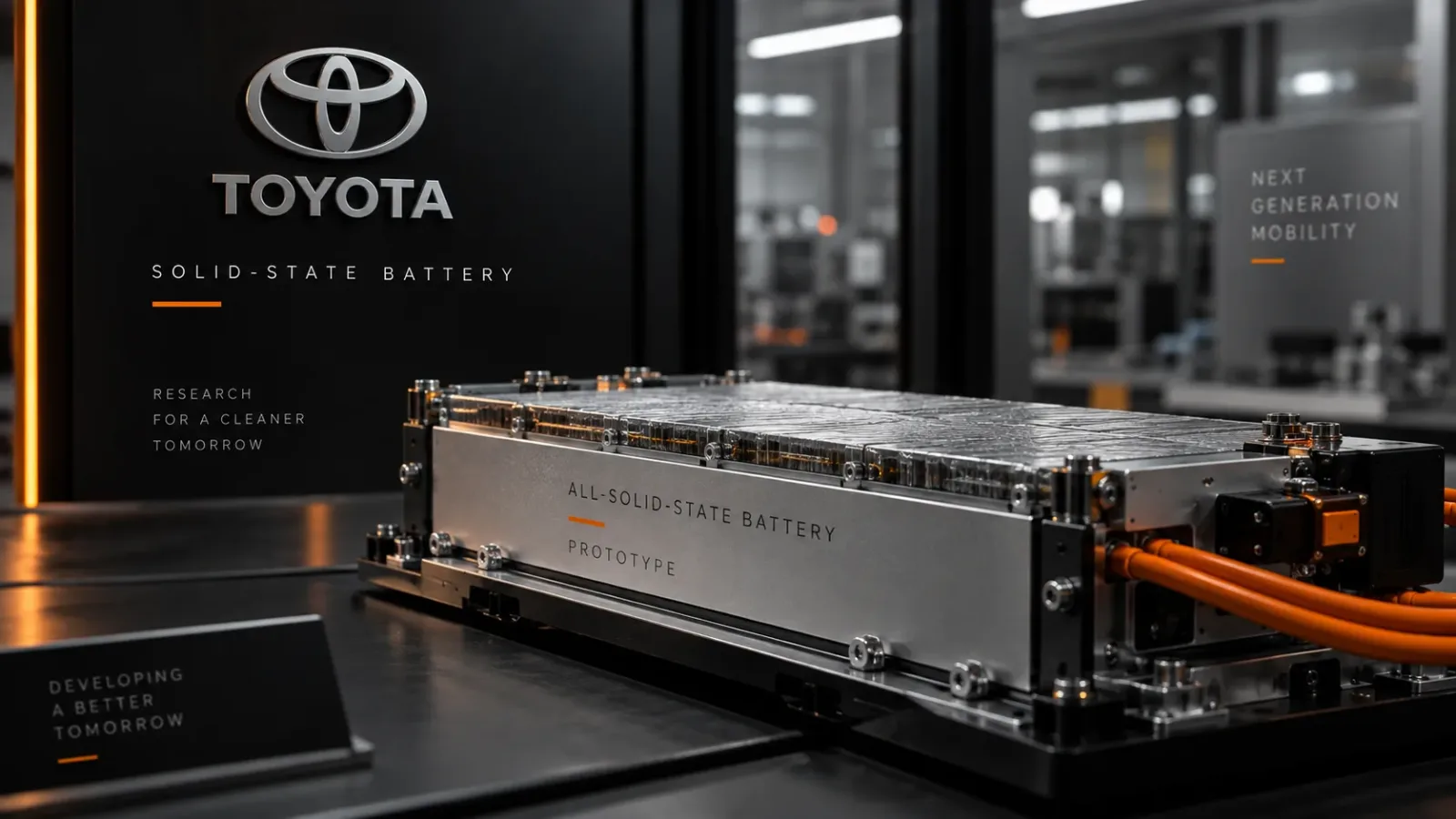 Toyota is among the automakers making one of the strongest public pushes toward all-solid-state batteries. The company is working with Idemitsu Kosan on sulfide solid electrolytes and the manufacturing technology required to produce them at scale. Toyota continues to target 2027–2028 for commercialization, followed by broader mass production. The company has previously outlined ambitious development goals, including a quick-charge time of 10 minutes or less from 10% to 80% state of charge and approximately 20% greater cruising range compared with the performance-version battery Toyota used as its development benchmark. Toyota has also been working with Sumitomo Metal Mining on durable cathode materials suitable for mass production. That detail is important. The challenge is no longer simply developing an experimental battery. Toyota and its partners are working on the materials, production methods and supply chain needed to manufacture it.
BYD: What Comes After the Blade Battery?
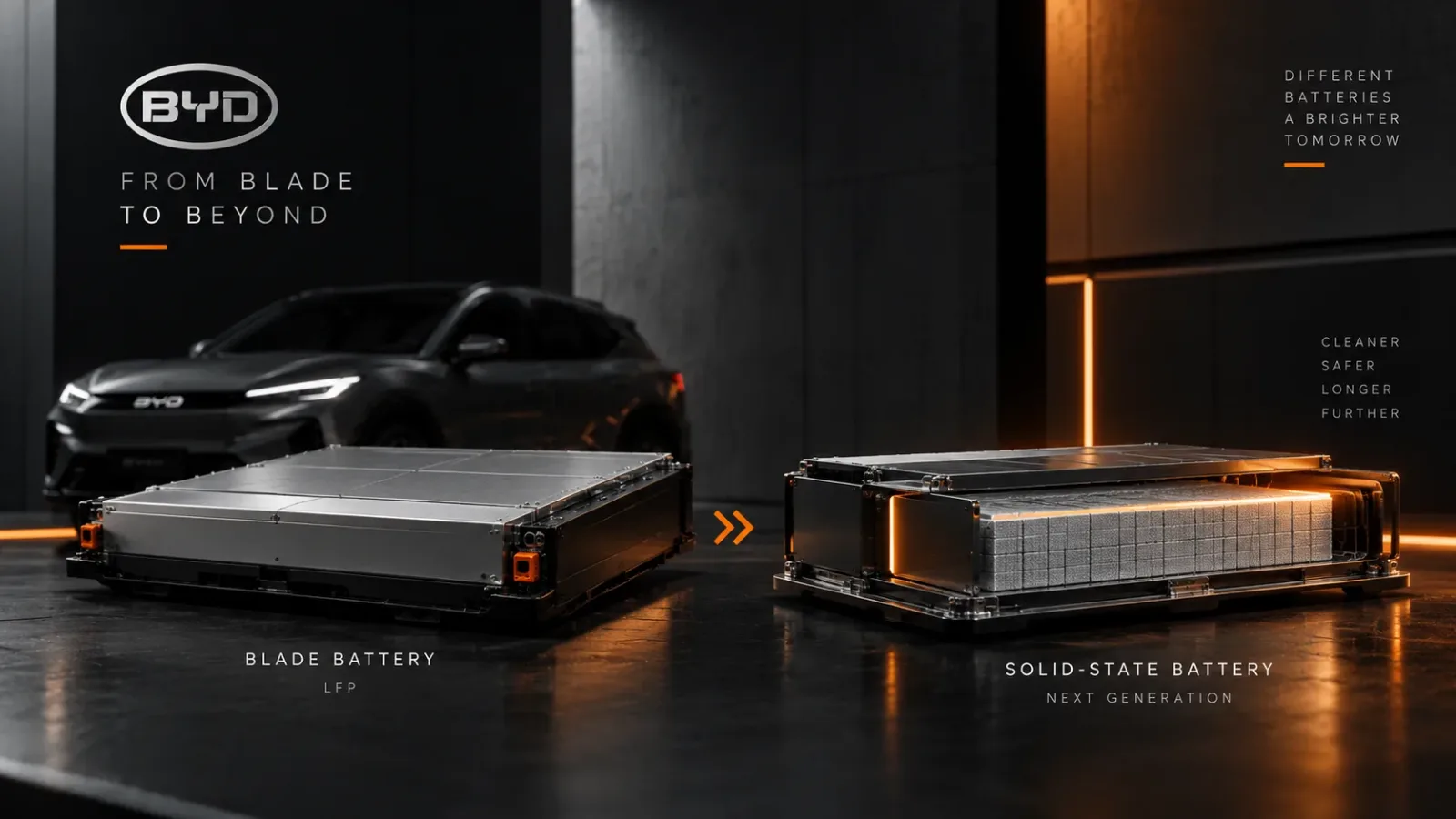 China is another major battlefield in the solid-state race. BYD is particularly interesting because the company already produces both electric vehicles and batteries at enormous scale. Its Blade Battery helped demonstrate how lithium iron phosphate, or LFP, chemistry could provide a compelling combination of safety, durability and relatively low cost. But even BYD is looking beyond today's battery technology. Recent reports indicate that BYD is targeting small-scale solid-state battery production around 2027. That doesn't mean the Blade Battery is suddenly obsolete. Quite the opposite. LFP batteries already benefit from established supply chains, mature production lines and years of real-world manufacturing experience. Solid-state batteries will have to compete not only with today's batteries but also with the improved lithium-ion batteries that manufacturers will be producing several years from now. That makes BYD's position particularly interesting. The company could continue improving low-cost LFP batteries while simultaneously developing solid-state technology for vehicles where higher energy density or performance justifies the additional cost.
CATL: The Battery Giant Enters the Race
CATL cannot be ignored in any discussion about the future of EV batteries. The Chinese battery manufacturer has become one of the most important companies in the global EV supply chain, supplying cells and battery technology to numerous automakers. Recent reports indicate CATL is targeting small-scale solid-state battery production in 2027. But CATL's strategy also illustrates an important point about the future battery market. There probably won't be one battery technology that replaces everything else. CATL continues developing conventional lithium-ion technology while also investing in alternative chemistries such as sodium-ion and next-generation solid-state batteries. Different batteries may ultimately serve different vehicles. Affordable city EVs might prioritize cost and durability. Performance vehicles could prioritize power density. Long-range premium vehicles might justify more expensive high-energy-density cells. Solid-state therefore may become another important branch of battery technology rather than the immediate replacement for every battery currently on the road.
Nissan: Building Toward 2028
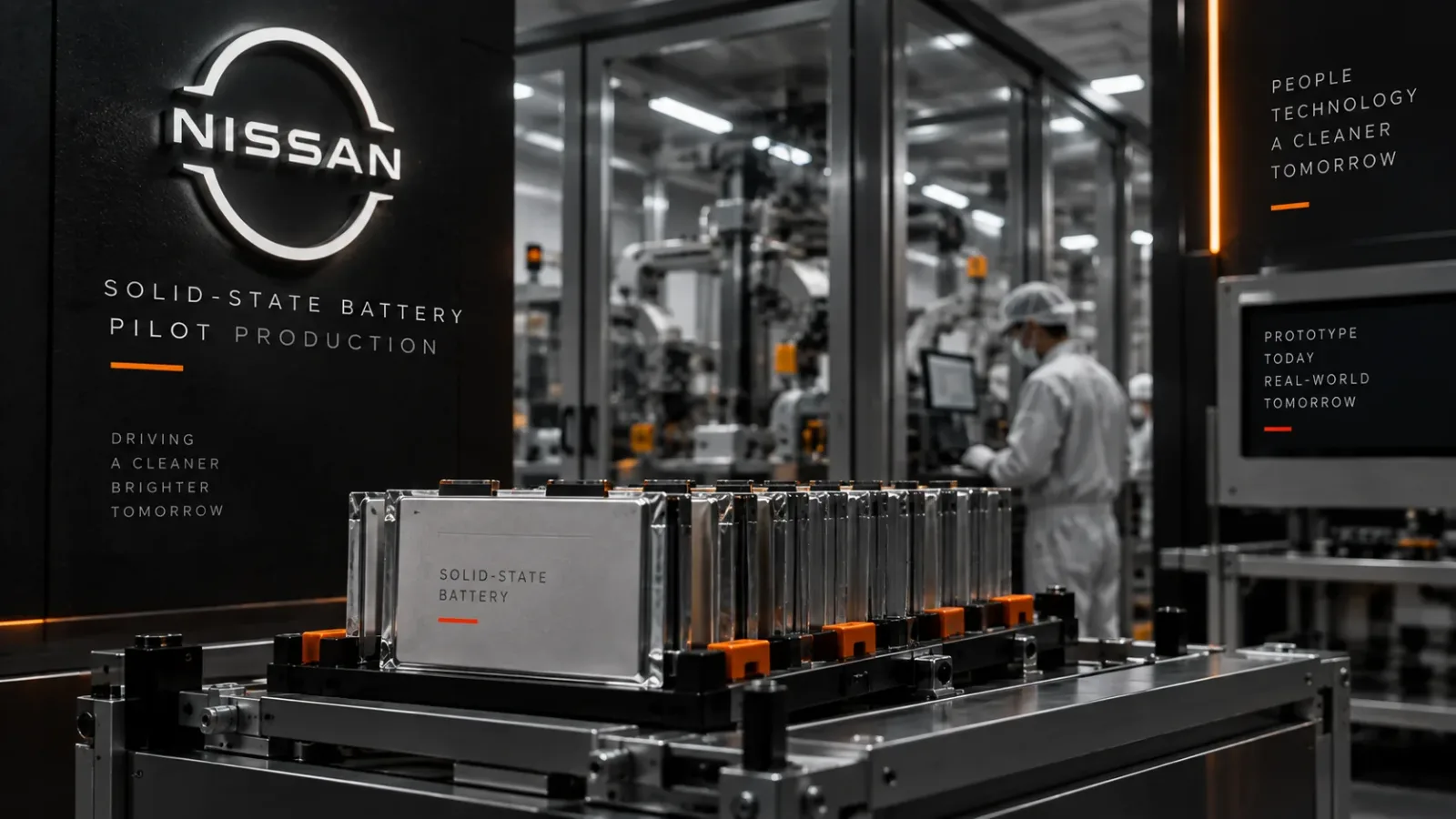 Nissan has also been working on all-solid-state batteries for years. The Japanese manufacturer previously established a prototype production facility and has been developing a pilot production line as it works toward introducing an EV using internally developed all-solid-state batteries in fiscal 2028. Nissan has said the technology could offer approximately twice the energy density of conventional batteries while significantly reducing charging times. More important than the headline numbers, however, is the existence of pilot manufacturing.
Pilot lines allow engineers to discover problems that aren't always obvious when producing individual laboratory cells.
- How quickly can the material be processed?
- How consistent are the cells?
- How many defective cells appear?
- Can manufacturing equipment operate continuously?
- And ultimately: How much does every usable kilowatt-hour cost?
These questions will determine whether solid-state batteries become a niche technology or something capable of transforming mass-market EVs.
What Could Solid-State Batteries Mean for Real EV Owners?
The easiest way to understand the potential of solid-state technology is to forget about battery chemistry for a moment. Imagine an electric crossover that currently uses a large battery pack to provide its desired driving range. A future solid-state version might take several different approaches. The manufacturer could keep approximately the same battery size and use the additional energy capacity to significantly increase range. Or it could maintain roughly the same driving range while installing a smaller battery. The second approach deserves more attention. A smaller battery means less mass. Less mass can reduce the energy required to move the vehicle. That can improve efficiency, braking, handling and potentially tire wear. It could also free up space inside the vehicle. Another manufacturer might choose a middle ground slightly smaller battery, somewhat longer range and dramatically faster charging. In other words, solid-state technology does not automatically mean every future EV will travel 1,000 kilometers. Manufacturers will decide how to use the additional capability.
Will Solid-State Batteries Replace LFP and Today's Lithium-Ion Batteries?
Probably not immediately. Today's batteries are moving targets. While engineers develop solid-state cells, conventional lithium-ion batteries continue getting better. LFP batteries have become particularly important because they avoid nickel and cobalt in the cathode and can provide excellent durability at relatively low cost. Other lithium-ion chemistries remain attractive when manufacturers need higher energy density. Sodium-ion technology is also emerging for applications where material availability, cost and temperature performance may be more important than maximum energy density. Solid-state batteries will therefore enter a market filled with highly developed competitors. Early solid-state applications may make the most sense in vehicles where manufacturers can justify higher battery costs potentially premium cars, high-performance vehicles or models where reducing battery weight is especially valuable. If production costs eventually fall, the technology could spread into mainstream vehicles. But that transition is likely to take years rather than happening overnight.
2027–2030 Could Be the Period That Decides Everything
Several important development programs are now converging around the second half of this decade.
- Toyota — 2027–2028
- BYD — Around 2027
- CATL — 2027
- Nissan — Fiscal 2028
These dates should not be interpreted as the moment conventional batteries disappear. Pilot production is very different from producing batteries for millions of vehicles every year. Instead, 2027–2030 could be the period when the automotive industry finally learns whether solid-state batteries can make the transition from impressive technology demonstrations to commercially viable automotive products.
Note: Timelines are manufacturer targets and may change as development progresses.
The Real Breakthrough Isn't Range It's Manufacturing
Solid-state batteries have already demonstrated enough potential to keep some of the world's largest automakers and battery manufacturers investing heavily in the technology. But impressive specifications alone won't transform the electric vehicle. The real breakthrough happens when a manufacturer can produce solid-state cells repeatedly, reliably and affordably not by the hundreds in a laboratory, but by the millions inside factories. Toyota, Nissan, BYD, CATL and other manufacturers are approaching that challenge from different directions. Some are developing new electrolytes. Others are building pilot production lines. Suppliers are developing cathodes and manufacturing processes capable of operating at industrial scale. And while all of this happens, conventional lithium-ion batteries continue improving. That competition may ultimately benefit EV buyers regardless of which technology wins the most market share. The next battery revolution may not arrive as one dramatic announcement. It may happen gradually one production line, one vehicle and one battery pack at a time. But if manufacturers can solve the enormous challenge of mass production, solid-state batteries could change more than how far an electric vehicle can travel. They could change how EVs are designed, how quickly they charge, how much battery they need and ultimately, what an electric vehicle can become.
Comments
No comments yet. Be the first to join the discussion.