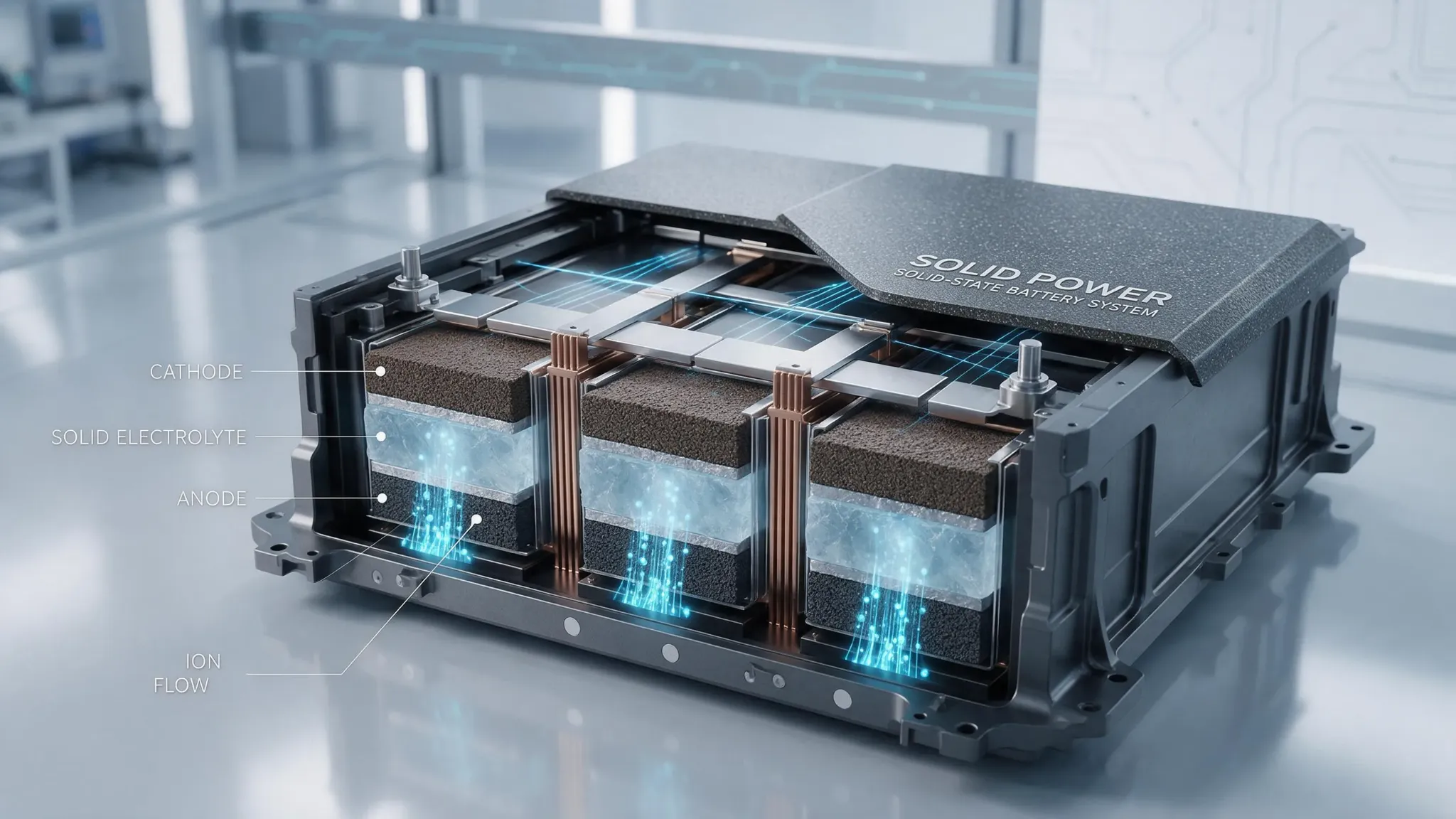
Few battery technologies have generated as much anticipation as the solid-state battery. For years, it has been described as the breakthrough that could give electric vehicles more range, shorter charging times and improved safety while reducing some of the compromises associated with today's lithium-ion batteries. The promise is attractive. Replace the conventional liquid electrolyte inside a lithium-ion cell with a solid material, potentially combine it with higher-energy electrodes such as lithium metal, and a battery could theoretically store more energy without simply becoming larger and heavier. But there is an important difference between proving that a battery chemistry works in a laboratory and manufacturing millions of automotive cells reliably. That is where the solid-state battery story stands in 2026. The science is real. Working cells are real. Pilot production lines are real. Major automotive and battery companies are spending heavily to commercialize the technology. What does not yet exist is widespread mass production of all-solid-state batteries for mainstream electric vehicles. And that distinction matters.
Solid-State Battery Science Is Much Older Than the EV
The basic idea behind a solid electrolyte is not new. Its scientific foundations reach back almost two centuries. Michael Faraday observed ionic conduction in solid materials including silver sulfide and lead fluoride during the 1830s, demonstrating an important principle: ions do not need a liquid environment in order to move. That did not immediately lead to modern batteries. For much of battery history, liquid electrolytes were simply easier to use. A liquid naturally forms good contact with the surfaces of electrodes, allowing ions to move through the cell even as materials expand and contract during charging. Solids are more difficult. Two solid surfaces placed against one another can develop microscopic gaps, cracks and uneven areas. Those interfaces become extremely important inside a battery that must repeatedly move large quantities of lithium ions for hundreds or thousands of cycles. So while solid ionic conductors were scientifically understood, turning them into practical high-energy rechargeable batteries remained difficult.
LiPON Showed That Solid Electrolytes Could Work
An important modern milestone arrived at Oak Ridge National Laboratory in the early 1990s. Researchers there developed lithium phosphorus oxynitride, better known as LiPON, as a solid electrolyte for thin-film lithium batteries. ORNL says LiPON was discovered in 1991 and became useful because of its electrochemical stability and ability to work with lithium-metal electrodes. Those batteries were tiny compared with an automotive battery pack. But they demonstrated something important. A rechargeable battery with a solid electrolyte could operate successfully. The challenge was scale. A thin-film battery designed for a sensor or specialized electronic device is very different from manufacturing hundreds of kilograms of battery cells capable of powering an EV for hundreds of kilometers. That scale problem remains at the center of solid-state development today.
A Major Breakthrough Came in 2011
Another important moment came in 2011. Researchers led by Noriaki Kamaya reported a sulfide solid electrolyte called Li₁₀GeP₂S₁₂, commonly shortened to LGPS. The material demonstrated room-temperature lithium-ion conductivity of about 12 mS/cm, which was remarkable because its ionic conductivity was comparable to and in that study exceeded conventional organic liquid electrolytes. That helped change perceptions of solid-state batteries. Previously, one of the biggest concerns was whether ions could move quickly enough through a solid material. LGPS showed that, at least from an ionic-conductivity perspective, some solid materials could perform extremely well. But solving conductivity did not solve the entire battery. Scientists still had to deal with interfaces, mechanical pressure, chemical stability, dendrites, manufacturing and cost. And that explains why a breakthrough published in 2011 did not lead to millions of solid-state EVs five years later.
There Is No Single “Solid-State Battery”
This is one of the most important things to understand. Solid-state battery is an umbrella term, not one specific chemistry. Developers are working with several different electrolyte families. Sulfide electrolytes can offer very high ionic conductivity and are relatively soft, making good electrode contact easier. Toyota and several other developers are concentrating heavily on sulfide systems. Oxide or ceramic electrolytes can offer excellent chemical and thermal stability, but their hardness can make interfaces and manufacturing more difficult. Polymer-based systems can be easier to process and flexible, although some struggle to achieve sufficient conductivity at normal operating temperatures. Hybrid approaches combine characteristics of different materials. That means two companies can both advertise a “solid-state battery” while using fundamentally different designs. Their safety, charging capability, energy density and manufacturing challenges may therefore be very different.
Semi-Solid Is Not the Same as All-Solid-State
This distinction has become particularly important as battery marketing has expanded. Some vehicles and battery developers use terms such as semi-solid, solid-liquid hybrid, or condensed battery. Those technologies may reduce the amount of liquid electrolyte and offer real improvements. But they are not necessarily the same thing as an all-solid-state battery, where the electrolyte between the electrodes is solid. That does not make semi-solid technology inferior. In fact, intermediate approaches may reach commercial scale sooner because they can preserve some existing lithium-ion manufacturing techniques. But when comparing battery announcements, consumers should be careful not to treat every product containing the word “solid” as identical.
Why Automakers Want Solid-State Batteries
The attraction is not difficult to understand. The industry is pursuing solid-state batteries because they could potentially improve several characteristics simultaneously.
Higher Energy Density
Many advanced solid-state designs aim to use lithium-metal or anode-free configurations. Traditional lithium-ion cells commonly use graphite to store lithium at the anode. Lithium metal can potentially store substantially more energy for the same mass and volume. That creates the possibility of either: more driving range from the same battery size, or the same range from a smaller and lighter battery. The second possibility may ultimately be just as important. An EV does not necessarily need 1,000 km of range. If solid-state technology allowed a manufacturer to provide today's 500 km range using a significantly smaller battery, the car could potentially become lighter and more efficient.
Faster Charging Is Another Major Goal
A battery must do more than store energy. It must also accept energy quickly without excessive heat, lithium plating or long-term degradation. Several solid-state developers are targeting significantly faster charging rates than conventional lithium-ion batteries. Toyota, for example, has said its all-solid-state development program is targeting approximately 10 minutes or less for a 10-to-80-percent charge. That is a development target not a specification of a production Toyota EV currently available for sale. That distinction is essential. Laboratory targets and production-car performance are not the same thing.
Safety Could Improve but “Solid” Does Not Mean Indestructible
One of the most repeated claims about solid-state batteries is that they are safer. There is good reason for that expectation. Conventional lithium-ion cells commonly use flammable organic liquid electrolytes. Replacing them with appropriately designed solid materials could reduce one important source of fire risk. WIPO lists improved safety among the major potential advantages of solid-state technology. But describing a solid-state battery as non-flammable and therefore completely safe would be misleading. Some solid electrolytes can react with moisture. Lithium metal itself is highly reactive. Internal short circuits remain possible. And mechanical failure at the interface can still create serious problems. Solid-state technology may improve battery safety considerably., It does not eliminate the laws of electrochemistry.
Dendrites Are Still a Serious Problem
Lithium metal creates one of the technology's most difficult engineering challenges. During charging, lithium may deposit unevenly. Thin structures known as dendrites can form and propagate through imperfections or cracks in the solid electrolyte. If a conductive pathway eventually reaches the opposite electrode, the cell can short circuit. The problem is particularly interesting because it challenges the assumption that a hard ceramic automatically blocks dendrites. Researchers have shown that mechanical stress and microscopic defects can allow lithium to penetrate or fracture solid electrolytes. ORNL has described how nonuniform lithium plating can generate pressure capable of damaging the electrolyte interface. So the challenge is not simply finding a material that conducts ions. The electrolyte also has to remain mechanically and chemically stable while the battery repeatedly expands, contracts and moves lithium.
The Interface May Be Harder Than the Electrolyte
A liquid has a useful property inside a battery: it flows. It can penetrate small pores and maintain contact with electrode surfaces. A solid cannot do that as easily. If microscopic gaps form between a solid electrolyte and an electrode, resistance increases and battery performance deteriorates. This is why solid-state research increasingly focuses on interfaces rather than simply searching for another electrolyte material. Toyota has publicly discussed this issue. The company says repeated charging and discharging can create cracks between the electrodes and solid electrolyte, reducing battery performance. Its work with Idemitsu has therefore concentrated partly on creating sulfide electrolytes that are flexible, adhesive and resistant to cracking. That sounds less exciting than announcing 1,000 km of range. But solving interface durability is far more important if these batteries are ever going to be mass-produced.
Toyota Is Targeting 2027 - 2028
Toyota has one of the industry's most visible all-solid-state battery programs. The company says it began researching the technology in 2006 and is now working with Idemitsu Kosan on sulfide solid electrolytes. Toyota continues to target 2027 - 2028 for initial commercialization of all-solid-state batteries in battery-electric vehicles. Toyota has previously outlined ambitious performance targets. Its first-generation all-solid-state technology is intended to deliver approximately a 20 percent improvement in cruising range compared with Toyota's planned next-generation performance lithium-ion battery, along with 10 - 80 percent charging in 10 minutes or less. Toyota has also discussed more advanced future versions with even larger range improvements. But these remain development goals. No mass-production vehicle with those final specifications has yet been announced.
Toyota Is Now Working on the Materials Supply Chain
The company's progress is also moving beyond laboratory cell development. In October 2025, Toyota and Sumitomo Metal Mining announced a joint-development agreement aimed at mass production of cathode materials specifically for all-solid-state batteries. That is an important development. Building a commercial battery requires much more than solving the chemistry inside one prototype cell.
A manufacturer needs:
- cathode materials;
- solid electrolyte;
- anode materials;
- production equipment;
- quality control;
- reliable suppliers;
- and manufacturing processes capable of producing huge volumes with extremely low defect rates.
This is where battery development begins turning into industrial development.
Samsung SDI Wants Mass Production in the Second Half of 2027
Samsung SDI is another company moving aggressively toward commercialization. Its dedicated all-solid-state battery pilot line, known as the S-Line, was completed at its Suwon research center in 2023. Samsung subsequently supplied samples to customers and continued developing its technology. In 2026, the company introduced the commercial technology name SolidStack and reaffirmed its goal of beginning mass production in the second half of 2027. Samsung's approach includes an anode-free design, which aims to improve energy density by eliminating a conventional pre-installed anode material from the cell. The company is developing versions not only for EVs but also for applications such as robotics. Again, 2027 is a target. Until high-volume customer vehicles are actually being produced, it should not be described as guaranteed mass-market availability.
QuantumScape Has Reached Automated Pilot Production
QuantumScape is taking a different approach. The company is developing a solid-state lithium-metal battery using a proprietary ceramic separator and an anode-free architecture. In February 2026, QuantumScape inaugurated its new Eagle Line in San Jose, California. This is significant, but the terminology matters. The Eagle Line is a pilot production line. QuantumScape says it is intended to produce cells for:
- customer sampling;
- testing;
- technology demonstrations;
- and product integration work.
It is not a gigafactory producing batteries for hundreds of thousands of cars. Its importance is that the company can now test whether processes developed in laboratories can be automated and repeated with enough consistency to form the basis for larger-scale manufacturing. That is one of the most difficult steps in battery commercialization.
Volkswagen Is Important to the QuantumScape Story
QuantumScape's relationship with Volkswagen Group and battery subsidiary PowerCo has attracted considerable attention. The long-term model is increasingly based on licensing and industrializing QuantumScape's technology through partners, rather than requiring QuantumScape to build every future battery factory itself. That makes the Eagle Line particularly important. If the technology is going to be transferred into gigawatt-hour-scale production, the manufacturing processes themselves need to be repeatable. A brilliant laboratory cell that requires unusual hand assembly is not commercially useful.
BMW, Samsung SDI and Solid Power Are Also Working Together
Solid Power is concentrating heavily on sulfide-based solid electrolyte technology. In 2026, the company continued work with BMW and Samsung SDI under a joint evaluation agreement. Solid Power reported in August that development work had improved electrolyte performance and that construction of its continuous sulfide-electrolyte pilot production line remained on schedule, with validation and startup planned for the fourth quarter of 2026. This highlights another possible route to commercialization. Not every solid-state company needs to become a complete battery manufacturer. A company may instead specialize in the solid electrolyte material or production technology and supply or license that technology to established battery manufacturers. That could ultimately accelerate adoption.
Honda Has Built Its Own Demonstration Production Line
Honda is pursuing solid-state technology internally as well. The company completed a demonstration production line in Sakura City, Japan, designed to reproduce many of the manufacturing processes that would eventually be required for mass production. Honda says the purpose is to validate production technology and establish battery-cell specifications before larger-scale manufacturing. Its stated objective is to begin applying all-solid-state batteries to electrified products during the second half of the 2020s. This is another example of where the industry stands. Major companies are no longer only producing laboratory coin cells. They are building industrial-scale demonstration equipment. But demonstration production is still not the same as manufacturing millions of cells economically.
Patent Activity Shows How Serious the Competition Has Become
The amount of intellectual-property activity surrounding solid-state batteries has grown dramatically. WIPO reports that the number of published solid-state battery patent families increased from approximately 290 in 2010 to more than 2,000 in 2023. Scientific publishing has also expanded substantially. Japan has been particularly important. According to WIPO's analysis, Japanese inventors were responsible for almost 40 percent of solid-state battery patent families published between 2000 and 2023. That helps explain why Toyota, Honda, Nissan, Panasonic and Samsung's neighboring Korean battery industry feature so prominently in the development race. But patents themselves do not guarantee commercial success. The decisive competition will happen on factory floors.
Manufacturing Yield May Decide the Winner
Imagine producing one excellent battery cell. Now imagine producing one billion nearly identical cells. Those are completely different engineering problems. A defect that occurs once every thousand cells may seem rare in a laboratory. In a factory producing millions of cells, it becomes a serious quality and safety problem. Solid electrolytes can require precise control of thickness, pressure, particle distribution and interfaces. Ceramic materials may crack. Sulfide materials can require carefully controlled manufacturing environments. Lithium-metal interfaces must remain extremely uniform. And all of this has to happen quickly enough for the final battery to be affordable. This is why manufacturing yield may ultimately matter more than laboratory energy-density records. A 500 Wh/kg prototype that cannot be manufactured economically is less useful to the automotive industry than a somewhat lower-energy cell that factories can produce reliably by the millions.
Cost Could Be the Hardest Barrier of All
EV buyers rarely purchase chemistry. They purchase cars. A solid-state battery can have extraordinary laboratory performance and still fail commercially if it makes the vehicle too expensive. Today's lithium-ion industry has spent decades improving manufacturing efficiency. Factories are enormous. Supply chains are global. Processes are highly optimized. Chemistries such as LFP continue getting cheaper while improving in charging performance and energy density. That means solid-state technology is not competing against the lithium-ion battery of 2015. It will compete against the lithium-ion battery of 2028, 2030 and beyond. That is a much higher bar.
Conventional Lithium-Ion Is Not Standing Still
This point is sometimes lost in discussions about solid-state technology. While companies work toward solid-state commercialization, conventional batteries continue improving. LFP chemistry is becoming capable of remarkably fast charging. Silicon is increasingly being added to anodes. Cell-to-pack and cell-to-body structures remove inactive material. Higher-voltage architectures improve charging performance. Battery-management software is becoming more sophisticated. Sodium-ion batteries are also developing for applications where low cost matters more than maximum energy density. So solid-state batteries do not simply need to work. They need to offer enough additional value to justify changing mature manufacturing systems.
Solid-State Batteries May Arrive at the Top of the Market First
For that reason, the first automotive applications may not be inexpensive city cars. Premium, performance or specialized vehicles can absorb higher battery costs more easily. Those customers may also place greater value on:
- high power;
- reduced battery weight;
- fast charging;
- or increased range.
This is a familiar technology pattern. Expensive new components often enter the market where customers are willing to pay more before economies of scale move them downward. If solid-state manufacturing matures successfully, broader adoption could follow. But there is no guarantee that every EV segment will eventually use the technology.
A 1,000 KM EV May Not Be the Best Use of Solid-State Technology
This is where the solid-state discussion becomes particularly interesting. Suppose a new battery offers substantially higher energy density. Manufacturers have two obvious choices. They can install roughly the same battery mass and advertise enormous driving range. Or they can install a smaller battery and keep range similar to today's EVs. The second approach could produce a lighter vehicle requiring fewer battery materials.
That could improve:
- efficiency;
- handling;
- tire wear;
- manufacturing cost;
- charging energy;
- and potentially the environmental footprint of the battery.
For that reason, the biggest achievement of solid-state technology may not eventually be a 1,200 km EV. It may be a 500 km EV carrying dramatically less battery mass. That possibility receives far less attention because “smaller battery” is not as exciting a headline as “1,000 km range.” But it might be more important.
2027 Will Not Suddenly Make Lithium-Ion Obsolete
Several companies now reference 2027 or 2028 in their commercialization plans. That can easily create the impression that conventional lithium-ion batteries are about to disappear. They are not. Toyota's target is an initial market launch. Samsung SDI is targeting the beginning of mass production. QuantumScape is currently scaling pilot manufacturing. Honda is validating its production process. Even if all of those programs succeed, production volumes will initially be tiny compared with the global lithium-ion industry. A new battery technology enters automotive manufacturing gradually. Factories must be built. Supply chains must scale. Costs must decline. Long-term field reliability has to be proven. Vehicle platforms must be engineered around the cells. And customers have to see enough benefit to justify the cost. That process takes years.
2026 Is Still a Turning Point
That does not mean solid-state battery development is all hype. Quite the opposite. The technology has clearly moved into a more serious phase. WIPO's patent data shows rapidly growing research activity. Toyota and Idemitsu are developing a materials supply chain. Toyota and Sumitomo Metal Mining are preparing cathode materials. Samsung SDI already operates a pilot line and targets second-half 2027 production. QuantumScape's automated Eagle Line is now operating. Honda has built a demonstration production line. Solid Power is scaling sulfide-electrolyte production while working with BMW and Samsung SDI. Those are industrial activities, not laboratory thought experiments. What remains uncertain is how quickly they can translate into high-volume, affordable and durable automotive batteries.
The Real Solid-State Race Is a Manufacturing Race
For years, the solid-state battery story focused on laboratory performance. Which electrolyte has the highest conductivity? Which company produced the highest energy-density cell? Who can charge fastest? Those questions still matter. But as the technology approaches commercialization, a different set of questions is becoming more important. Can the cell be manufactured repeatedly? Can defects be controlled? Can the materials be produced cheaply? Can interfaces survive thousands of cycles? Can the factory operate fast enough? Can the supply chain support millions of vehicles? And can the final battery compete economically with conventional lithium-ion technology that continues to improve every year? Those are much less glamorous questions. They are also the questions that will determine whether solid-state batteries transform the automotive industry.
The Technology Is Real. The Revolution Isn't Here Yet.
Solid-state batteries have travelled an extraordinary path. The scientific roots stretch back to Faraday's observations of ionic conduction in solids. LiPON demonstrated the usefulness of solid electrolytes in thin-film batteries. LGPS showed that solid materials could achieve extraordinary ionic conductivity. And today, some of the world's largest automotive and battery companies are building pilot and demonstration production lines aimed at turning that science into commercial products. That is genuine progress. But 2026 is not the year conventional lithium-ion suddenly becomes obsolete. It is the year the solid-state battery race increasingly moves from chemistry laboratories to manufacturing lines. That may ultimately be the hardest transition of all. If companies such as Toyota, Samsung SDI, QuantumScape, Honda and their partners solve the manufacturing challenge, solid-state batteries could eventually allow EVs to become lighter, faster-charging and more energy-dense. If they cannot bring costs and production complexity under control, the technology may remain concentrated in premium and specialized applications while conventional lithium-ion continues improving around it. So the most important question is no longer:
Can a solid-state battery work?
We already know that it can. The real question is: Can we manufacture millions of them reliably and cheaply enough to change the car industry? That answer is still being built.
Sources & References:
1. WIPO - Technology Trends: Future of Transportation
Patent growth, potential advantages of solid-state batteries and the major commercialization challenges. (wipo.int)
2. Oak Ridge National Laboratory - LiPON and Solid-State Battery Research
History of LiPON and research into solid-state interfaces and mechanical failure. (ornl.gov)
3. Nature Materials - Li₁₀GeP₂S₁₂ Superionic Conductor
The landmark 2011 LGPS research demonstrating very high room-temperature ionic conductivity. (nature.com)
4. Toyota & Idemitsu - All-Solid-State Battery Commercialization
Toyota's 2027 - 2028 commercialization target, sulfide electrolyte work and mass-production strategy. (global.toyota)
5. Toyota & Sumitomo Metal Mining - Cathode Materials
2025 agreement to develop mass-production cathode materials for all-solid-state batteries. (global.toyota)
6. Samsung SDI - SolidStack
Current all-solid-state battery program and target for mass production in the second half of 2027. (samsungsdi.com)
7. QuantumScape - Eagle Line
February 2026 inauguration of its automated solid-state battery pilot production line. (quantumscape.com)
8. Honda - All-Solid-State Demonstration Production Line
Honda's manufacturing-validation program and target for application during the second half of the 2020s. (global.honda)
9. Solid Power - Q2 2026 Update
Sulfide electrolyte pilot production and ongoing collaboration with Samsung SDI and BMW. (solidpowerbattery.com)

Comments
No comments yet. Be the first to join the discussion.