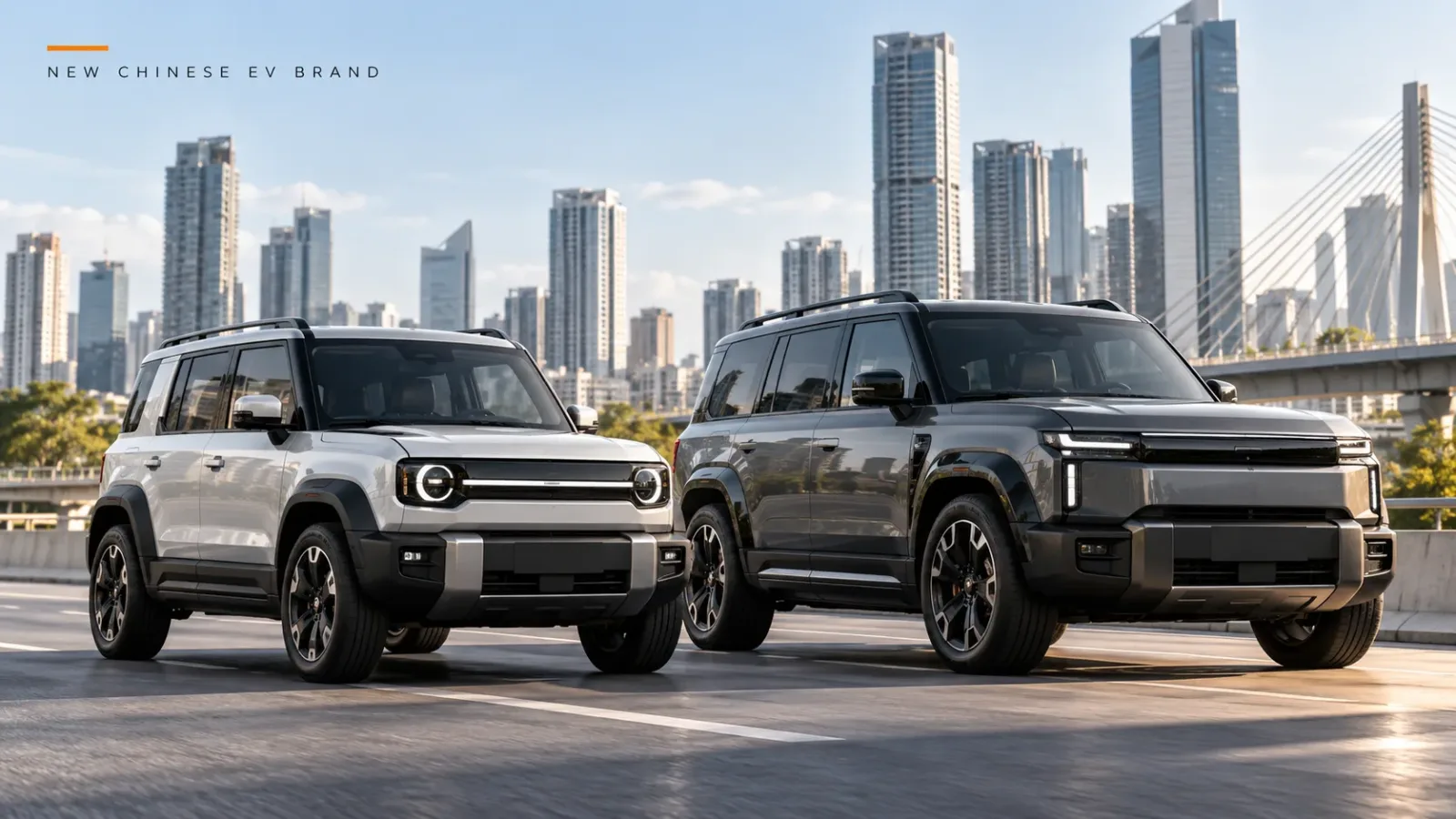
Walk into a Philippine auto show today and the difference from only a few years ago is difficult to ignore. There are more brands, more electric vehicles, more plug-in hybrids and more unfamiliar badges than Filipino buyers have probably ever had to choose from. And another one is about to join them. iCAUR is preparing to officially enter the Philippine market this October, bringing two distinctly boxy electrified SUVs: the fully electric V23 and the larger range-extended V27. As of October 6, the formal Philippine brand launch is still ahead, although local media have already been given an early look at both vehicles. At first glance, this looks like another new-car launch story. But the more interesting question is much bigger:
How many new automotive brands can the Philippine market realistically support?
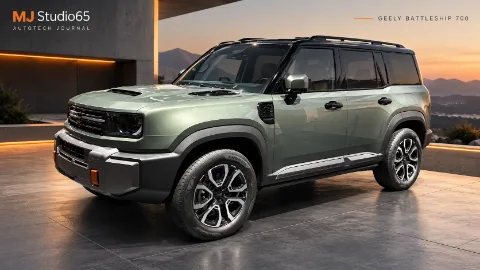
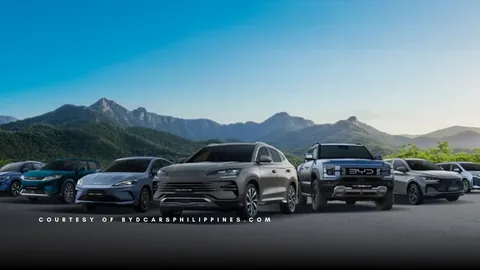
Because iCAUR is not entering an empty market. It is arriving at a time when BYD, Geely, Jetour, MG, Chery, GAC, Changan, Omoda & Jaecoo, BAIC, GWM, Lynk & Co and several other Chinese manufacturers are already fighting for Filipino buyers. Some are growing rapidly. Others are still trying to establish themselves. And now the competition is becoming even more intense.
iCAUR Isn't Trying to Look Like Everyone Else
One thing works immediately in iCAUR's favor: its vehicles are easy to recognize. Instead of following the smooth, aerodynamic crossover styling common among many new EVs, the brand has embraced upright proportions, squared-off bodywork and a rugged appearance inspired by traditional off-road vehicles. The company describes its philosophy as “Classic Never Fades,” combining traditional automotive shapes with modern electrification and technology. Its Philippine lineup initially consists of the compact V23 battery-electric SUV and the significantly larger V27 range-extended SUV. That visual identity matters. One of the problems facing any new automotive brand is differentiation. If buyers have never heard of the badge, the vehicle itself has to give them a reason to pay attention. The V23 and V27 certainly do that. Whether buyers see their styling as distinctive or overly familiar to established off-road vehicles will be subjective, but they are unlikely to disappear anonymously in a parking lot.
The V23 Is the Smaller and More Playful Choice
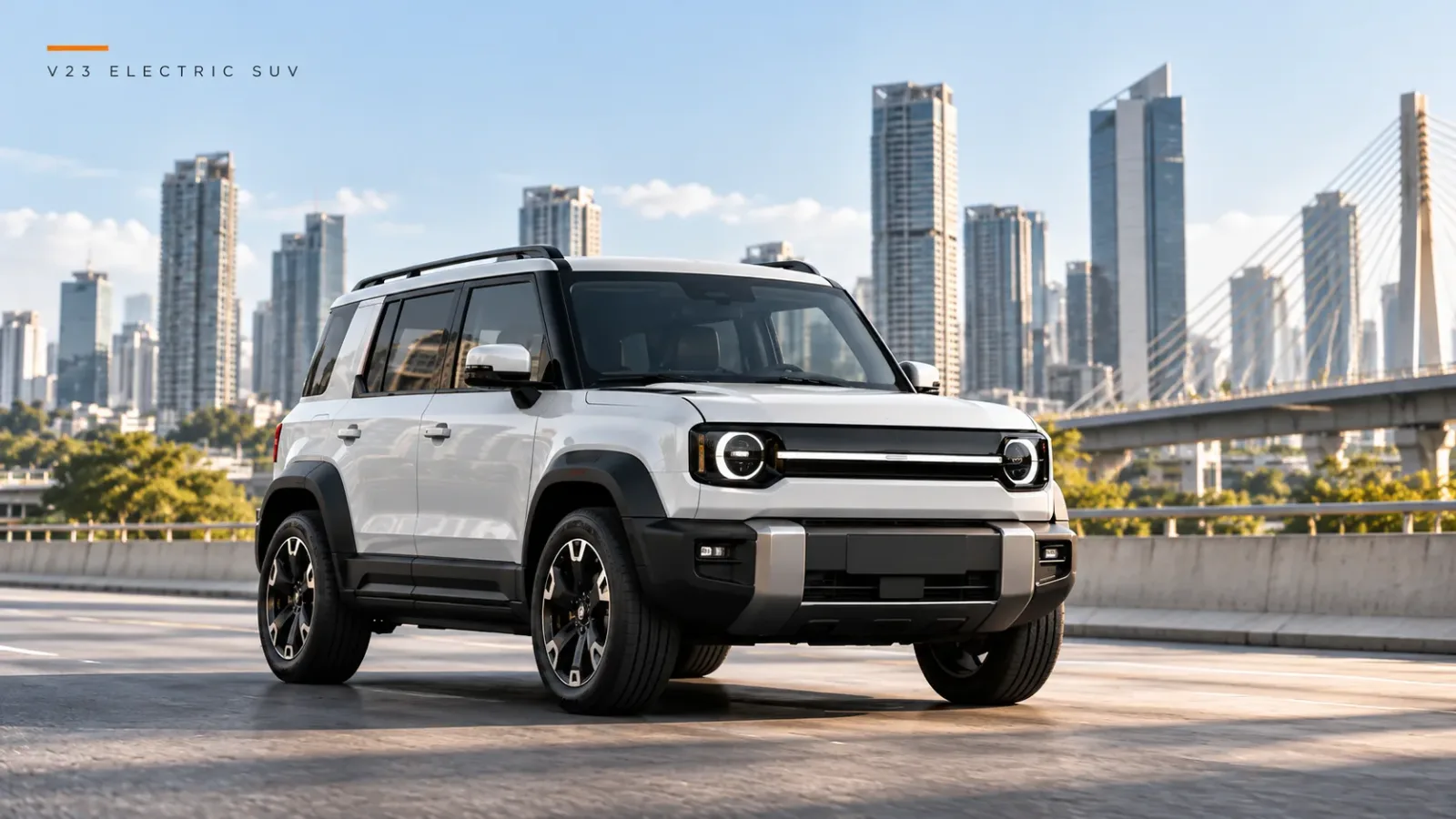 The iCAUR V23 is the smaller of the two and is a pure battery-electric vehicle. It measures 4,220 mm long, 1,915 mm wide and 1,845 mm tall, with a 2,735 mm wheelbase. The Philippine iCAUR website lists two powertrain configurations: one producing 100 kW and 180 Nm, paired with a 59.93 kWh battery, and a more powerful configuration producing 155 kW and 292 Nm using an 81.76 kWh battery. Department of Energy documentation reported by Top Gear Philippines indicates that three locally recognized variants could eventually be offered. In overseas specifications, the smaller battery version uses a single-motor drivetrain while the larger-battery model receives dual motors and four-wheel drive. But specifications may not be the V23's biggest selling point. Its appeal is lifestyle. It is compact enough for urban use yet designed to look adventurous. It has the increasingly popular combination of a squared-off SUV body, large wheel arches and personalization possibilities. That gives iCAUR something different from the increasingly large number of conventional-looking electric crossovers entering the country.
The V27 Is a Much More Serious Proposition
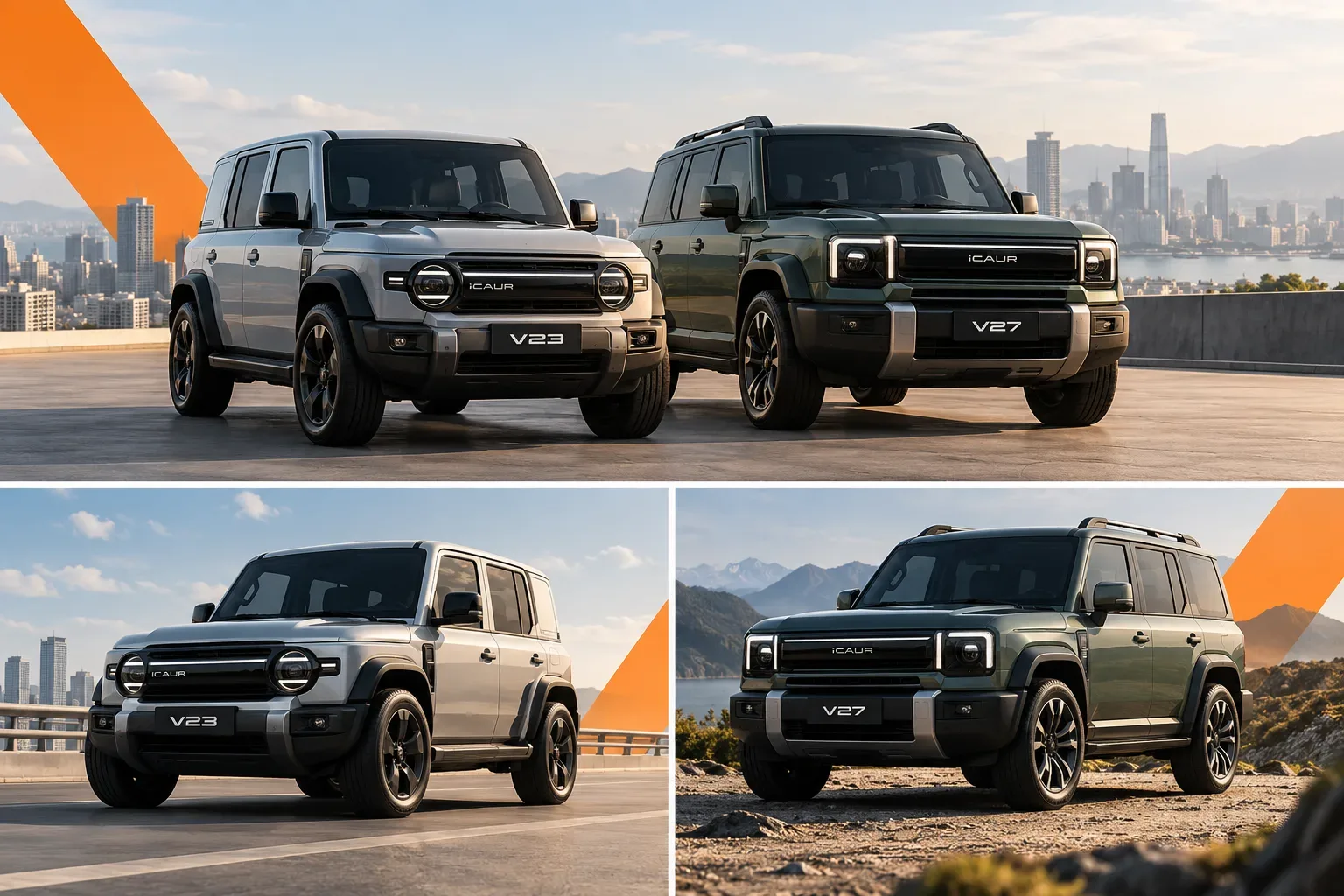 The V27 plays in an entirely different category. At 5,045 mm long, 1,976 mm wide and 1,894 mm tall, with a 2,900 mm wheelbase, this is a substantial SUV rather than a small urban EV. More importantly for the Philippine market, it is not dependent entirely on charging infrastructure. The V27 uses what iCAUR calls its Golden REEV system. REEV means Range-Extended Electric Vehicle. The wheels are primarily driven electrically while an internal-combustion engine can generate electricity when the battery needs additional energy. Higher-output V27 versions produce a combined 335 kW from their front and rear motors, along with 505 Nm of motor torque, and iCAUR quotes 0–100 km/h acceleration in 5.9 seconds. The Philippine product page also lists a CATL lithium-iron-phosphate battery, 600 mm of water-wading capability and a 24-degree approach angle. Globally, iCAUR has said the V27 can provide more than 150 km of pure-electric driving and more than 1,000 km of combined range under its applicable test conditions. Actual Philippine specifications and officially rated local-market range should still be confirmed once the vehicle formally launches. That powertrain could be particularly important here. A Filipino buyer may like electric driving but still worry about taking a family SUV on a long provincial journey where chargers are less predictable. A range extender changes that equation. The owner can use electricity for many everyday trips while retaining fuel as a backup for longer travel. It is one reason REEVs and plug-in hybrids may prove particularly attractive during the Philippines' transition toward electrification.
The Timing Could Actually Be Very Good
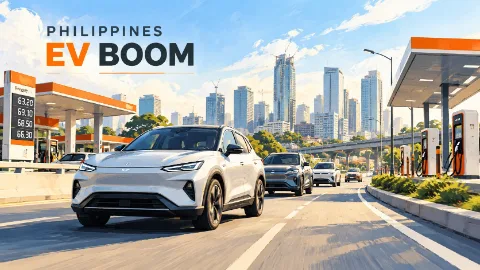
It would be easy to argue that another EV brand is arriving too late. The numbers suggest otherwise. Philippine electrified-vehicle adoption is accelerating rapidly. According to the Department of Energy, 66,685 electrified vehicles were sold from January through August 2026. That included 20,716 conventional hybrids, 29,649 plug-in hybrids and 16,320 battery-electric vehicles. Combined, those vehicles represented approximately 24.7% of estimated Philippine vehicle sales during the period. Think about that for a moment. Nearly one out of every four vehicles counted in those eight months was already some form of electrified vehicle. At the end of August, the DOE also counted 949 recognized EV models and 1,876 registered charging stations nationwide. The transition is no longer something that might happen eventually. It is already happening. And Chinese manufacturers have played a significant role in accelerating it.
Chinese Brands Are No Longer Just Filling the Cheap-Car Segment
There was a time when the easiest strategy for a new Chinese automotive brand was straightforward: Offer more equipment for less money. That strategy still exists, but the market has become considerably more sophisticated. Chinese manufacturers are now competing on battery technology, plug-in-hybrid systems, infotainment, driver-assistance systems, charging speed, performance, design and increasingly even premium positioning. The sales numbers demonstrate that buyers are responding. During the first half of 2026, Jetour led participating CAMPI brands in reported PHEV sales with 1,891 units, while Geely followed with 1,270. Omoda & Jaecoo recorded 1,484 battery-electric vehicle sales during the same period, while Geely, GAC, MG and Changan were also represented in the BEV rankings. These industry figures exclude some manufacturers that do not report through CAMPI, most notably BYD, meaning the actual competitive presence of Chinese electrified vehicles is larger than those tables alone suggest. For iCAUR, that is simultaneously good news and bad news. The good news is that Filipino buyers are clearly becoming more willing to consider unfamiliar brands and alternative powertrains. The bad news is that iCAUR will have to compete against companies that arrived earlier and have already started building recognition.
A Good Vehicle Is No Longer Enough
This is where the Philippine market is entering a new phase. When only a few Chinese brands were available, an attractive vehicle with excellent specifications could generate considerable attention. Today, specifications alone are less powerful. A new SUV can arrive with a large touchscreen, panoramic roof, 360-degree camera, advanced driver assistance, ventilated seats, powerful electric motors and a long equipment list and find several competitors offering something similar. The battleground is shifting. What happens after somebody buys the vehicle is becoming just as important as what happens inside the showroom. That means dealer coverage.
- Parts availability.
- Service-center capability.
- Battery support.
- Software updates.
- Warranty handling.
- Insurance.
- Resale value.
And perhaps most importantly, confidence that the company selling the vehicle today will still have a strong Philippine operation several years from now. Those things are much harder to communicate on a specification sheet.
iCAUR Appears to Understand the Dealer Problem
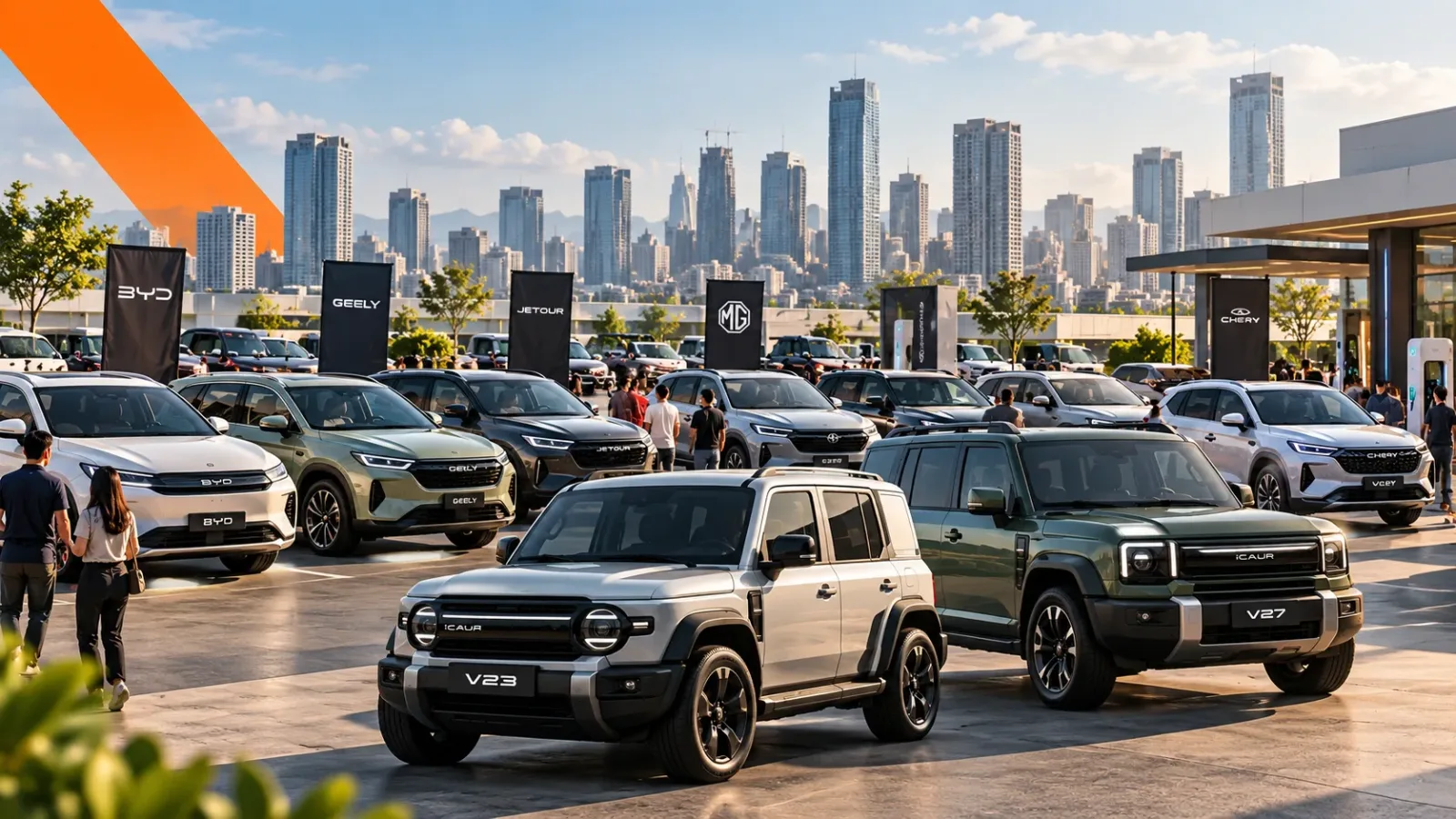 The brand is at least building local infrastructure before opening its doors. Ahead of its Philippine launch, iCAUR announced its initial dealer partners: MG Gateway, Britannica United, DC Automotive and Laus Auto Group. These are established automotive dealer organizations rather than completely new companies entering retail for the first time. That is important. An established dealer partner already understands vehicle sales, service operations, parts management and customer expectations. But an initial dealer network is only the beginning. If iCAUR sells strongly, buyers outside major metropolitan areas will eventually expect convenient service access too. That may become one of the defining challenges for the dozens of brands now competing in the Philippines. There are only so many good dealership locations. Only so many trained technicians. Only so many customers. And building a nationwide support network is expensive.
The Philippine Market Is Growing but It Is Not Unlimited
Another important piece of context is often overlooked. Electrified-vehicle sales may be rising rapidly, but the overall automotive market has not simply expanded without limits. CAMPI and the Truck Manufacturers Association reported 241,725 vehicles sold from January through July 2026, about 10.2% lower than the same period in 2025. So new brands are not merely arriving to collect customers created by an endlessly expanding market. In many cases, they are fighting over the same buyer. Every V23 sold might represent a customer who considered another small EV. Every V27 potentially competes with another electrified SUV. Every new dealership has to persuade somebody who might otherwise walk into Toyota, Mitsubishi, Ford, BYD, Geely, Jetour, MG or another established showroom. Competition is becoming brutal. And that may ultimately be healthy for consumers.
More Brands Can Mean Better Cars and Better Prices
There is another side to this story. Filipino buyers may actually benefit enormously from having too many manufacturers rather than too few. Competition forces brands to improve. If five companies sell similar electrified SUVs, pricing becomes harder to inflate. If one manufacturer offers an eight-year battery warranty, competitors may have to respond. If another offers free maintenance or home charging equipment, others may need to improve their ownership packages. Better financing, longer warranties, more standard equipment and aggressive introductory pricing frequently appear when manufacturers are fighting for market share. We are already seeing technologies that were once limited to expensive vehicles moving rapidly downward in price. Large displays, 360-degree cameras, adaptive cruise control, vehicle-to-load capability, powerful electric motors and sophisticated hybrid systems are becoming increasingly common. Chinese manufacturers have helped accelerate that process. So from the consumer's point of view, more competition is not necessarily a problem. The question is what happens after the competition begins eliminating weaker players.
Not Every Brand Will Become a Major Player
This may be the uncomfortable reality of the next few years. The Philippine automotive market probably does not need every brand currently entering it to become successful. Some will grow. Some will remain niche. Some distributors may change. Some brands may eventually consolidate operations. And some could disappear. That is normal in a competitive market. The real concern is protecting customers when it happens. A vehicle is not a smartphone that owners typically replace every two or three years. Many Filipinos finance vehicles for five years and expect to keep them much longer. A customer therefore isn't simply buying the product sitting in front of them. They are placing a long-term bet on the organization behind it. That makes reputation increasingly valuable. The next phase of competition among Chinese manufacturers in the Philippines may therefore be less about who can launch the most impressive car and more about who can prove they are here for the long term.
iCAUR Has One Advantage: It Knows Its Identity
This is where iCAUR may have found a useful position. Instead of attempting to become another general-purpose manufacturer with hatchbacks, sedans, MPVs and crossovers competing everywhere simultaneously, its opening Philippine lineup communicates a fairly clear identity.
Boxy SUVs.
Lifestyle.
Electrification.
Customization.
The V23 represents the smaller, fully electric end of that idea. The V27 takes essentially the same design philosophy into a large range-extended SUV. That consistency could make the brand easier to understand. And in a market increasingly filled with unfamiliar names, being memorable has value.
Pricing Will Decide a Lot
There is still one piece of information that could completely change the discussion:
Philippine pricing.
As of October 6, iCAUR has not yet completed its formal local launch, so final pricing and complete Philippine-market specifications remain among the most important details still to come. The V23 can look interesting on paper. The V27 can offer considerable performance, range and technology. But neither exists in isolation. At the wrong price, Filipino buyers have an enormous number of alternatives. At the right price, both vehicles could become extremely interesting. This is especially true for the V27 because the range-extended SUV segment is rapidly becoming one of the most competitive areas of the Chinese automotive industry. Value will matter. But value can no longer mean simply giving buyers more features. It has to include the entire ownership experience.
So, Are There Too Many Chinese Car Brands in the Philippines?
Maybe. But that might be the wrong question. The better question is:
How many of them can build enough trust to remain?
The Philippine automotive market does not need to decide that immediately. Consumers will do it gradually. Every purchase is a vote. Every service experience is another. Every warranty claim, software update, replacement part and resale transaction will help determine which brands earn long-term credibility. iCAUR is arriving with two products that are at least visually distinctive and technologically relevant to where the market is heading. The V23 brings a compact battery-electric lifestyle SUV. The V27 brings a much larger range-extended vehicle that may be easier for Filipino motorists still concerned about charging availability. And they are arriving precisely when electrified vehicle adoption is accelerating. That gives iCAUR an opportunity. But opportunity is not the same thing as guaranteed success. The first generation of Chinese brands in the Philippines had to convince buyers that Chinese-made vehicles deserved consideration. The new generation faces a different challenge. They now have to convince buyers why their particular Chinese brand deserves to be chosen over all the others. That may be a much harder competition. And it could ultimately be one of the best things to happen to Filipino car buyers.
Comments
No comments yet. Be the first to join the discussion.