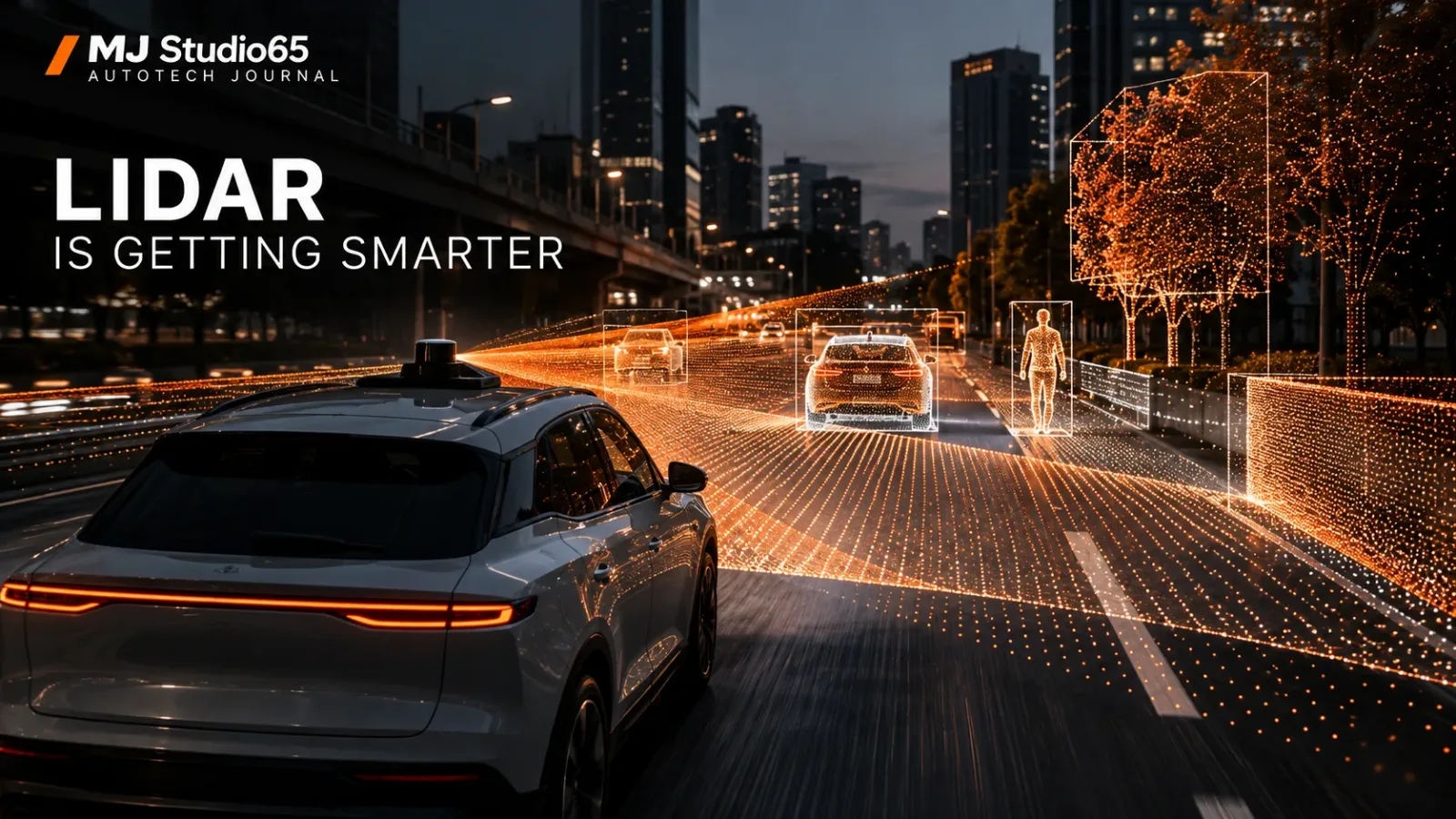
Modern cars are learning to see. Cameras recognize lane markings, traffic lights and other visual details. Radar can measure the distance and movement of objects around a vehicle. LiDAR adds another layer by using laser light to build a highly detailed three-dimensional picture of the surrounding environment. But what if LiDAR could do more than determine where an object is? What if it could also provide clues about what that object is made of? New research into polarization-resolved LiDAR suggests that this could become possible. Researchers have demonstrated a photonic LiDAR system capable of producing 3D information while also analyzing how different materials change the polarization of reflected laser light. In experiments, the system was able to distinguish between materials including wood, stone and steel. It represents an interesting change in the way we think about LiDAR. Instead of simply measuring the geometry of the world around a vehicle, future LiDAR systems could potentially provide another layer of information about the surfaces they are observing.
What LiDAR actually sees today
LiDAR stands for Light Detection and Ranging. The basic principle is relatively simple. A LiDAR sensor sends laser light toward the environment and measures the light that returns after reflecting from an object. From that information, the system can calculate distance. Repeat the process thousands or even millions of times across the surrounding environment and the result becomes a three-dimensional collection of measurements known as a point cloud. That point cloud can reveal the shape and position of vehicles, pedestrians, buildings, barriers and other objects. LiDAR is particularly useful because depth is measured directly rather than inferred only from a two-dimensional image. Current autonomous-driving systems demonstrate how useful this can be. Waymo, for example, combines LiDAR with cameras and radar because each sensor provides different information. LiDAR is particularly valuable for depth and 3D geometry, while cameras provide visual information such as color and signs, and radar contributes information about distance and motion. That combination is known as sensor fusion. But even a detailed LiDAR point cloud does not automatically tell the vehicle everything it needs to know.
Knowing where something isn't the same as knowing what it is
Imagine that a LiDAR sensor detects a large flat object 30 meters ahead. The system may determine its distance, height, width and position with impressive accuracy. But those measurements alone do not necessarily reveal whether the object is a concrete wall, a metal panel, a wooden structure or something else. Software can attempt to identify the object by analyzing its shape, intensity measurements and information from other sensors such as cameras. That works remarkably well in many situations. But researchers are exploring whether the light returning to the LiDAR itself contains additional information that conventional systems are not fully using. One of those additional signals is polarization.
Light carries more information than distance
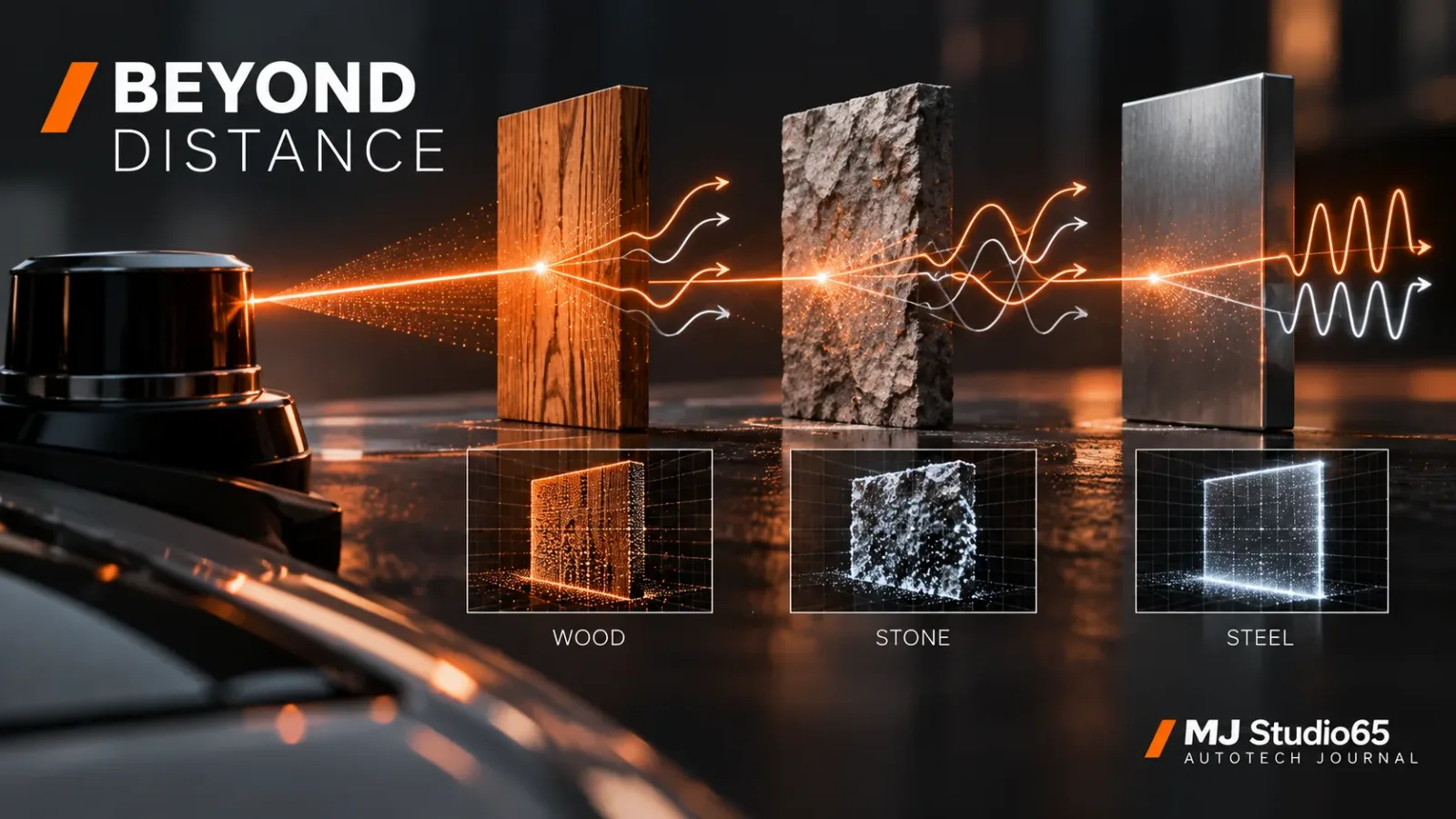 Light behaves as an electromagnetic wave. One characteristic of that wave is its polarization essentially the orientation of its electromagnetic oscillation. When light strikes a surface and reflects back toward a sensor, its polarization can change. Different surfaces can interact with polarized light differently depending on factors such as their material properties, texture and geometry. That means the returning laser signal potentially contains more information than simply how long it took to come back. Researchers have been investigating whether those differences can help LiDAR systems distinguish between materials. A study published in Nature Communications in September 2026 demonstrates an especially interesting approach. The researchers combined a silicon-photonic optical phased-array LiDAR with another photonic chip designed to analyze polarization. Instead of producing only a conventional 3D point cloud, the system generates additional polarization information from the returning laser signal. And then another important part of the system comes into play.
Putting material recognition on the photonic chip
The researchers integrated what they describe as a polarization-resolved optical neural network, or PolarONN. Rather than sending all of the polarization information into a conventional electronic processor and performing the entire classification process there, the photonic system can process the optical information directly. The resulting point-cloud data can contain several pieces of information:
- 3D geometry; describing where the measured point exists in space.
- Return intensity; describing the strength of the reflected signal.
- Polarization information; extracted from the returning light.
And finally,
- material classification; inferred by the photonic neural network.
In other words, a point in the LiDAR map could potentially contain more than coordinates. It could carry information about the physical characteristics of the surface that produced that point. That is the important idea behind the research.
Wood, Stone or Steel?
To demonstrate the concept, researchers tested the system using three representative materials: wood, stone and steel. The experimental system achieved classification accuracy above 85 percent at distances of up to 10 meters. That number needs some context. Ten meters is far shorter than the detection distances expected from long-range automotive LiDAR, and three carefully selected materials are nowhere near the complexity of a real road. A city street could contain painted metal, glass, concrete, asphalt, rubber, plastic, vegetation, water, road markings, clothing and countless combinations of surface finishes and contamination. Objects are also rarely positioned conveniently for a sensor. They can be wet, dirty, damaged, partially hidden or illuminated under difficult conditions. So this research does not mean that cars can suddenly look at every object on the road and determine exactly what it is made from. It demonstrates something more fundamental: material information can potentially be extracted as part of the LiDAR sensing process itself. And that could become valuable as the technology develops.
Why would a car need to recognize materials?
Consider a vehicle approaching something lying on the road. Knowing that an object exists is obviously important. Knowing its dimensions is better. But understanding more about the object's physical characteristics could provide additional context to the perception system. A reflective metal object may require a different interpretation from vegetation. A solid roadside structure may be treated differently from another surface producing a similar geometric shape. Road surfaces are another interesting possibility. Future perception systems may need to distinguish between normal pavement and surfaces affected by water, snow, ice, mud or other conditions. Material-aware sensing would not necessarily make those decisions by itself. But it could provide another source of information for the vehicle's perception software. That is where the technology becomes particularly interesting. Autonomous driving does not depend on one perfect sensor. It depends on multiple imperfect sensors providing complementary information.
Cameras, Radar and LiDAR still need each other
A smarter LiDAR does not make cameras or radar unnecessary. Each technology sees the world differently. A camera can capture enormous amounts of visual information. It can identify colors, lane markings, traffic lights, text and many other details that are difficult to obtain from a conventional LiDAR point cloud. LiDAR excels at measuring three-dimensional geometry and depth. Radar is particularly useful for detecting objects and measuring motion, and it can remain effective under some conditions that are difficult for optical sensors. Modern autonomous-driving systems therefore increasingly combine several sensing technologies. The information from those sensors can then be processed together so that weaknesses in one sensor can potentially be compensated for by strengths in another. Even advanced LiDAR still faces environmental challenges. Rain, fog, snow and airborne particles can scatter or attenuate laser light. Research into autonomous perception therefore continues to investigate combinations of LiDAR, radar and cameras that adapt to changing environmental conditions. Polarization-resolved LiDAR would add another piece to that sensor-fusion puzzle rather than replacing everything already there.
The importance of silicon photonics
There is another reason this research is worth watching. The system uses silicon photonics. Instead of constructing every optical function using relatively large individual optical components, silicon photonics allows many optical functions to be integrated onto extremely small chips using manufacturing techniques related to those used by the semiconductor industry. This could eventually help make advanced LiDAR systems smaller, faster and more integrated. And polarization sensing isn't the only LiDAR capability moving toward photonic integration. Separate research published in Nature Communications in 2026 demonstrated a monolithically integrated silicon-photonic FMCW LiDAR system capable of three-dimensional imaging at distances up to 20 meters while also providing depth and velocity measurements. The two research projects use different architectures and should not be treated as a single technology. But together they illustrate a larger trend: More of the LiDAR system is moving onto photonic chips. That could eventually change not only what LiDAR can measure, but also the size, complexity and cost of the hardware required to do it.
From measuring distance to understanding a scene
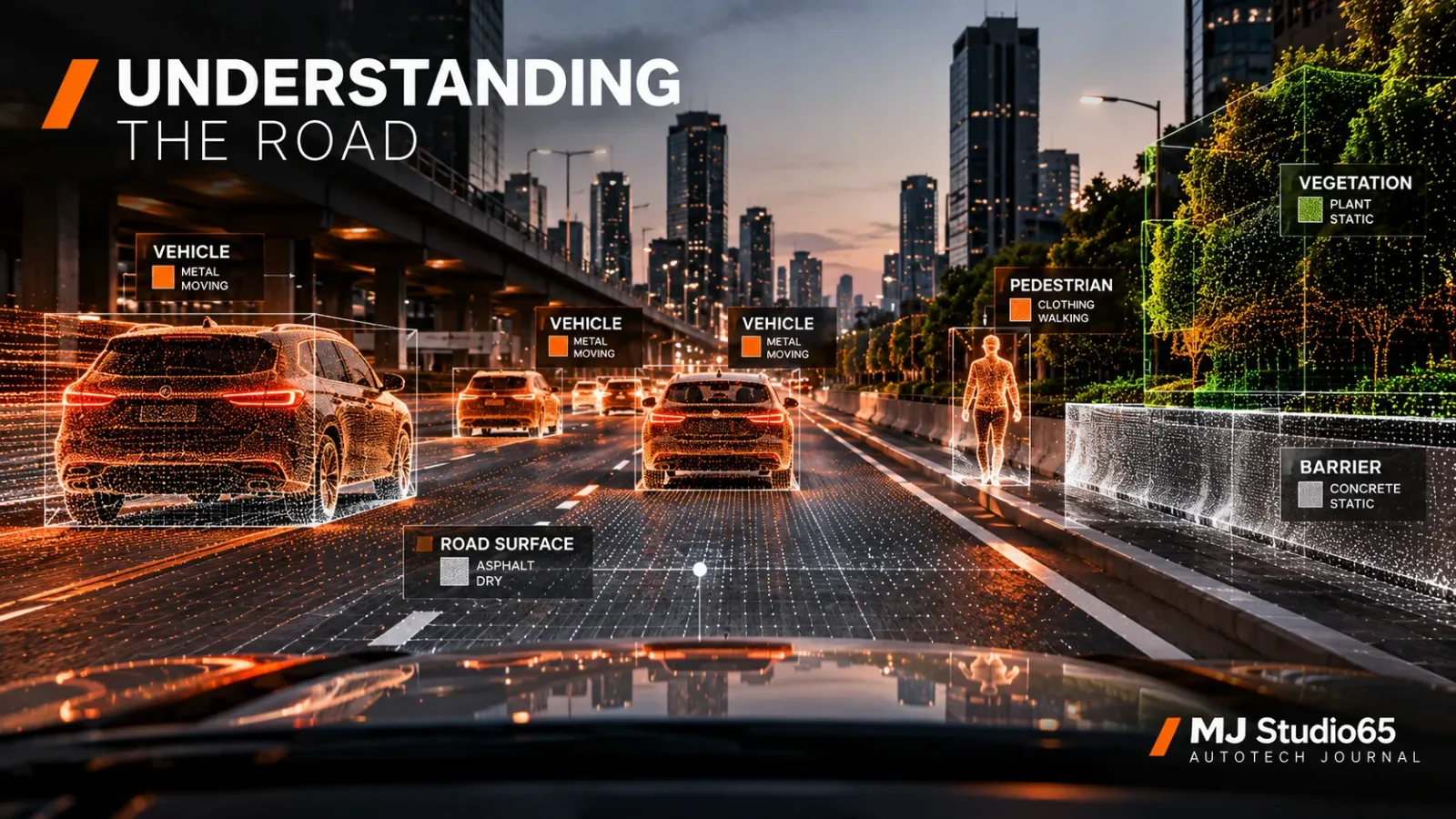 For decades, ranging sensors have largely been designed around a straightforward question: How far away is something? Modern LiDAR has already transformed that simple measurement into detailed three-dimensional maps containing enormous numbers of points. The next stage may be about making those points richer. Instead of: There is an object 15 meters ahead. A future perception system could potentially receive information closer to: There is an object 15 meters ahead, this is its three-dimensional shape, this is how it is moving, this is how strongly it reflected the laser, and these are characteristics of its surface. The more meaningful information a perception system receives, the more context its software potentially has when deciding what is happening around the vehicle. But there is still a considerable distance between demonstrating that capability in a laboratory and deploying it on millions of cars.
The road from laboratory to production car
Automotive technology has unforgiving requirements. A sensor mounted on a vehicle has to survive vibration, heat, cold, rain, dust and years of continuous operation. It also has to work across dramatically different environments. Material recognition that performs well against three known materials at 10 meters is therefore only an early demonstration. A production automotive system would have to cope with far greater distances and thousands of real-world variations. Manufacturers would also have to consider cost, power consumption, chip manufacturing, calibration, reliability and integration with existing vehicle computing platforms. Most importantly, the technology would have to prove that the additional information actually improves vehicle perception enough to justify the added complexity. Those questions remain unanswered.
LiDAR Is already moving into more Vehicles
While polarization-aware material recognition remains experimental, conventional automotive LiDAR is already moving beyond research vehicles and robotaxis. LiDAR manufacturer Hesai announced in 2026 that it planned to increase annual production capacity from two million units to more than four million units, citing demand from advanced driver-assistance systems and robotics. The company has also announced automotive programs covering numerous production models. That does not mean LiDAR will appear on every vehicle. Different manufacturers continue to take different approaches to vehicle perception, including combinations of cameras, radar, ultrasonic sensors and LiDAR. But growing production volumes mean the technology is no longer restricted to experimental autonomous vehicles carrying extremely expensive sensors on their roofs. LiDAR itself is becoming smaller and increasingly integrated into production vehicles. The research question is now moving beyond simply making LiDAR affordable. Researchers are also asking: What else can we make it see?
A Car that understands more than shape
The most interesting part of polarization-resolved LiDAR may not be whether a car can specifically identify wood, stone or steel. Those materials were a demonstration. The larger idea is that a laser reflection contains information that conventional ranging systems may not fully exploit. Distance tells a vehicle where something is. Geometry provides clues about its shape. Intensity adds information about how the laser was reflected. Polarization could provide another clue about the nature of the surface itself. Combine those signals with cameras, radar and increasingly powerful AI perception systems, and future vehicles could build a much richer model of their surroundings. Today's LiDAR helps machines map the world in three dimensions. Tomorrow's LiDAR may help them understand a little more about what that world is made of.
Comments
No comments yet. Be the first to join the discussion.