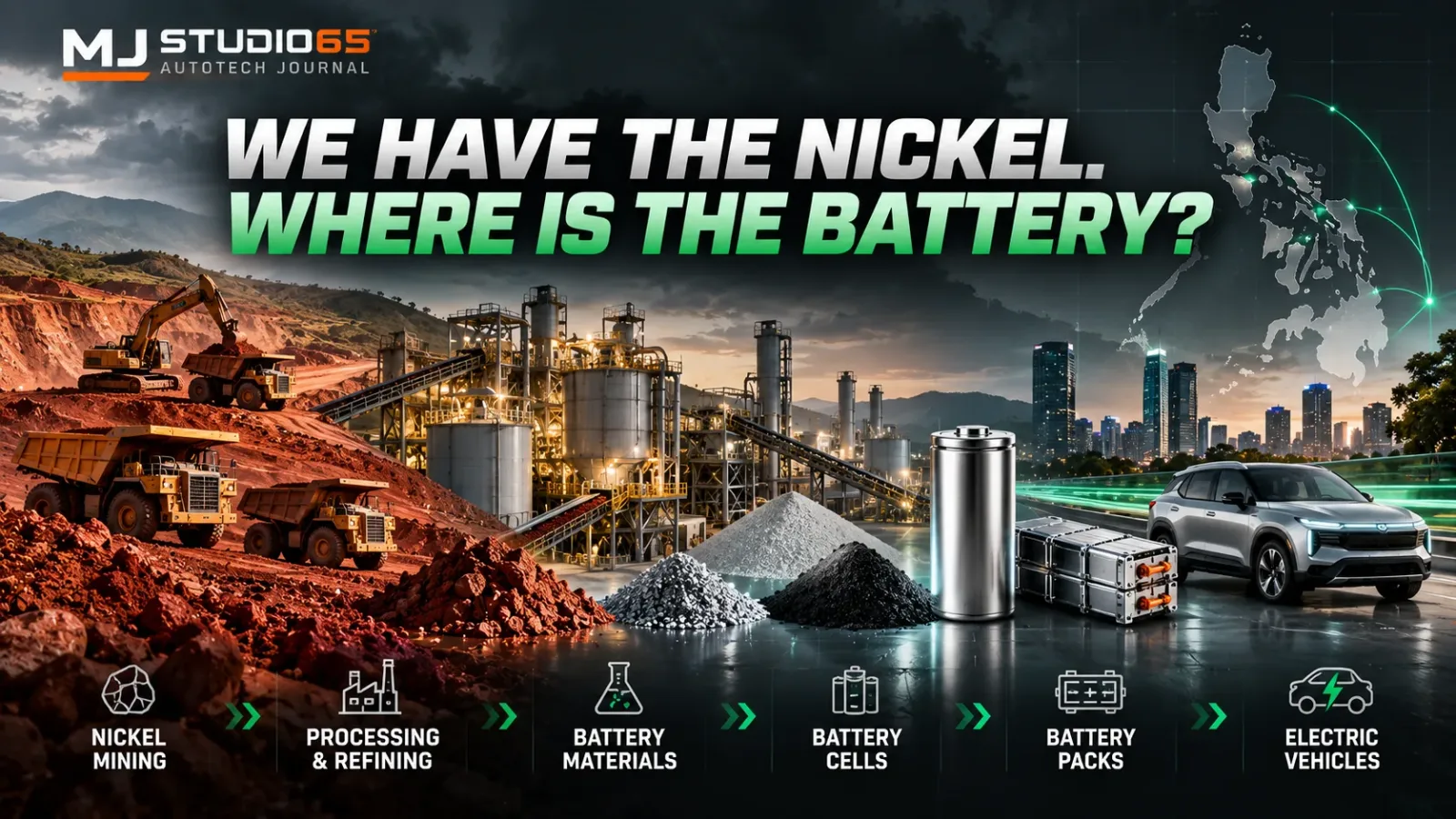
The Philippines Has the Nickel But Where Does the Real Value Go?
The global transition toward electric vehicles has created enormous demand for materials that most drivers rarely think about. Lithium receives much of the attention, but nickel remains important to many high-energy-density lithium-ion batteries, particularly nickel-containing chemistries such as NMC and NCA. That should place the Philippines in an interesting position. The country is not a minor participant in the global nickel industry. In 2024, the Philippines was the world's second-largest nickel producer, accounting for about 9.5% of global mine production, with Philippine mines producing roughly 354,000 metric tons of contained nickel. Yet there is an uncomfortable question hiding behind those impressive numbers. If the Philippines possesses one of the world's important supplies of nickel, why does so much of the economic value created from that resource still happen somewhere else? The question isn't whether we should simply dig up more nickel, nor is it whether the Philippines should suddenly try to manufacture every component inside an electric vehicle. The more important question is how far along the value chain the country can realistically move and whether doing so could turn a natural resource into something more enduring than an exported commodity.
We Have the Resource
Nickel mining is already a substantial industry in several parts of the Philippines, with Caraga remaining particularly important. During the first half of 2025, the region accounted for 36.6% of Philippine nickel direct-shipping ore production, followed by Eastern Visayas, Central Luzon and MIMAROPA. The Philippines primarily produces lateritic nickel ores, the type of deposits commonly found across tropical regions of Southeast Asia. Some Philippine nickel already undergoes significant domestic processing. Facilities such as Coral Bay and Taganito demonstrate that the country is not exclusively an exporter of unprocessed ore. Nevertheless, enormous quantities still leave the country relatively early in the industrial chain. In 2024, Philippine exports of nickel ore and concentrates totaled approximately 44.5 million wet metric tons, with roughly 77% going to China and 23% to Indonesia. That is where the bigger economic question begins. Once nickel leaves the Philippines, the material can continue through several increasingly sophisticated stages. It may be processed and refined, converted into specialized chemicals, turned into precursor material and cathode active material, incorporated into battery cells, assembled into battery packs and eventually installed in electric vehicles or stationary energy-storage systems. At every additional stage, engineering, infrastructure, intellectual property, manufacturing expertise and economic value can be added. The Philippines owns the material near the beginning of that journey. The question is how much more of the journey could happen here.
Nickel Ore Is Not an EV Battery
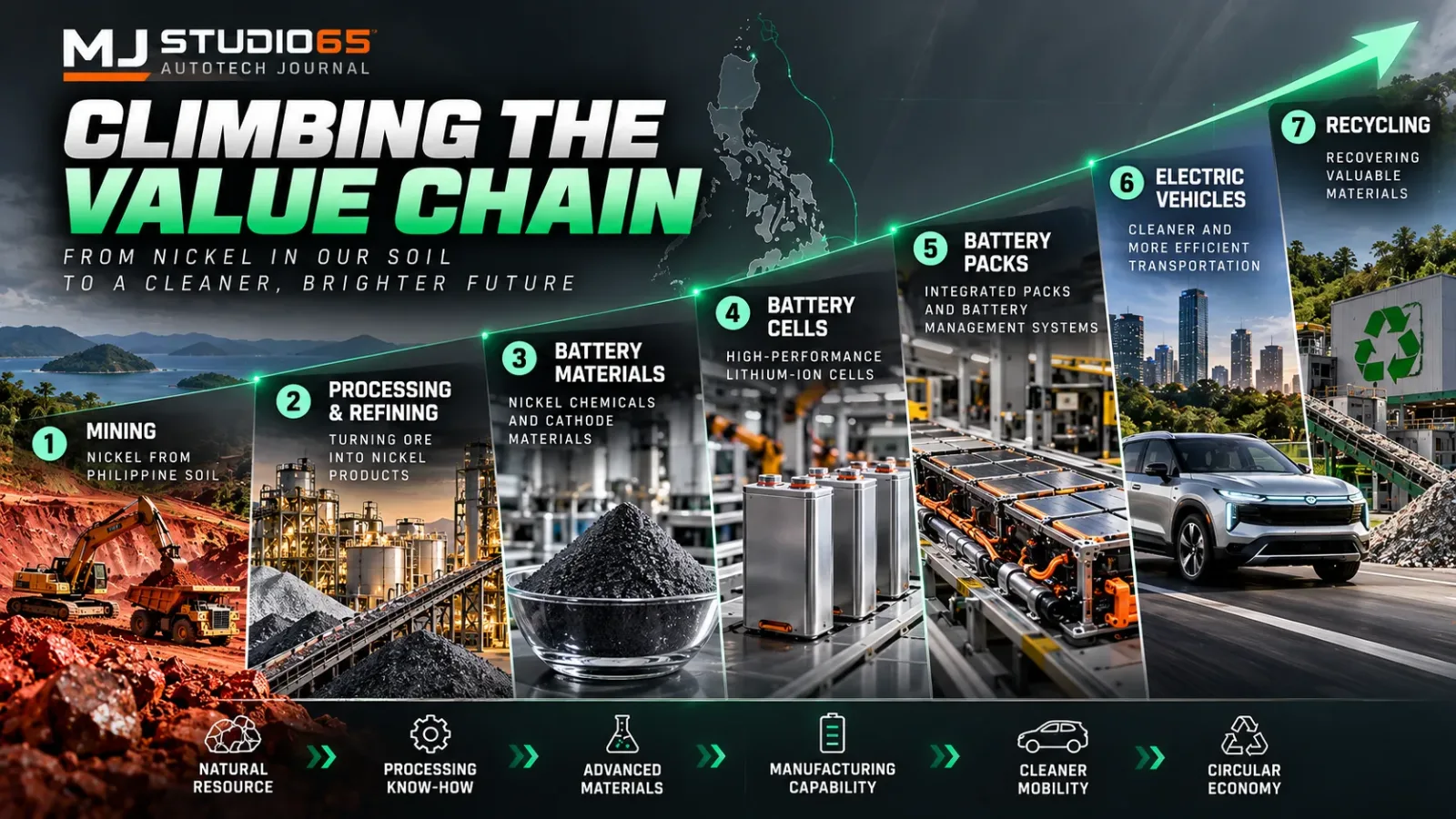 It is tempting to simplify the issue by saying that because the Philippines has nickel, the Philippines should manufacture batteries. Reality is considerably more complicated. Mining nickel is one industrial capability. Producing battery-grade nickel chemicals is another. Manufacturing cathode precursors requires additional technology, chemical processing and extremely consistent quality control. Producing cathode active material adds another layer of sophistication, while battery-cell manufacturing requires enormous capital investment, specialized equipment, tightly controlled production environments, reliable electricity and water, sophisticated supply chains, intellectual property and customers capable of absorbing very large production volumes. Nickel is also only one ingredient. A modern lithium-ion cell requires lithium, graphite or another anode material, electrolyte, separators, copper and aluminum foils and numerous other components. Having nickel therefore gives the Philippines an advantage, but it does not automatically give us a battery industry. That distinction matters because the objective should not be to build a battery factory simply because we happen to possess one of its raw materials. The objective should be to determine which portions of the battery supply chain match Philippine resources, industrial capabilities and long-term economic interests.
The Value Ladder Matters
Instead of asking whether the Philippines can jump directly from mining to gigafactories, it may be more useful to imagine the battery industry as a ladder. At the bottom is mining. Above it comes mineral processing and refining, followed by battery chemicals and precursor materials, cathode and anode materials, battery cells, battery packs and battery-management systems, and eventually downstream products such as electric vehicles and stationary energy storage. At the end of the product's useful life another industry appears: battery recycling and material recovery. Interestingly, Philippine industrial planning already recognizes essentially this progression. A Board of Investments industrial strategy identifies opportunities spanning mining, mineral processing and refining, battery-material processing, battery manufacturing, downstream applications and recycling. The strategic question therefore shouldn't necessarily be whether we can build the entire ladder tomorrow. A more realistic question is: which rung can the Philippines climb next? Moving from ore exports toward processing would represent one step. Producing more specialized battery materials would represent another. Developing battery-pack assembly, power electronics, battery-management systems or recycling could provide additional paths. Industrial development does not have to happen in one enormous leap.
Indonesia Shows Both the Opportunity and the Risk
We do not have to look very far for an example of what happens when a nickel-producing country aggressively moves downstream. Indonesia once exported enormous quantities of nickel ore. It subsequently restricted ore exports and encouraged massive domestic investment in processing. Chinese capital and technology helped build smelters and industrial complexes, transforming Indonesia into the dominant force in the global nickel market. By 2026, Indonesia accounted for more than 60% of global nickel output, and its processing industry had become so large that domestic mines alone could not always provide all the ore its facilities wanted. Indonesia consequently increased imports of ore from countries including the Philippines. There is something remarkable about that situation: Philippine nickel can cross the sea to Indonesia because Indonesia has built the processing capacity capable of consuming it. That does not automatically mean the Philippines should copy Indonesia's policies. Indonesia's experience also demonstrates the complications that come with aggressive downstream expansion. Processing requires enormous amounts of capital, infrastructure and energy. It can create significant environmental pressures and increase dependence on foreign investment and technology. It can also expose a country to changes in global commodity markets. Nickel prices have already faced substantial pressure as Indonesian production expanded. Philippine miners have felt those effects as well. In the first half of 2025, the Mines and Geosciences Bureau reported that the average nickel price was 12.1% lower year-on-year, while Philippine nickel direct-shipping ore production and value also declined. Moving downstream can capture more value, but it does not eliminate commodity cycles.
The Battery Market Is Changing Too
There is another reason the Philippines should be cautious about building an industrial strategy around the assumption that every future electric vehicle will require large quantities of nickel. Battery chemistry is evolving. Lithium iron phosphate batteries, better known as LFP, contain neither nickel nor cobalt, and their growing adoption—particularly among Chinese manufacturers has changed expectations for future nickel demand. Expanding LFP adoption has already contributed to uncertainty surrounding some of the enormous nickel-processing capacity developed around anticipated EV demand. Nickel-containing chemistries are not disappearing. NMC and NCA remain important where manufacturers value high energy density, while nickel also has enormous applications outside batteries, particularly in stainless steel. But the lesson is important. The Philippines should not build its industrial future around one battery chemistry remaining dominant forever. A stronger strategy would develop processing knowledge, chemical engineering, materials science, manufacturing expertise and recycling capability that can adapt as technology changes. Those capabilities could remain valuable even if the exact chemistry inside tomorrow's batteries looks different from what manufacturers use today.
Maybe We Should Stop Thinking Only About Battery Factories
When people hear about building a domestic battery industry, the image that often comes to mind is a gigantic factory producing millions of lithium-ion cells. That may eventually become part of the Philippine story, but there are many industries between a nickel mine and a finished battery cell. Battery precursor chemicals must be manufactured. Cathode materials need to be produced. Battery packs require structural components, cooling systems, wiring, electronics and battery-management systems. Cells and packs require testing and certification. Used batteries eventually need diagnostics, second-life applications, dismantling and recycling. The Philippines does not necessarily need to dominate every stage. It needs to identify the stages where its existing advantages actually matter. Our mineral resources are one advantage. Our established electronics and semiconductor manufacturing base is another. Our geographic position inside Asian supply chains provides another opportunity. Our engineering workforce could become another advantage if the necessary skills, research programs and industrial opportunities develop alongside investment. That combination may ultimately prove more valuable than nickel alone.
The Real Opportunity Is Knowledge
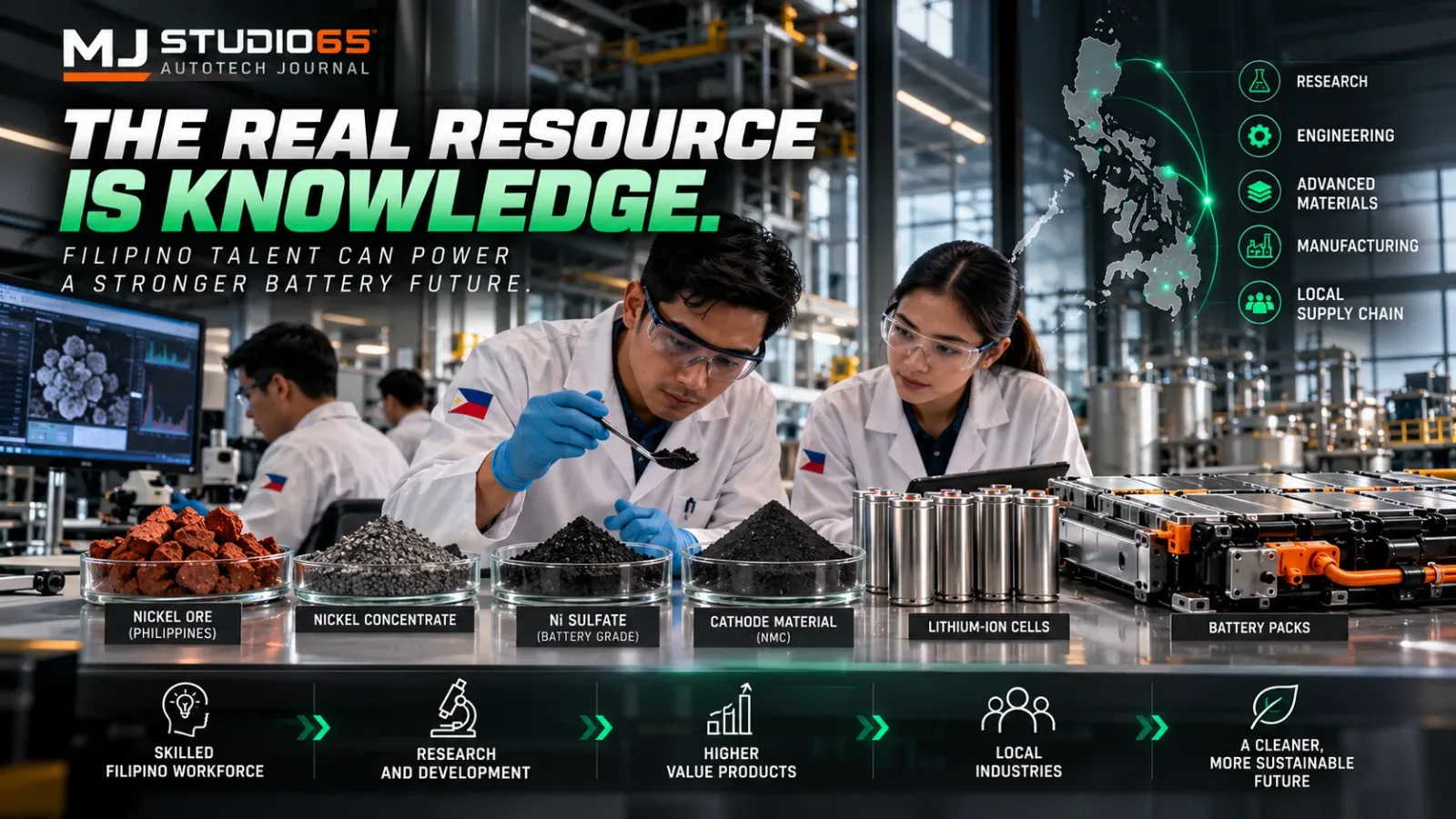 Imagine two possible futures. In the first, Philippine mines continue extracting nickel. Ships arrive, ore is loaded and the material leaves the country. Mining creates jobs, taxes and export revenue, but much of the sophisticated industrial activity occurs somewhere else. In the second future, some ore still leaves because international trade is not going away, but a growing share enters Philippine processing facilities. Filipino chemical engineers work on refining. Materials scientists develop battery compounds. Technicians operate advanced industrial plants. Universities cooperate with industry. Local companies supply equipment and services. Recycling facilities eventually recover nickel and other valuable materials from batteries that have already completed one useful life. The difference between those futures isn't simply the number of factories. It is knowledge accumulated inside the country. A mineral deposit is finite. Eventually a mine produces less material or reaches the end of its economic life. But the engineers, scientists, technicians, suppliers and institutions developed around an advanced industry can move into other technologies and other industries. That is why the most valuable product of moving further along the battery supply chain may not actually be the battery. It may be capability.
But Processing Has an Environmental Cost Too
Moving downstream should not be presented as an environmental free lunch. Nickel processing can require substantial amounts of energy, water and chemicals. Laterite processing can generate large volumes of residues. Smelting can be extremely energy intensive. High-pressure acid leaching, one route used to extract nickel and cobalt from certain lateritic ores for battery-oriented products, requires careful management of acid, water, energy and processing residues. The Board of Investments' own industrial strategy acknowledges environmental challenges historically associated with mining and mineral processing and discusses cleaner approaches including bioleaching and dry-stack tailings. That matters because moving more processing into the Philippines also means moving more of its environmental consequences here. We should not congratulate ourselves for capturing more economic value if communities near mines and processing plants are left carrying disproportionate environmental costs. The objective cannot simply be more processing. It has to be better processing, with credible environmental safeguards, transparent monitoring, responsible water management, rehabilitation and accountability extending throughout the life of a project.
Cheap and Clean Electricity Could Become a Competitive Advantage
Battery materials contain an invisible ingredient: energy. A mineral-processing facility powered primarily by high-carbon electricity can give the resulting material a significantly larger carbon footprint than one produced using cleaner energy. That increasingly matters as automakers and battery manufacturers examine emissions across their supply chains. For the Philippines, this creates both a challenge and an opportunity. Processing nickel domestically would increase industrial electricity demand, and electricity costs and reliability would influence whether facilities could compete internationally. But if new industrial facilities can increasingly be paired with reliable and cleaner electricity, the Philippines could potentially differentiate its materials rather than competing only on ore availability or labor costs. In the future, buyers may increasingly care not only about where the nickel came from, but also how it was produced. A tonne of nickel produced with stronger environmental standards, lower emissions and transparent sourcing could eventually carry strategic value beyond the commodity itself.
Communities Have to Capture More of the Value Too
There is another value chain that rarely appears in battery diagrams. It begins at the mine and ends with the communities surrounding it. If the Philippines moves toward more domestic mineral processing, local communities should see benefits extending beyond temporary construction employment. That can mean skilled permanent jobs, technical education, local supplier opportunities, infrastructure, environmental monitoring and economic activity capable of surviving beyond the mine itself. Universities and technical schools near industrial regions could develop programs aligned with materials science, chemical engineering, automation, environmental monitoring and advanced manufacturing. Local businesses could become suppliers instead of merely spectators to large industrial projects. Otherwise, “moving up the value chain” risks becoming something visible mainly in national investment statistics. Industrial development becomes far more meaningful when capability spreads outward to workers, universities, local companies and communities.
Recycling Could Change What It Means to Be a Mineral-Rich Country
There is also a longer-term opportunity that has little to do with extracting additional ore from the ground. Every electric-vehicle battery eventually reaches the end of its first automotive life, but the materials inside it do not suddenly become worthless. Nickel, lithium, copper and cobalt in chemistries that contain it can potentially be recovered and used again. A mature battery economy therefore begins to look circular: material is mined and processed, incorporated into batteries, used in vehicles or energy-storage systems, potentially given a second life, and eventually recycled so valuable materials can return to manufacturing. The BOI's industrial roadmap explicitly includes recycling and second-life applications within the battery value chain. That could become strategically important for the Philippines. Mining gives us access to primary resources today. Recycling could eventually provide an additional domestic source of critical materials without requiring the same amount of new extraction. A country that learns both how to produce battery materials and how to recover them could build an industry considerably more resilient than one dependent only on mining.
Nickel Should Be the Beginning of the Conversation, Not the End
The Philippines' mineral wealth creates an opportunity, but it does not guarantee industrial success. We have already seen how quickly the global nickel market can change. Indonesia's enormous expansion altered supply. Nickel prices weakened. Battery manufacturers increased their use of LFP chemistry. New battery technologies continue developing. Trying to predict exactly which battery chemistry will dominate twenty years from now would therefore be risky. Building capabilities that remain useful across different technologies is a stronger proposition. Chemical engineering, advanced materials, precision manufacturing, industrial automation, battery-management electronics, recycling, research and development, technical education and reliable infrastructure can participate in multiple generations of battery technology. Nickel can provide a reason to start building those capabilities, but nickel should not become the limit of the strategy.
The Philippines Doesn't Need to Build Everything
There is sometimes a tendency to measure industrial ambition by whether a country can manufacture an entire finished product. Modern manufacturing rarely works that way. An electric vehicle can contain components and materials originating from dozens of countries. What matters economically is whether a country occupies valuable and sustainable positions within that network. The Philippines doesn't necessarily need to mine every battery mineral, refine every chemical, manufacture every cell and assemble every electric vehicle. It needs to determine where Philippine resources, skills and geography provide genuine advantages and then deliberately develop higher-value capabilities around them. That could mean additional mineral processing. It could mean precursor materials. It could mean battery packs rather than cells. It could mean battery-management electronics and power systems. It could mean recycling. Over time, several of those industries could develop alongside one another. The objective should not simply be to say that a battery was made in the Philippines. The more meaningful achievement would be building industries in which Filipino companies, engineers, technicians and researchers contribute significant portions of the technology and value inside that battery.
From Resource Supplier to Technology Participant
There is nothing inherently wrong with exporting nickel ore. International trade allows countries to specialize, and mining itself creates economic activity. But natural resources are finite. The knowledge developed around them does not have to be. That is why the most interesting opportunity created by Philippine nickel may not ultimately be the nickel itself. It may be what we learn to do with it. If Philippine ore leaves our shores, passes through advanced processing elsewhere, becomes battery material somewhere else, enters a cell manufactured in another country and eventually returns inside an imported electric vehicle, then the Philippines participated in the EV revolution but primarily near the beginning of the chain. There is an opportunity to participate further along it. Doing so would require capital, infrastructure, environmental safeguards, competitive energy, research, skilled workers and long-term industrial planning. It would also require accepting that not every stage of battery manufacturing necessarily belongs here. The Philippines already possesses some of the material the electric future needs. The bigger question is what we choose to build around that advantage. A mineral can be exported once. Capability can create value for generations. The real opportunity, therefore, is not simply to sell more nickel. It is to determine whether nickel can become one of the foundations for a broader Philippine capability in advanced materials, battery technology, manufacturing and recycling. The Philippines already has the resource. The next challenge is capturing more of the knowledge, technology and economic value created after it leaves the ground.

Comments
No comments yet. Be the first to join the discussion.