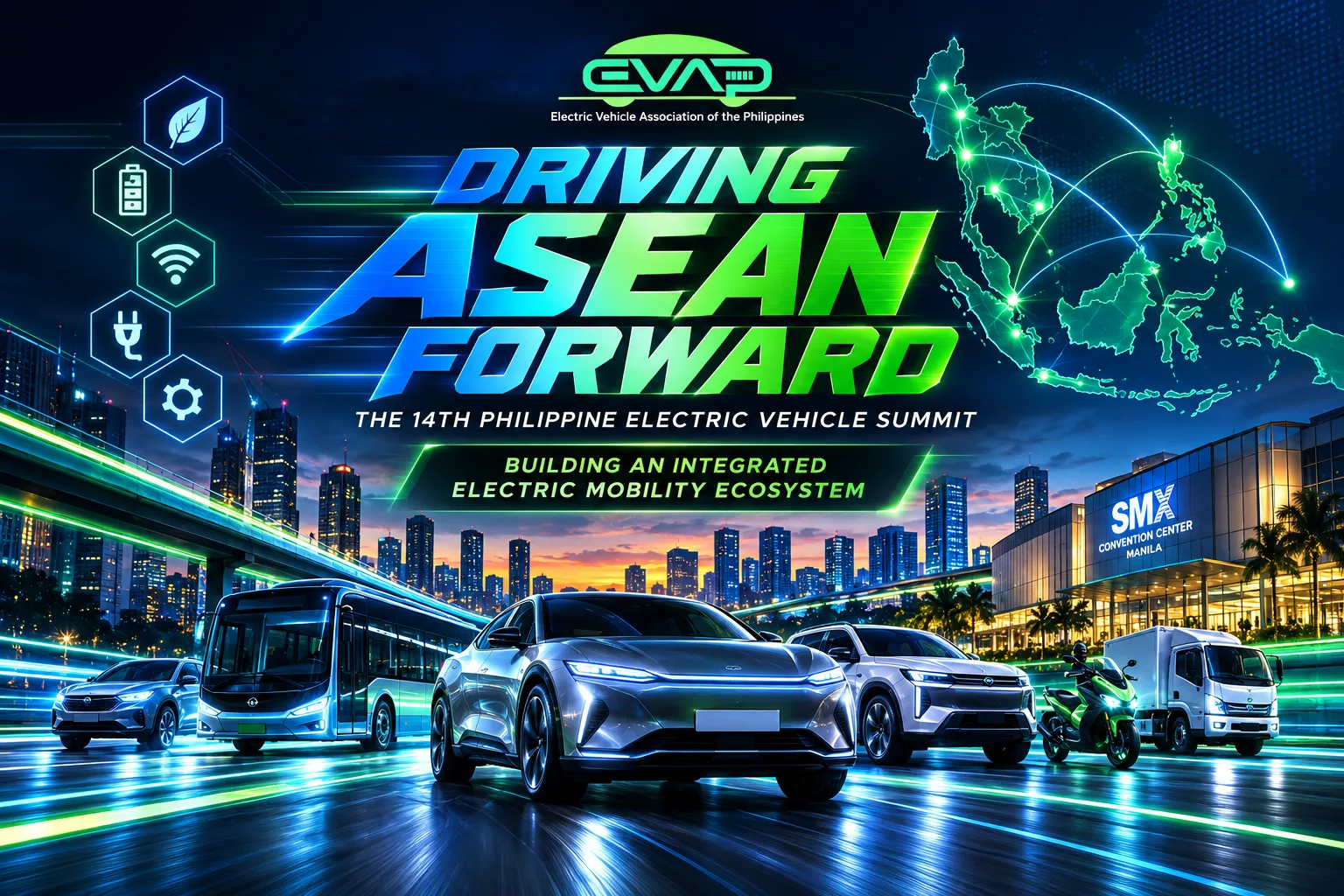
The Philippines is taking another step toward a more electrified automotive future as the 14th Philippine Electric Vehicle Summit (PEVS) opens on October 22, 2026, at the SMX Convention Center in Pasay City. Running until October 24, the three-day event brings together automotive manufacturers, charging infrastructure providers, government representatives, energy companies, industry experts, and consumers to explore the opportunities and challenges surrounding electric mobility. Organized by the Electric Vehicle Association of the Philippines (EVAP), this year's summit carries the theme "Driving ASEAN Forward: Building an Integrated Electric Mobility Ecosystem." The theme reflects a growing recognition that electric mobility involves more than introducing new vehicles. It requires an interconnected network of infrastructure, policies, services, and technologies capable of supporting motorists throughout their ownership experience.
The event arrives at a particularly interesting time for the Philippine automotive industry. Electric vehicles, conventional hybrids, and plug-in hybrids are becoming increasingly visible in showrooms and on local roads. Manufacturers are expanding their electrified lineups, offering Filipino buyers more choices across different vehicle segments and price ranges. Yet greater availability does not automatically mean the country is fully prepared for widespread electrification. While technological advancements are making electric vehicles more capable and appealing, important questions remain about charging accessibility, long-term ownership costs, technical support, and the practical realities of driving in the Philippines. The summit therefore presents an opportunity to examine not only how far the local EV industry has progressed, but also what must happen next.
Electric Vehicle Adoption Gains Momentum in the Philippines
The Philippine automotive market is experiencing a noticeable shift as more motorists explore alternatives to traditional gasoline and diesel-powered vehicles. According to figures reported by the Department of Energy (DOE), approximately 66,685 electrified vehicles were sold nationwide between January and August 2026, representing around 24.7% of the estimated vehicle market during the same period.
The reported figures show the following breakdown:
Plug-in hybrid electric vehicles (PHEVs): 29,649 units
Hybrid electric vehicles (HEVs): 20,716 units
Battery-electric vehicles (BEVs): 16,320 units
These numbers suggest that Filipino motorists are increasingly considering electrified transportation, although their preferences extend beyond fully electric vehicles. The relatively strong presence of plug-in hybrids and conventional hybrids is particularly noteworthy. Both technologies offer ways to reduce gasoline consumption while retaining the flexibility of an internal combustion engine. For many consumers, that flexibility remains relevant because driving requirements differ considerably across the country. A motorist who primarily travels within Metro Manila may have very different priorities from someone who regularly drives between provinces or visits locations where charging facilities are limited. Vehicle price, fuel efficiency, charging convenience, passenger capacity, and long-distance usability can all influence purchasing decisions.
From my perspective, the growing diversity of electrified vehicle sales reflects a practical approach among Filipino buyers. Rather than treating electrification as an immediate transition from gasoline to fully electric transportation, many motorists appear to be choosing technologies that suit their existing driving habits and circumstances. This is an important distinction because the growth of electrified vehicle sales does not necessarily translate directly into the same level of readiness for battery-electric vehicle ownership. Conventional hybrids do not require external charging, while plug-in hybrids can continue operating with gasoline when their rechargeable batteries are depleted. Fully electric vehicles, however, depend on access to electricity for continued operation. Understanding these differences is essential when evaluating the country's progress toward electric mobility.
Beyond the Vehicles: What the 2026 Philippine EV Summit Offers
The Philippine Electric Vehicle Summit provides a platform for manufacturers and industry stakeholders to showcase developments in electrified transportation. Visitors can expect a broad selection of vehicles, including compact electric cars, family-oriented SUVs, premium electric models, commercial vehicles, and electric motorcycles. Among the automotive and mobility brands announced ahead of the event are BYD, Toyota, Nissan, Kia, MG, Geely, Zeekr, Deepal, MINI, Lotus, Changan, AVATR, Dongfeng, Forland, NWOW, and NXT. The participation of established manufacturers alongside newer brands illustrates how the competitive landscape is changing. Traditional automotive characteristics such as styling, performance, comfort, and fuel efficiency remain important, but electrified vehicles introduce additional considerations. Battery capacity, electric driving range, charging performance, energy management systems, software integration, and connected vehicle technologies are becoming increasingly relevant to consumers. For manufacturers, these developments create opportunities to differentiate their products and demonstrate how electrification can improve transportation. For prospective buyers, the summit offers an opportunity to compare different technologies and gain a better understanding of their potential advantages and limitations.
However, advertised specifications should always be considered alongside real-world operating conditions. A vehicle's electric driving range, for example, can vary depending on speed, traffic, terrain, temperature, air-conditioning demand, and driving behavior. Similarly, charging performance depends on both the vehicle's capabilities and the charging equipment being used. A large battery or an impressive maximum charging figure does not necessarily guarantee a more convenient ownership experience for every motorist.
I believe the greatest value of an event like the Philippine EV Summit is its ability to connect technological innovation with practical consumer understanding. The opportunity to examine different vehicles, learn about their operating requirements, and discuss ownership considerations can help buyers make more informed decisions. Beyond the displays, the summit also provides a setting for conversations about industry development, charging networks, energy planning, and the future direction of electric mobility in the Philippines. These discussions are particularly relevant as the country moves from the early stages of EV adoption toward a market that must support a growing number of vehicles over the long term.
Charging Infrastructure: Progress, but Important Challenges Remain
Charging infrastructure remains one of the most important considerations in the expansion of fully electric transportation. According to the Department of Energy, the Philippines had 1,876 registered electric vehicle charging stations nationwide as of the end of August 2026. This is an encouraging indication that charging infrastructure is developing alongside the increasing availability of electrified vehicles. However, the number of registered stations alone does not fully describe how accessible or dependable the charging network is for motorists. A functional charging ecosystem depends on several factors, including geographic coverage, operating reliability, connector compatibility, charging speed, payment convenience, and transparent electricity pricing. A charging station located inside a major commercial establishment may be useful for nearby residents and shoppers. However, motorists traveling between provinces need dependable facilities along highways and regional routes. This is especially important in the Philippines, where journeys can involve considerable distances between urban centers and where charging availability may differ significantly from one location to another. For a battery-electric vehicle owner, planning a long-distance trip involves more than checking the distance to the destination. Drivers must also consider where they can recharge, whether the available equipment is compatible with their vehicle, how long charging may take, and whether a station is operational or occupied upon arrival.
Charging Speed and Reliability in Real-World Conditions
Charging performance deserves particular attention because advertised charging capabilities do not always reflect the actual experience. Not every electric vehicle can accept the maximum power output offered by a public fast charger. The charging rate may also change depending on battery temperature, state of charge, vehicle limitations, and battery management settings. As a result, two vehicles connected to similar charging equipment may experience different charging times. Reliability is equally important. A charging station provides limited value if motorists arrive to find that the equipment is malfunctioning, unavailable, or incompatible with their vehicles. Regular maintenance, accurate station information, responsive customer support, and convenient payment systems can therefore be just as important as installing additional equipment. Real-time information about charger availability and operating status would also help drivers plan their journeys with greater confidence. From my perspective, the success of charging infrastructure should be measured not simply by the number of stations installed, but by how consistently those facilities meet the needs of motorists.
Residential Charging: A Different Kind of Challenge
Public charging facilities are only one part of the equation. For many EV owners, charging at home can provide the greatest convenience, particularly when a vehicle can be recharged overnight while it is parked. However, this arrangement is not equally accessible to everyone. Motorists living in condominiums, apartments, rental properties, or residential developments with shared parking facilities may face additional challenges when installing charging equipment. These can include obtaining property management approval, evaluating electrical capacity, installing dedicated wiring or metering, and complying with applicable safety requirements. Some residents may not have assigned parking spaces suitable for charging installations. This creates a potential barrier for consumers who are interested in purchasing a fully electric vehicle but lack a practical place to recharge it regularly. Property developers and building administrators will therefore have an increasingly important role in supporting residential charging. New developments may benefit from incorporating EV-ready electrical provisions during construction, while existing buildings may require carefully planned upgrades. For the Philippines, improving residential charging access could be particularly significant because it would make electric vehicle ownership more practical for motorists who cannot depend entirely on public charging stations. Ultimately, the country's charging network must develop in ways that reflect how Filipinos actually live and travel.
The Growing Role of Plug-In Hybrids in the Philippine Market
As the country expands its electrified vehicle market, plug-in hybrid electric vehicles are attracting attention as an alternative for motorists who want electric driving capability without relying exclusively on charging infrastructure. A plug-in hybrid combines an internal combustion engine with an electric motor and a rechargeable high-voltage battery. Unlike a conventional hybrid, which generally uses a smaller battery recharged through the vehicle's own systems, a PHEV can be connected to an external electricity source. This allows many plug-in hybrids to travel on electric power during shorter journeys while retaining gasoline capability when additional range is required. For Filipino motorists, this arrangement can be useful when daily driving patterns are relatively predictable but occasional long-distance trips are unavoidable. A driver with convenient home charging may be able to complete a significant portion of regular commuting on electric power, depending on the vehicle's available electric range. When traveling to provincial destinations where public charging is limited, the gasoline engine provides an additional source of propulsion. This flexibility is one reason plug-in hybrids may remain relevant during the country's transition toward greater electrification.
The Benefits Depend on How the Vehicle Is Used
Although plug-in hybrids offer the potential for reduced gasoline consumption, their efficiency depends heavily on ownership habits. Motorists who recharge regularly and make effective use of the available electric range may achieve considerable fuel savings during daily driving. Those who rarely plug in their vehicles may experience different results, especially when the vehicle operates primarily using its gasoline engine. Battery size, vehicle weight, driving conditions, and the design of the hybrid powertrain can also influence overall efficiency. This means purchasing a plug-in hybrid does not automatically guarantee the lowest possible fuel consumption. The technology works best when its operating characteristics match the owner's driving patterns and charging opportunities. There are also maintenance considerations. A plug-in hybrid contains both combustion-engine and high-voltage electric propulsion components. Although the engine may operate less frequently during electric driving, it still requires appropriate servicing. The battery, electric motor, power electronics, and charging system also require qualified technical support when necessary. Another characteristic buyers should understand is how the vehicle manages its battery. Some PHEVs reserve a portion of their battery capacity for hybrid operation and may automatically activate their gasoline engines before the displayed charge reaches zero. Actual electric range can also differ from advertised figures because of road conditions, temperature, driving speed, and energy consumption. These characteristics highlight the importance of understanding a vehicle's operating system rather than evaluating it solely through published specifications.
Different Technologies for Different Driving Requirements
The choice between a conventional hybrid, plug-in hybrid, and fully electric vehicle should not be reduced to a simple comparison of which technology is more advanced. Each offers a different ownership proposition. A battery-electric vehicle may be particularly convenient for motorists with reliable home charging and predictable driving requirements. A plug-in hybrid may appeal to drivers who want to use electricity for routine journeys while retaining gasoline capability for longer trips. A conventional hybrid may suit consumers seeking improved fuel efficiency without the need for external charging. None of these options is automatically ideal for every household. Purchase price, energy costs, maintenance requirements, driving distances, available charging facilities, and long-term ownership expectations all deserve consideration.
In my view, the most appropriate electrified vehicle is not necessarily the one with the most advanced technology, but the one that best matches how its owner actually drives. Plug-in hybrids may therefore serve as a practical bridge for some Filipino motorists while charging infrastructure continues to develop. At the same time, it is important to recognize that PHEVs still produce tailpipe emissions whenever their gasoline engines operate. Their environmental and fuel-saving benefits depend partly on how frequently they are charged and driven electrically. A balanced understanding of these advantages and limitations will help consumers determine whether the technology genuinely meets their needs.
Building a Sustainable EV Ecosystem Requires More Than Automakers
The future of electric mobility in the Philippines will depend on cooperation across industries. Automotive manufacturers play a central role by developing vehicles, introducing new technologies, and providing warranties and after-sales services. However, other sectors are equally important in establishing an environment where electrified vehicles can be owned and operated confidently. Electricity providers must consider the increasing demand associated with vehicle charging. Infrastructure operators need to plan for capacity, equipment maintenance, and future expansion. Financial institutions, insurance providers, property developers, technical training organizations, and government agencies must also adapt to the changing requirements of the automotive industry. A successful EV ecosystem therefore involves much more than vehicle availability.
Financing, Insurance, and Long-Term Ownership Costs
Affordability remains an important consideration for Filipino consumers. Although some electrified vehicles can offer lower energy expenses or reduced maintenance requirements in certain operating conditions, their initial purchase prices may still represent a significant financial commitment. Banks and financing institutions can contribute by offering products suited to the characteristics of electrified vehicles. Insurance providers also need to account for specialized components such as high-voltage batteries, charging systems, and electric drivetrains. For buyers, understanding the scope of insurance coverage is essential. Battery-related damage, flood exposure, collision repairs, and access to qualified service facilities may influence both insurance premiums and potential repair costs. Long-term vehicle value also deserves attention. As electric vehicle technology evolves, consumers may have questions about battery durability, warranty coverage, replacement expenses, software support, and resale value. Clear information from manufacturers and service providers can help motorists evaluate these considerations before purchasing. I believe affordability should be assessed beyond the showroom price. The total cost of ownership including energy, maintenance, insurance, potential repairs, and long-term support is a more meaningful basis for evaluating whether an electrified vehicle represents good value.
Technical Training and After-Sales Support
The increasing presence of electric and plug-in hybrid vehicles creates new requirements for the automotive service industry. High-voltage batteries, electric motors, power electronics, and specialized vehicle control systems require appropriate diagnostic equipment and technical expertise. Servicing these components also involves safety procedures that differ from those used for many conventional vehicle systems. Automotive technicians must receive suitable training, while dealerships and independent service facilities need access to proper tools, replacement components, and manufacturer-approved information. Technical schools and automotive training institutions can contribute by developing programs that prepare workers for these emerging requirements. Long-term service accessibility will become increasingly important as the country's electrified vehicle fleet ages. A vehicle that performs well during its first few years of ownership may eventually require specialized repairs or replacement components. Consumers will naturally want to know whether qualified technicians and dependable after-sales services will remain available throughout the vehicle's useful life. For manufacturers, establishing a strong support network is therefore an important part of building lasting consumer confidence.
Government Policies and Industry Coordination
The Philippine government has established a framework for electric mobility through Republic Act No. 11697, or the Electric Vehicle Industry Development Act (EVIDA), and the Comprehensive Roadmap for the Electric Vehicle Industry (CREVI). These initiatives provide a foundation for supporting EV adoption, infrastructure development, and broader industry coordination. However, their effectiveness will ultimately depend on implementation and the practical improvements experienced by consumers. Local government units have roles in facilitating appropriate infrastructure development and coordinating applicable permits and safety requirements. National agencies are responsible for various aspects of energy planning, industry development, standards, and regulatory oversight. Emergency preparedness is another important consideration. Firefighters, rescue personnel, towing operators, and other responders may encounter damaged electric vehicles or high-voltage battery systems during emergencies. Appropriate training and response procedures are necessary to manage these situations safely. As adoption expands, coordination among public agencies, automotive companies, utilities, and technical organizations will become increasingly important. The goal should be to establish a transportation ecosystem that can support electrified vehicles throughout their operating lives, rather than focusing exclusively on encouraging initial purchases.
Final Thoughts: The Real Measure of Electric Mobility Progress
The 14th Philippine Electric Vehicle Summit arrives at an important moment for the country's automotive industry. Electric and electrified vehicles are no longer technologies discussed only by enthusiasts or early adopters. They are becoming increasingly realistic options for Filipino motorists, supported by a growing selection of models and greater industry participation. The progress is encouraging, but the next stage of development will require the industry to move beyond vehicle launches and impressive technical specifications. The priorities must increasingly include dependable charging infrastructure, accessible ownership solutions, qualified technical support, transparent information, and policies that translate into practical benefits.
I also believe the Philippine market should be allowed to develop according to its own transportation requirements. Our roads, residential environments, travel patterns, and infrastructure conditions are not identical to those of other countries. The transition toward electrification must recognize these differences rather than assume that a single technology or adoption strategy will work equally well for everyone. For me, the real measure of progress will not simply be how many electric vehicles are displayed at an exhibition or sold during a particular year. It will be how confidently an ordinary Filipino motorist can purchase an electrified vehicle, understand its capabilities, maintain it over the long term, and travel without unnecessary uncertainty about the support available along the way. That is where the next chapter of electric mobility in the Philippines will ultimately be decided. The future is not just about putting more electric vehicles on Philippine roads. It is about making electric mobility practical, dependable, and accessible for the people who use them every day.
Sources References
Philippine EV Summit - Official Event Website - dates, venue, event theme and focus areas.
Department of Energy - EV Adoption Report, September 23, 2026 - sales figures, vehicle classifications and charging stations.
Top Gear Philippines - EV Summit Preview - participating brands and owner community.
SMX Convention Center - Event Listing - venue and schedule.


Comments
No comments yet. Be the first to join the discussion.