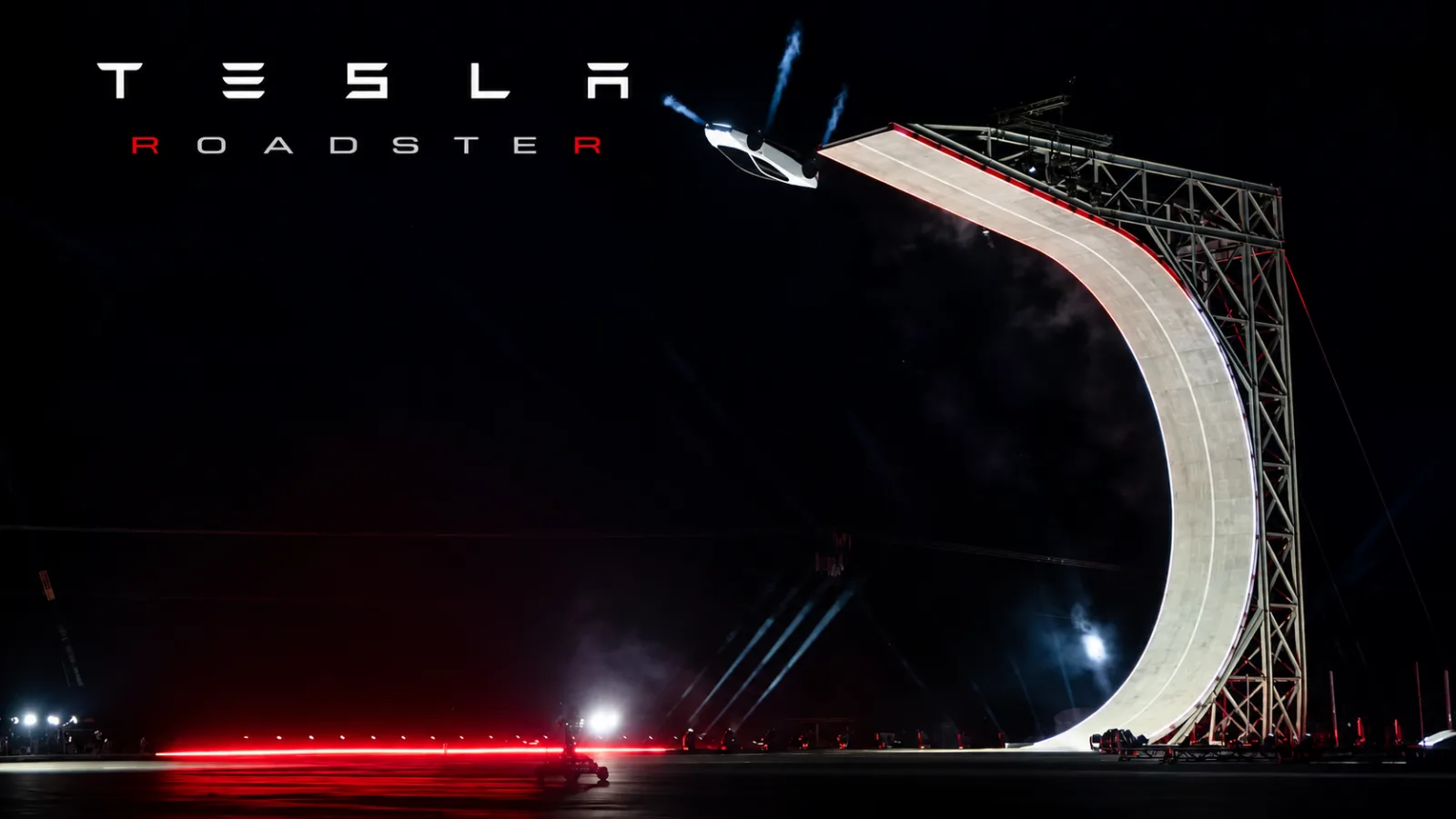
While much of the automotive industry remains focused on extending electric driving range, improving charging times, and fitting increasingly larger screens into vehicle interiors, I find it fascinating that Elon Musk continues to approach the electric car from an entirely different direction. For Musk, building a faster electric vehicle apparently isn't enough. He seems determined to challenge the very limits of what a road-going machine can achieve, even if that means borrowing ideas from aerospace engineering. The next-generation Tesla Roadster is perhaps the clearest example of that ambition. With an extraordinary acceleration target of less than one second from 0 to 60 mph under a proposed SpaceX-assisted configuration, and earlier claims of a top speed exceeding 400 km/h, the Roadster sounds less like a conventional electric supercar and more like an engineering experiment that somehow found its way onto public roads. What particularly captures my attention isn't simply the acceleration figure. It's the possibility of combining electric motors, advanced battery technology, and rocket-inspired propulsion systems in a single vehicle. Think about that for a moment. We're no longer discussing how quickly an electric car can accelerate using its wheels alone. We're talking about a machine that could potentially use additional thrust to achieve performance beyond what conventional tire traction normally allows. Of course, there's a significant difference between making an extraordinary promise and delivering a production vehicle capable of fulfilling it. Still, I believe the Roadster represents something interesting about Tesla's approach to innovation. While traditional performance manufacturers refine horsepower, aerodynamics, and handling, Musk appears willing to question whether the established rules of supercar engineering should apply at all. Whether that approach ultimately produces a revolutionary vehicle or remains an ambitious technological demonstration is something the automotive world is still waiting to discover.
A Roadster That Defies Conventional Thinking
When I look back at the original Tesla Roadster, I see a vehicle that helped change how people perceived electric cars. At a time when EVs were largely associated with efficiency and environmental benefits, Tesla demonstrated that electric propulsion could also deliver genuine excitement and impressive performance. Then came the second-generation Roadster concept in 2017, accompanied by promises of extraordinary acceleration, remarkable driving range, and performance figures that could challenge some of the world's most expensive supercars. I must admit, those claims sounded almost too ambitious at the time. And as the years passed without a production model reaching customers, it became increasingly reasonable to question whether Tesla could actually deliver on those promises. Fast-forward to October 2026, and the latest unveiling has certainly given us something new to talk about. What caught my attention wasn't simply the Roadster's futuristic appearance or its acceleration figures. It was the way Tesla appeared to move beyond the traditional concept of how a car should generate performance. We have become accustomed to manufacturers competing over horsepower, torque, aerodynamics, and traction. But Tesla seems interested in exploring something entirely different: what happens when you combine electric propulsion with technology inspired by spacecraft? Watching the Roadster climb a specially constructed curved ramp, remain attached as the surface turned upside down, and then use integrated thrusters to perform an airborne maneuver was certainly unusual. Another demonstration reportedly showed the vehicle jumping over a lineup of Tesla cars. I find the engineering behind these demonstrations fascinating. It challenges the familiar idea that a performance car must rely entirely on the interaction between its tires and the road. But I also think we need to keep these achievements in perspective. These were carefully controlled demonstrations involving prototype technology. They don't necessarily mean future Roadster owners will be able to perform similar maneuvers on public roads, nor do they establish how practical or reliable these systems will be in everyday conditions.
A Roadster That Defies Conventional Thinking
Looking back at the original Tesla Roadster, I think it deserves recognition for helping change the perception of electric vehicles. Before Tesla entered the performance car conversation, EVs were often viewed primarily as practical, environmentally friendly alternatives to gasoline-powered cars. The Roadster helped demonstrate that electric vehicles could also be exciting, powerful, and genuinely fun to drive. When Tesla introduced the second-generation Roadster concept in 2017, the company promised something even more ambitious. Extraordinary acceleration, impressive driving range, and performance capable of competing with some of the world's fastest supercars certainly attracted attention. But as the years went by without a production model reaching customers, I began to wonder whether Tesla had simply promised too much. After all, announcing impressive performance figures is one thing; turning those numbers into a reliable production vehicle is another. The October 2026 unveiling, however, brought an entirely different dimension to the Roadster story. What impressed me wasn't necessarily the vehicle's design or its claimed acceleration. It was Tesla's willingness to explore performance beyond the traditional limitations of electric motors and tire traction. Seeing the Roadster climb a specially constructed curved ramp, remain attached as the surface turned upside down, and then perform an airborne maneuver using integrated thrusters was something I never expected to see from a road-going electric sports car. Another demonstration reportedly involved the vehicle jumping over a lineup of Tesla vehicles. To me, these demonstrations suggest that Musk isn't merely interested in building a faster electric supercar. He seems determined to explore what happens when automotive engineering meets aerospace technology. Of course, I wouldn't interpret these demonstrations as proof that future Roadster owners will be able to perform similar stunts on public roads. These were controlled experiments involving prototype technology, and there are still important questions about safety, reliability, and practicality. Nevertheless, I find this direction of development particularly interesting. While most manufacturers continue improving performance through more powerful motors, better batteries, and sophisticated aerodynamics, Tesla is experimenting with additional ways of generating force and controlling vehicle movement. Whether these ideas eventually become practical features or remain limited to specialized demonstrations, I believe they represent an interesting departure from conventional automotive thinking. For me, the Roadster is becoming more than a story about acceleration and top speed. It is also a reminder that some of the most fascinating developments in automotive technology begin when engineers are willing to challenge what we normally expect a car to do.
The Secret Behind Driving Upside Down
Of all the extraordinary things demonstrated during the Tesla Roadster unveiling, I have to say that watching a car drive upside down caught my attention even more than its incredible acceleration claims. We've seen supercars achieve remarkable speeds, and we're already familiar with electric vehicles delivering instant torque and breathtaking acceleration. But seeing a car remain attached to an inverted surface makes you wonder just how far automotive engineering can go. Naturally, my first question was: how exactly does Tesla manage to keep a car attached to the road when gravity is trying to pull it in the opposite direction? The answer appears to lie in an advanced aerodynamic system that uses powerful fans and ground sealing to create substantial suction beneath the vehicle. In conventional performance cars, aerodynamic downforce generally increases as the vehicle travels faster. Air flowing around the body, wings, and underbody helps push the tires against the road, improving grip and stability. Tesla's approach is particularly interesting because its proposed system doesn't depend entirely on vehicle speed. By actively removing air from beneath the chassis, the system creates a pressure difference between the underside of the car and the surrounding atmosphere. That difference generates a force pulling the vehicle toward the surface beneath it. In simple terms, imagine a powerful vacuum system helping hold the car against the road. If that force becomes strong enough to overcome the vehicle's weight, remaining attached to an upside-down surface becomes theoretically possible. What fascinates me is that this technology could potentially offer benefits beyond performing spectacular demonstrations. Imagine a performance car capable of generating substantial downforce even at relatively low speeds. In theory, that could improve traction during acceleration, enhance cornering stability, and give engineers greater control over how the vehicle interacts with the road. However, I also see some important questions that Tesla will eventually need to answer. The demonstration took place on a specially prepared surface under controlled conditions. Real-world roads are far less predictable. We encounter uneven pavement, potholes, standing water, loose gravel, and debris almost every day. How effectively would such a system maintain its suction under those conditions? What happens if the ground seal is interrupted? And how much energy would the fans consume during continuous operation? These are practical engineering considerations that cannot be answered by an impressive demonstration alone. Still, I find the concept genuinely fascinating. It reminds me that automotive innovation doesn't always have to revolve around adding horsepower or increasing battery capacity. Sometimes, a different approach to an existing engineering problem can open possibilities that previously seemed unrealistic. For me, the Roadster's upside-down demonstration is less about proving that cars should drive on ceilings and more about showing what becomes possible when engineers rethink how a vehicle generates grip.
Acceleration Beyond the Limits of Tire Grip
When Tesla first announced the second-generation Roadster back in 2017, its acceleration claims were already difficult to imagine. But the latest demonstration has taken those ambitions to an entirely different level. According to Tesla, its prototype managed to accelerate from 0 to 60 mph (approximately 96.6 km/h) in just 0.81 seconds. I have to admit, that number is almost difficult to comprehend. We're talking about reaching highway speeds in less time than it takes most people to react to something happening in front of them. To appreciate how extraordinary that is, we need to understand one of the fundamental limitations of conventional performance cars: tire grip. Regardless of how powerful an engine or electric motor becomes, the vehicle still needs to transfer that power to the road through its tires. Even the most advanced all-wheel-drive systems, sophisticated traction controls, and specially developed performance tires have physical limitations. Push beyond those limits, and the tires begin losing traction. This is where Tesla's approach becomes particularly interesting to me. Instead of relying entirely on electric motors to deliver acceleration, the Roadster's proposed thruster-assisted system introduces an additional source of forward force. By releasing compressed gas through strategically positioned nozzles, the vehicle can generate thrust independently of the tires. In theory, this allows the Roadster to achieve acceleration that would be extremely difficult for a conventional wheel-driven vehicle to reproduce. Tesla has outlined several versions of the new Roadster, beginning with the road-oriented Performance model, followed by the more extreme Thrust configuration and an invitation-only Rocket variant. The Thrust version is intended to achieve 0–60 mph in less than one second, while the Rocket variant takes the concept further by incorporating additional propulsion capabilities designed for controlled airborne maneuvers. Personally, I find the engineering concept fascinating. For decades, manufacturers have competed to extract more horsepower, improve power delivery, and maximize tire traction. Tesla is now exploring whether an additional propulsion system could overcome some of those traditional limitations. However, I also believe there is a significant difference between achieving an extraordinary acceleration figure during a controlled demonstration and delivering that performance consistently in a production vehicle. The reported 0.81-second result remains a manufacturer-reported prototype achievement, not an independently certified production-car record. We also need to consider how the system performs repeatedly, how quickly its compressed-gas supply can be replenished, and what safety measures would be required to manage such extreme acceleration. There is also the question of practicality. Even if a car can reach 60 mph in less than a second, how useful would that capability actually be outside a controlled environment? For most drivers, including enthusiasts, such acceleration would be far beyond anything needed for everyday driving. Still, I don't think the Roadster should be judged purely by its practical usefulness. In many ways, it appears to be an engineering experiment designed to explore the outer limits of electric vehicle performance. And that, to me, is what makes this development worth following.
How Fast Will the New Tesla Roadster Go?
Acceleration is one thing, but top speed is another area where Tesla is making some very ambitious claims. According to Tesla, the new Roadster is being developed to exceed 230 mph, or approximately 370 km/h. That's an extraordinary figure, placing it in the same performance territory as some of the world's most exotic supercars. Personally, I've always found top-speed figures fascinating, especially when manufacturers attempt to push beyond what most production vehicles can achieve. But I also believe that reaching an impressive number on a speedometer is only one part of building a truly capable high-performance car. At speeds approaching 370 km/h, almost every aspect of vehicle engineering becomes critical. Aerodynamic stability, tire durability, braking performance, suspension behavior, and battery temperature management all become major considerations. Even relatively small changes in airflow or road conditions can have significant consequences when a vehicle is traveling that fast. And this is where I think the Roadster faces one of its most interesting engineering challenges. Tesla isn't simply developing a powerful electric drivetrain. The company is also experimenting with active aerodynamic systems intended to manage airflow and generate additional downforce. In theory, these technologies could help improve stability and traction at extreme speeds. However, generating downforce is not without its compromises. Additional aerodynamic resistance can affect efficiency, energy consumption, and ultimately how fast a vehicle can travel. Finding the right balance between speed, stability, and efficiency will be essential. Another area I'm particularly curious about is the battery. When Tesla first introduced the second-generation Roadster concept in 2017, the company spoke about an extraordinary driving range that seemed almost unbelievable for an electric sports car at the time. But battery technology, vehicle development priorities, and performance expectations have changed considerably since then. I would be interested to see how Tesla balances the Roadster's extreme performance ambitions with practical considerations such as battery capacity, vehicle weight, charging capability, and real-world driving range. After all, delivering tremendous acceleration is impressive, but maintaining performance without excessive heat buildup or rapid energy depletion presents a different engineering challenge. For now, Tesla has not provided independently validated final production specifications covering all these areas. The claimed top speed and other performance targets therefore remain promises that will need to be demonstrated under proper testing conditions. And considering how long enthusiasts have already waited for the second-generation Roadster, I think it's reasonable to approach those numbers with both excitement and a degree of caution. What interests me most isn't whether Tesla can produce a car capable of briefly touching 370 km/h. It's whether the company can build a complete performance machine that remains stable, predictable, and technically capable when operating near its limits.
Three Configurations, Three Different Levels of Ambition
One thing I find particularly interesting about the new Tesla Roadster is that Tesla isn't approaching it as a single performance package. Instead, the company has outlined three different configurations, each representing a different level of engineering ambition. And looking at what Tesla is proposing, I think the differences go well beyond the usual approach of offering more horsepower or additional performance features. The starting point is the performance configuration, which appears to be the most conventional version of the Roadster, at least by Tesla's standards. It is intended to deliver extraordinary electric acceleration while incorporating advanced aerodynamic technology to improve traction and vehicle stability. Personally, I think this version could be the most interesting from an actual driving perspective. After all, a powerful electric sports car with sophisticated aerodynamics and well-developed handling characteristics is already an exciting proposition, even without additional propulsion systems. Then there's the thrust configuration, where things begin to move into unfamiliar territory. This version introduces rear-mounted cold-gas thrusters designed to provide additional forward propulsion beyond what the electric motors can deliver through the tires alone. The idea of using compressed gas to help accelerate a road-going vehicle is certainly unusual. But from an engineering standpoint, I can understand why Tesla is exploring it. Tire traction has always been one of the limiting factors in extreme acceleration, and generating additional thrust offers a different way of approaching that problem. Tesla's ambition for this configuration is to achieve 0–60 mph in less than one second, a figure that would be remarkable if consistently reproduced in a finished production vehicle. But the configuration that really pushes the boundaries of conventional automotive thinking is the Rocket variant. Described as an invitation-only version, it incorporates additional thrusters capable of generating forces in multiple directions. This is the configuration associated with the extraordinary airborne maneuvers demonstrated during the Roadster unveiling. I have to admit, this is where the Roadster begins to feel less like a traditional sports car and more like an experimental aerospace project with four wheels. However, there is an important distinction that I believe deserves attention. Tesla identifies the Rocket configuration as unsuitable for public-road use. That means the most spectacular capabilities demonstrated during the unveiling should not be interpreted as features that ordinary Roadster owners will necessarily be able to experience on public highways. And frankly, that distinction makes sense to me. There is a significant difference between developing technology for a controlled demonstration and engineering a vehicle that must operate safely alongside ordinary traffic, pedestrians, and other road users. What I appreciate about these three configurations is that they illustrate different directions Tesla could take with the Roadster. One focuses on extreme electric performance, another explores propulsion beyond tire traction, and the most ambitious version pushes into experimental vehicle movement. Of course, final production specifications, availability, and the practical limitations of each configuration still need to be established. For me, the most exciting version isn't automatically the one capable of performing the most spectacular stunt. I'm equally interested in seeing how much of this technology Tesla can successfully translate into a reliable, usable performance car.
Production Targeted for 2028: The Long Wait Continues
As exciting as the new Tesla Roadster looks, there is one important detail that I think we shouldn't overlook: after all these years, customers still cannot actually take one home. Elon Musk has indicated that production is now expected to begin in 2028. If Tesla manages to meet that target, it will be more than a decade since the second-generation Roadster was first introduced in 2017. That's quite a long time to wait for a sports car, especially one that generated so much excitement when it was originally announced. I still remember how ambitious Tesla's initial promises sounded. Extraordinary acceleration, remarkable driving range, and performance figures that seemed almost impossible for a production electric vehicle at the time. The original plan was to begin production in 2020, but that deadline came and went, followed by several more delays. To be fair, developing a vehicle with this level of technology is far from simple. And considering the aerospace-inspired systems Tesla is now experimenting with, I can understand why engineering, testing, and validation could take considerable time. The October 2026 unveiling at least gives us something more substantial than another announcement or computer-generated preview. Tesla has demonstrated a working prototype capable of performing some extraordinary maneuvers under controlled conditions. But I also believe there is a big difference between building an impressive prototype and establishing a production line capable of delivering finished vehicles to customers. Manufacturing consistency, component durability, safety certification, quality control, and long-term reliability are all challenges that must be addressed before a vehicle like this can enter production. Another detail I'm waiting to see is the final pricing. Tesla has yet to establish publicly confirmed prices for the complete Roadster lineup, particularly the more extreme configurations incorporating additional propulsion technology. While reservations are being accepted for certain versions, placing a deposit doesn't necessarily guarantee when a customer will receive a vehicle. And given the Roadster's history, I think prospective buyers have every reason to be cautious about delivery expectations. Personally, I would rather see Tesla take the time necessary to properly develop and validate the Roadster than rush an unfinished product into the market simply to meet another announced deadline. At the same time, I believe Tesla now has an opportunity to demonstrate that its ambitious engineering concepts can move beyond carefully staged presentations. The technology is fascinating, the performance targets are extraordinary, and the latest prototype has certainly renewed interest in the project. But the next major milestone shouldn't simply be another spectacular demonstration. It should be a production-ready vehicle with confirmed specifications, transparent testing results, and a realistic delivery schedule.
My Perspective: Innovation Is exciting, but execution matters
What fascinates me most about the new Tesla Roadster isn't really its extraordinary acceleration figures or even the spectacle of watching a car perform maneuvers that seem to belong in a science-fiction movie. It's the thinking behind the technology. For decades, automotive manufacturers have been pushing the limits of performance through increasingly powerful engines, sophisticated transmissions, improved suspension systems, and advanced aerodynamics. The arrival of electric vehicles has already changed much of that engineering landscape, introducing instant torque, precise motor control, and new possibilities for vehicle design. But Tesla seems determined to take things even further. Instead of simply asking how much faster an electric motor can make a car accelerate, Musk appears to be asking whether a vehicle must always depend entirely on its tires to generate the forces needed for acceleration and control. I find that way of thinking particularly interesting because it challenges something we've accepted as a fundamental part of automotive engineering for generations. At the same time, I don't believe that every unconventional idea automatically represents meaningful progress. As someone who follows automotive technology closely, I've learned to appreciate the difference between an impressive engineering demonstration and a vehicle that can consistently deliver its promised performance in the real world. A prototype performing extraordinary maneuvers under carefully controlled conditions is certainly exciting. But building a production car that is reliable, safe, predictable, and practical enough for its intended purpose is an entirely different challenge. And when we're talking about a machine potentially capable of reaching highway speeds in less than a second, those considerations become even more important. I'm particularly interested in how Tesla intends to manage the long-term durability of its propulsion systems, the reliability of its active aerodynamics, and the safety measures required to control such extreme forces. There is also the question of whether these technologies will offer meaningful advantages beyond demonstrating what is technically possible. I don't expect every innovation to immediately become useful in an ordinary passenger car. After all, some of the technologies we now take for granted began as expensive experiments in racing or high-performance engineering. But I do believe that the true value of innovation becomes clearer when it moves beyond the demonstration stage and proves itself through actual use. Tesla has certainly succeeded in attracting attention with the Roadster's unusual engineering approach. What remains to be seen is whether the company can translate that ambition into a finished vehicle that delivers the performance, refinement, and reliability buyers would reasonably expect.
Final Thoughts: Is the Tesla Roadster the Future of Electric Performance?
After looking at everything Tesla has demonstrated with the new Roadster, I can't help but appreciate just how unconventional this project has become. We've reached a point where electric vehicles are no longer struggling to prove that they can compete with traditional performance cars. In fact, some of today's most impressive acceleration figures already come from battery-powered machines. But with the Roadster, Tesla appears interested in exploring what comes next. The combination of powerful electric motors, active suction aerodynamics, and SpaceX-inspired compressed-gas thrusters suggests that the company is willing to experiment beyond the traditional boundaries of automotive engineering. And personally, I find that exciting. Not because I expect to see ordinary electric cars flying over traffic or driving upside down anytime soon, but because developments like these encourage engineers to think differently about problems that have existed for decades. Still, I believe we should be careful not to confuse technological ambition with a finished engineering achievement. Tesla has presented some extraordinary demonstrations, but there is still a considerable journey ahead before the Roadster becomes a production vehicle. With manufacturing currently targeted for 2028, questions surrounding final specifications, safety certification, road legality, reliability, and actual customer deliveries remain unanswered. And considering the Roadster's long history of delays, I think a healthy degree of skepticism is reasonable. What I would really like to see next is less emphasis on spectacular demonstrations and more evidence of production readiness, independent performance testing, and the practical engineering solutions that will make this technology usable. Because ultimately, a car doesn't become revolutionary simply by achieving an extraordinary number or performing something we've never seen before. Its real significance comes from proving that those innovations can deliver meaningful results beyond a controlled environment. For me, the Roadster's greatest contribution may not be whether it eventually becomes the fastest electric sports car in the world. It may be the way it challenges manufacturers, engineers, and enthusiasts to reconsider what an electric performance vehicle could become. Perhaps some of its technologies will remain exclusive to experimental machines. Perhaps others will eventually influence the development of future high-performance vehicles. At this stage, it's simply too early to know. But one thing is certain: Tesla has once again given the automotive world something unusual to discuss.
I admire the ambition behind the new Roadster, but I'll reserve my final judgment until Tesla delivers a production vehicle that proves these remarkable ideas can work in the real world. After all, imagination may inspire the next generation of automotive technology, but engineering execution is what ultimately turns that imagination into reality.

Comments
No comments yet. Be the first to join the discussion.