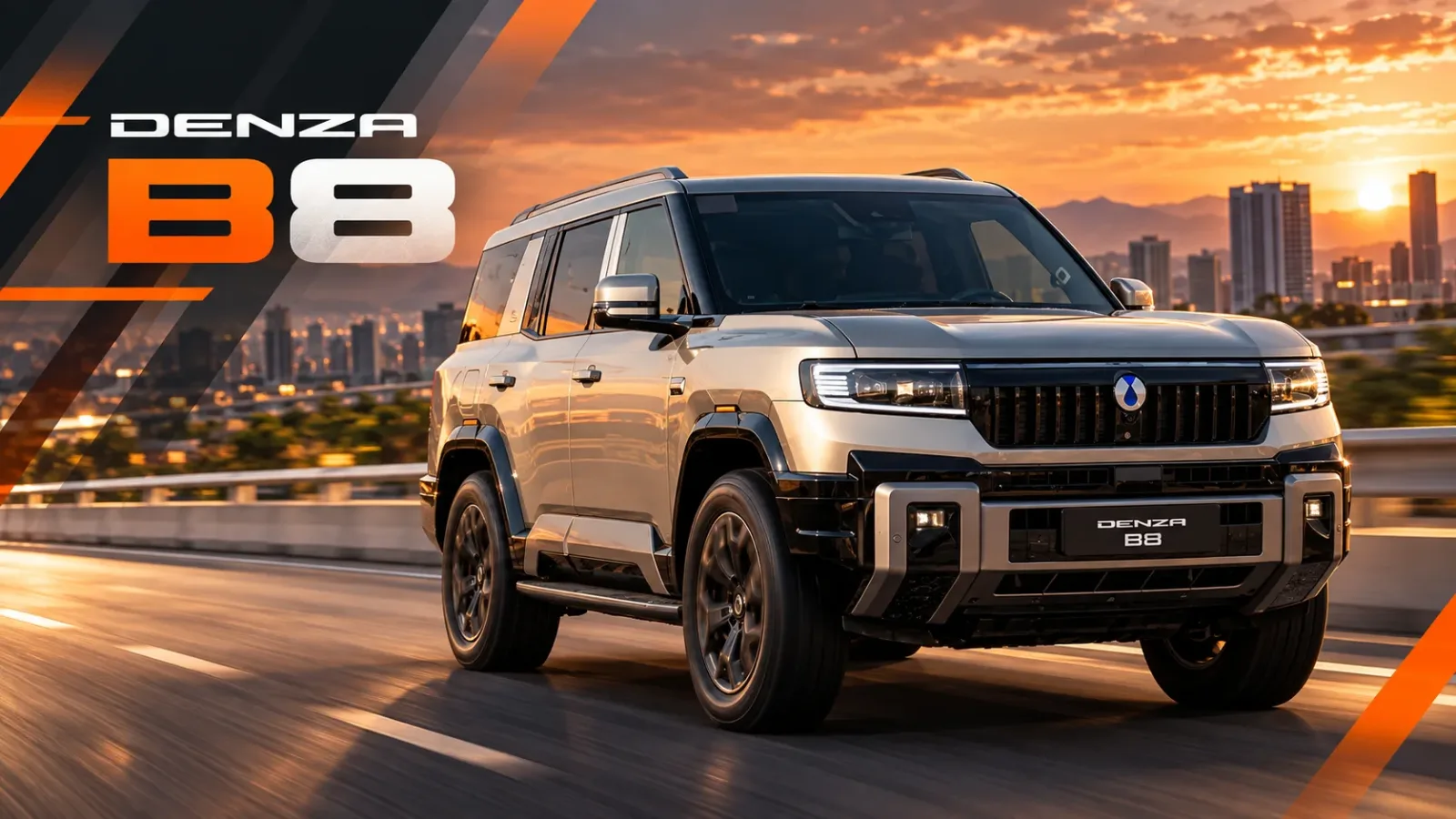
Can the DENZA B8 Justify Its ₱4.998M Price With Technology and Capability?
The DENZA B8 arrives in the Philippines at an interesting point in the evolution of the premium SUV. For decades, the formula for a large luxury off-roader was relatively predictable: a powerful gasoline or diesel engine, body-on-frame construction, four-wheel drive, substantial ground clearance and an interior designed to isolate passengers from whatever difficult terrain was underneath. The DENZA B8 keeps much of that traditional formula but changes what provides the power. Underneath its large, squared-off body is BYD Group's Dual-Mode Off-Road, or DMO, platform, combining a 2.0-liter turbocharged gasoline engine, dual electric motors, four-wheel drive and a 36.864-kWh Blade Battery. DENZA pairs that electrified drivetrain with body-on-frame construction and its sophisticated DiSus-P intelligent hydraulic suspension. The result is a vehicle that attempts to perform several very different jobs. It is a luxury family SUV. It is a plug-in hybrid capable of completing shorter journeys on battery power. It is a powerful high-performance vehicle. And underneath all that technology, it is designed to remain a genuinely capable off-roader. But with Philippine prices beginning at ₱4.998 million, impressive specifications alone aren't enough. The bigger question is whether all this technology makes the DENZA B8 a practical premium SUV for actual Philippine use.
DENZA, BYD Technology Moves Upmarket
Understanding the B8 first requires understanding DENZA. It operates as the premium automotive brand of BYD Group, and its Philippine expansion places the company in a very different market from mainstream BYD vehicles. The brand began establishing its Philippine presence in 2026, initially opening facilities in Alabang, Makati, Greenhills and Cebu. The B8 shows what that premium positioning means when applied to an off-road SUV. Rather than simply adding more leather and equipment to an existing crossover, DENZA has built the B8 around hardware specifically intended for large-SUV duties. And it is certainly large. The DENZA B8 measures 5,195 mm long, 1,994 mm wide and 1,905 mm tall, riding on a 2,920-mm wheelbase. Its official Philippine specification lists a substantial 3,305-kg curb weight and 3,947-kg gross vehicle mass. That places it firmly in full-size SUV territory. Its styling reflects that purpose. The upright body, high beltline, prominent wheel arches and rear-mounted spare tire give the B8 the appearance of a traditional expedition vehicle rather than an aerodynamic electric crossover. Underneath, however, the engineering is anything but traditional.
DENZA B8 Technical Specifications and DMO Hybrid Technology
The heart of the DENZA B8 PHEV is BYD's DMO or Dual-Mode Off-Road architecture. The Philippine B8 uses a 1.997-liter turbocharged gasoline engine, producing up to 180 kW and 380 Nm by itself, working alongside an EHS electric hybrid system and electric motors driving the vehicle's four-wheel-drive system. Combined system output is approximately 450 kW, or 603 hp, with 760 Nm of torque. Energy is stored in a 36.864-kWh BYD Blade Battery, using lithium iron phosphate chemistry. That battery is important because the B8 isn't merely using electricity to provide occasional assistance to its gasoline engine. It is a proper plug-in hybrid. DENZA's Philippine specifications quote up to 115 km of electric-only driving under the NEDC test cycle, while combined gasoline-and-electric range is listed at approximately 1,040 km NEDC. Those numbers require context.
NEDC is a laboratory testing procedure, and real-world range will vary with speed, traffic, terrain, weather, passenger load, air-conditioning use and driving style. Owners shouldn't assume that every fully charged B8 will reproduce the official figures. But the size of the battery changes how the vehicle can potentially be used. For an owner who has home charging and a relatively short daily commute, a significant portion of everyday driving could potentially be completed using electricity. When a longer journey begins, the gasoline engine and hybrid system remove the need to depend entirely on charging infrastructure. That is particularly relevant in a country where long-distance charging availability remains uneven outside major urban areas.
What Makes DMO Different?
The B8's electrification isn't only intended to reduce fuel consumption. The DMO platform was designed specifically around off-road vehicles. Electric motors offer engineers an important advantage in difficult terrain: extremely fast and precise control of torque. Instead of waiting for a conventional engine and transmission to respond before torque reaches the wheels, an electric motor can alter its output almost instantaneously. That can help when the available grip changes rapidly between individual wheels. The B8 combines that electrical control with a traditional body-on-frame architecture, creating an interesting mixture of mechanical toughness and software-controlled propulsion. DENZA describes the platform as combining electric refinement with genuine off-road capability. It also means that the B8 isn't simply a luxury crossover given aggressive styling. Its underlying engineering was developed with demanding terrain in mind.
DiSus-P; Suspension Becomes Part of the Technology
One of the B8's most interesting systems is not its engine or battery. It is the suspension. Both Philippine variants receive DiSus-P Intelligent Hydraulic Suspension with double-wishbone suspension architecture front and rear. DENZA says DiSus-P provides 140 mm of suspension travel and self-leveling capability. That allows the vehicle to alter its behavior according to conditions. On difficult terrain, suspension adjustment can provide additional clearance and wheel movement. During normal road use, the system can instead concentrate on stability and passenger comfort. Self-leveling becomes particularly useful when the vehicle is carrying passengers, luggage or a trailer because the suspension can compensate for the additional load. DENZA also rates the B8 for up to 3.5 tonnes of towing capacity, with the DiSus-P system providing integrated self-leveling. For buyers interested in towing boats, trailers or recreational equipment, that may prove considerably more useful than the headline acceleration figure.
Built to Leave the Pavement
The B8's off-road engineering goes considerably further than adjustable suspension. Four-wheel drive comes standard, while the Premium variant adds front and rear electronic differential systems; the Dynamic uses the front electronic differential arrangement. Different terrain modes allow the electronic control systems to alter power delivery according to surface conditions. The vehicle also incorporates cameras and off-road information displays designed to give the driver a clearer understanding of terrain that may otherwise be difficult to see from such a large vehicle. One particularly useful feature is its low-speed Creep mode. During a Philippine media demonstration, the system was shown automatically controlling acceleration and deceleration at extremely low speeds while negotiating obstacles and steep terrain. The B8 also incorporates real-time water-wading monitoring. Then there is water. The Philippine B8 is rated for a maximum wading depth of up to 850 mm. That capability shouldn't be interpreted as permission to drive casually into floodwater water depth, current, hidden obstacles and road conditions can still make flooding extremely dangerous. But from an engineering perspective, it demonstrates the environment for which DENZA designed the vehicle. The B8 is intended to be much more than an urban luxury SUV.
603 HP in a Three-Tonne SUV
Then we reach one of the B8's most surprising numbers. Despite weighing approximately 3.3 tonnes, DENZA claims the B8 can accelerate from 0–100 km/h in 4.8 seconds. That is a manufacturer figure rather than an independently measured MJ Studio65 result, but it illustrates how dramatically electric motors have changed large-SUV performance. The B8 produces approximately 603 hp and 760 Nm from its combined hybrid system. Yet outright acceleration arguably isn't the most interesting part of that performance. For an off-road vehicle, controllable low-speed torque can be considerably more useful than maximum horsepower. Electric motors can provide substantial torque from very low rotational speeds, while sophisticated electronic controls can determine how that output should be distributed according to available traction. That means the same electrification responsible for the B8's sports-car-like claimed acceleration can also contribute to its low-speed off-road capability. It is a very different philosophy from simply installing an enormous gasoline engine in a heavy SUV.
Blade Battery Technology
Another important difference between the DENZA B8 and a conventional luxury 4x4 sits underneath the passenger compartment. The B8 uses BYD's Blade Battery technology. The battery uses lithium iron phosphate chemistry, a technology BYD has deployed extensively across its electrified vehicles. With 36.864 kWh of capacity, this is a substantial battery for a plug-in hybrid. And its usefulness depends heavily on how the owner treats it. Regularly charging the B8 gives the vehicle the opportunity to use much more electricity during everyday journeys. If the vehicle is rarely plugged in, much of the advantage of carrying such a large battery is reduced. That distinction is important when evaluating any PHEV. A plug-in hybrid works best when it is actually plugged in.
A Luxury SUV Inside
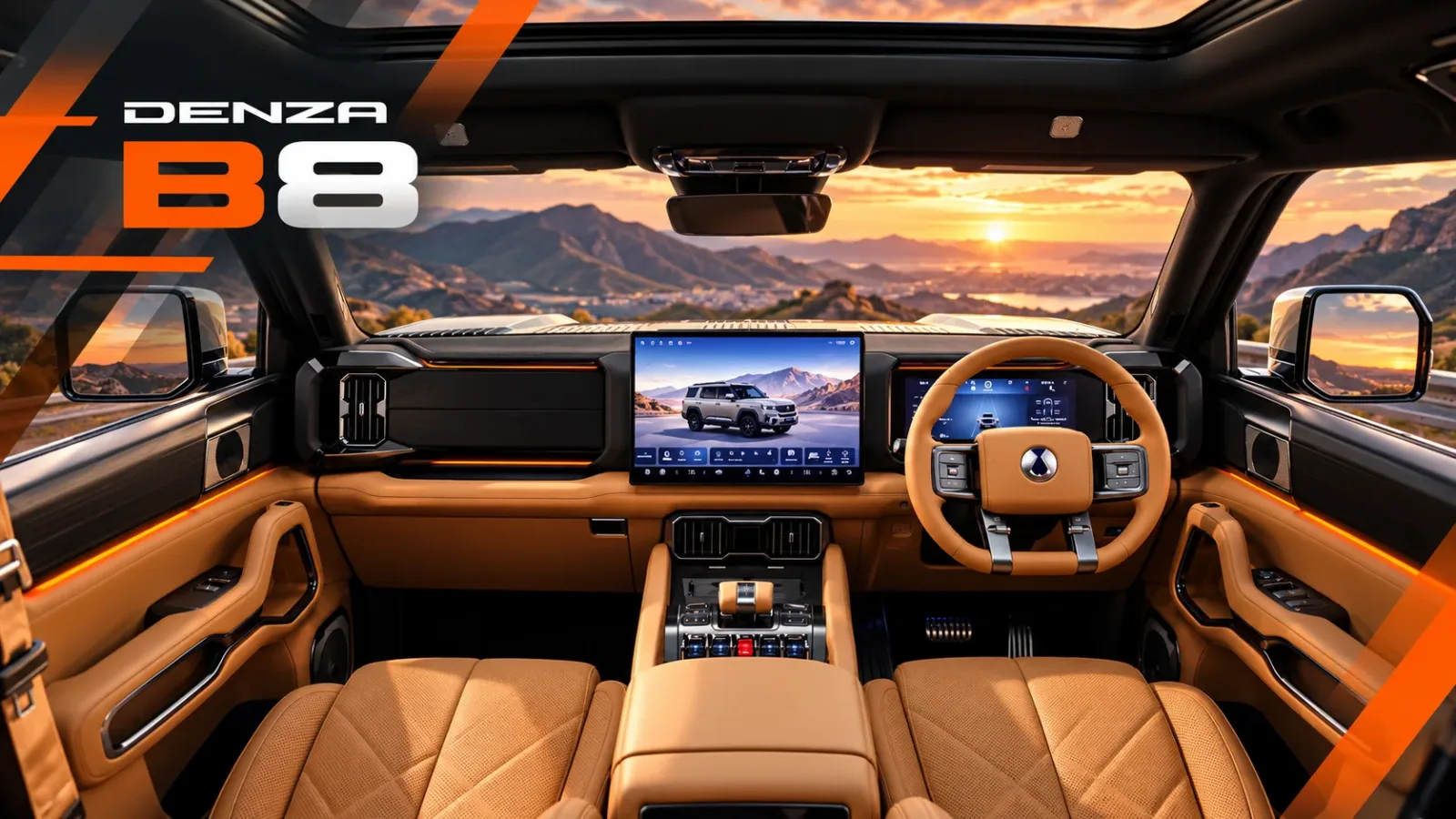 The rugged exterior doesn't tell the complete B8 story. Open the doors and DENZA's premium ambitions become much clearer. A 17.3-inch central touchscreen dominates the dashboard, accompanied by a 12.3-inch digital instrument display. The Philippine specification also includes Apple CarPlay and Android Auto, a 360-degree monitor, four-zone voice control, Wi-Fi connectivity, over-the-air software updates and multiple digital-key technologies. An 18-speaker Devialet audio system provides the entertainment, while the cabin includes multi-color ambient lighting, three-zone automatic climate control, wireless phone charging and an integrated refrigerator. The two Philippine variants differ most noticeably in passenger configuration. The B8 Dynamic uses a seven-seat layout, while the B8 Premium becomes a six-seater with second-row captain's chairs. That makes the Premium particularly interesting for families who prioritize second-row comfort. Instead of treating the middle row simply as somewhere to carry additional passengers, the captain's-chair configuration turns it into an important part of the luxury experience.
DENZA B8 Price in the Philippines
There are currently two Philippine variants:
- DENZA B8 Dynamic - ₱4,998,000
- DENZA B8 Premium - ₱5,398,000
These were the official launch prices announced in April 2026. That pricing puts the B8 firmly into premium-SUV territory. At nearly ₱5 million for the entry version and almost ₱5.4 million for the Premium buyers are no longer evaluating the vehicle simply on how many features they receive for their money. Expectations change. Material quality matters. Ride refinement matters. Noise isolation matters. Reliability matters. Resale value matters. And perhaps most importantly for a relatively new premium brand, after-sales support and parts availability matter. DENZA has begun developing a dedicated Philippine dealer network, including facilities in Metro Manila and Cebu. How that network develops as the number of vehicles on Philippine roads increases will become an important part of the ownership story.
How Practical Is the DENZA B8?
This is where the specification sheet becomes particularly interesting. At 5,195 mm long and almost two meters wide, the B8 is enormous by everyday Philippine-car standards. That size creates obvious benefits. There is space for three rows of passengers. The wide cabin allows generous seating. The substantial wheelbase contributes to passenger accommodation, while the vehicle's towing and off-road capabilities make it suitable for activities far beyond ordinary commuting. But physics still applies. A large SUV remains a large SUV. Narrow residential streets, older parking structures, tight ramps and crowded urban parking spaces will require more attention than they would in a smaller crossover. The 360-degree camera system and extensive electronic assistance should make maneuvering easier, but they cannot change the vehicle's physical dimensions. Its official minimum turning radius is 6.0 meters, another number worth considering for owners who regularly drive in dense urban environments.
Seven Seats Don't Automatically Mean Seven-Person Luggage Space
Cargo capacity deserves similar attention. DENZA lists 147 to 633 liters of luggage capacity, depending on seating configuration. The lower figure matters. When all three rows are being used, families travelling with several passengers may need to think carefully about luggage. That isn't unusual among three-row SUVs, but it demonstrates why vehicle practicality cannot be judged from exterior dimensions alone. A buyer expecting to carry six or seven people plus several large suitcases should physically inspect the cargo area with the third row raised before deciding whether it suits their needs. With fewer passengers and seats folded, the equation changes considerably.
Where the PHEV System Makes Sense
The B8 may be most interesting when used in two very different environments. During the week, an owner with home charging could potentially use its battery for a significant portion of everyday commuting. Then, when the weekend arrives, the same vehicle can leave the city without depending entirely on public charging. That flexibility is one of the strongest arguments for a PHEV in the Philippines. There is no requirement to find a fast charger halfway through a long provincial journey simply to continue travelling. The gasoline engine remains available once the usable battery charge falls. At the same time, the owner still has the opportunity to reduce gasoline use during shorter journeys by charging regularly. But that advantage diminishes if the vehicle is never plugged in. And at 3,305 kg, the B8 is moving a tremendous amount of mass. Once electrical assistance and stored battery energy become limited, efficiency will inevitably depend heavily on driving conditions and how the hybrid system manages that weight. This is one area where a proper long-term Philippine road test would tell us far more than laboratory figures.
Technology Creates Capability and Complexity
The B8 contains an extraordinary amount of hardware. There is a turbocharged gasoline engine, high-voltage Blade Battery, electric hybrid system, dual-motor propulsion, sophisticated power electronics, electronic differential control, DiSus-P hydraulic suspension, advanced driver-assistance systems and an extensively digital cabin. Each technology exists for a reason. Together, they allow a three-tonne luxury SUV to operate electrically for shorter journeys, accelerate to 100 km/h in a claimed 4.8 seconds, tow as much as 3.5 tonnes and tackle terrain that would stop many ordinary crossovers. But complexity is also something prospective long-term owners should consider. The real test will not occur during a showroom demonstration. It will come after years of heat, traffic, rough roads, charging cycles and accumulated mileage. That makes warranty support, technician training, replacement-parts availability and DENZA's developing Philippine dealer network important parts of the ownership equation.
A Different Future for the Luxury 4x4
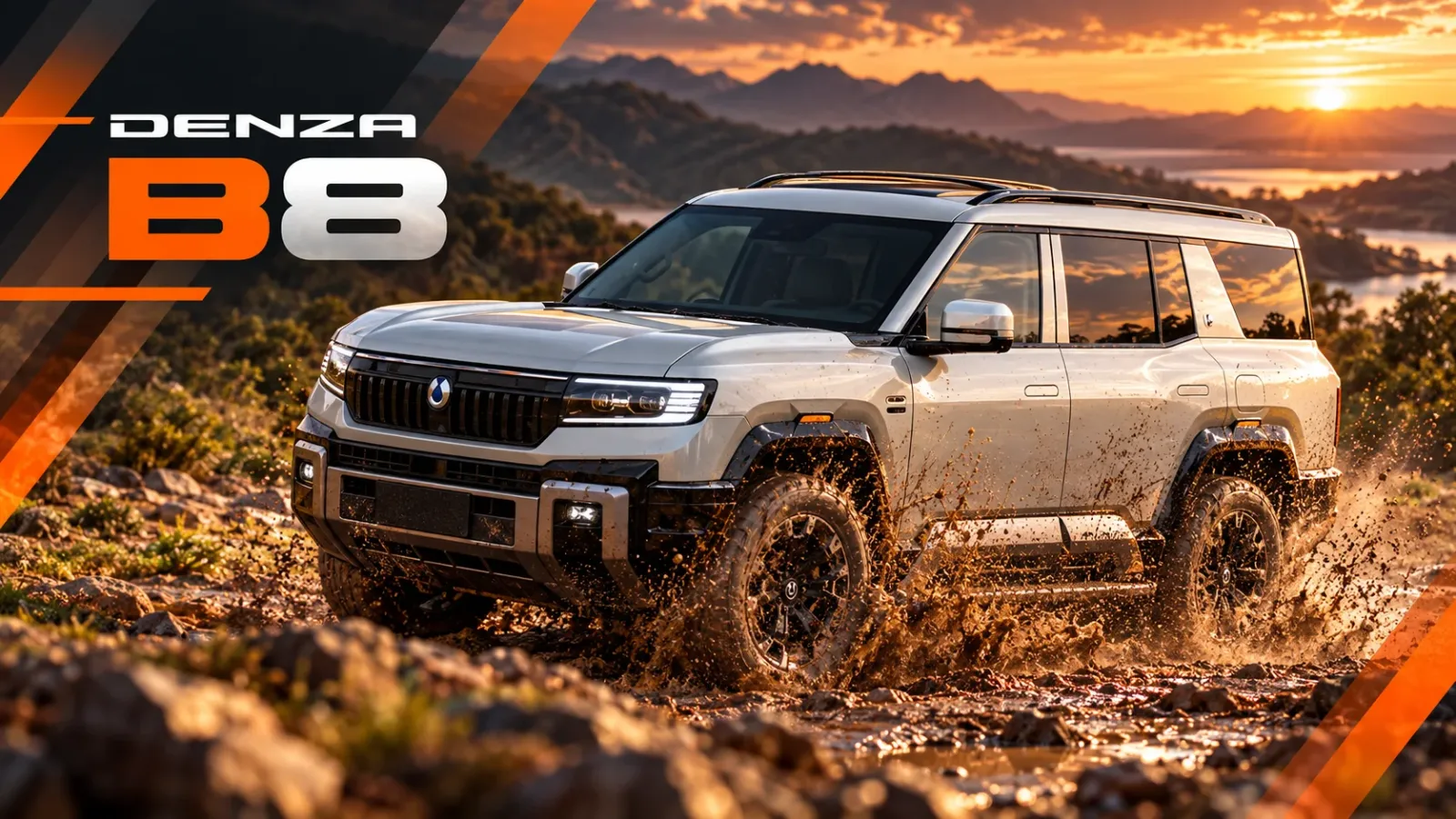 The DENZA B8 demonstrates how quickly the definition of a large off-road SUV is changing. Its basic architecture would be familiar to anyone who understands traditional 4x4s: a large body, body-on-frame construction, three-row seating, four-wheel drive and hardware designed to cope with difficult terrain. But almost everything controlling that hardware belongs to a newer generation. Electric motors provide propulsion. A Blade Battery stores enough energy for meaningful electric driving. Software manages torque. Electronic differential systems control traction. And DiSus-P continuously manages the suspension. DENZA claims 603 hp, 760 Nm, 0–100 km/h in 4.8 seconds, up to 115 km of NEDC electric range and 1,040 km of NEDC combined range for the Philippine B8. On paper, those are impressive numbers. But just like the Jetour GAIA G700, the B8 ultimately needs to prove something more important than its specifications. At ₱4.998 million to ₱5.398 million, buyers will expect the vehicle to remain comfortable, dependable and well-supported long after the novelty of its enormous displays, powerful electric motors and clever suspension has worn off. For families with home charging, regular long-distance travel and a genuine need for three-row space, towing or off-road capability, the B8 presents an interesting combination of abilities that would have been difficult to put into a single vehicle only a few years ago. For primarily urban users, its enormous dimensions and weight deserve just as much consideration as its technology. That may ultimately be what makes the DENZA B8 Philippines story worth following. It isn't simply BYD technology placed inside a more expensive SUV. It is an attempt to redefine what a premium body-on-frame 4x4 can be when electrification becomes part of the vehicle's fundamental engineering rather than an addition to it. And while the specification sheet tells us what the B8 can do, Philippine owners accumulating real mileage will eventually tell us something even more important, how well all of that technology works in the real world?
Comments
No comments yet. Be the first to join the discussion.