Tesla Full Self-Driving in 2026: What It Can Do, What It Can’t, and What’s New
Tesla’s Full Self-Driving (FSD) has evolved into an increasingly capable supervised driver-assistance system, able to handle much of an end-to-end journey across city streets and highways. However, despite what its name may suggest, it still requires a fully attentive human driver who is prepared to take control at any moment.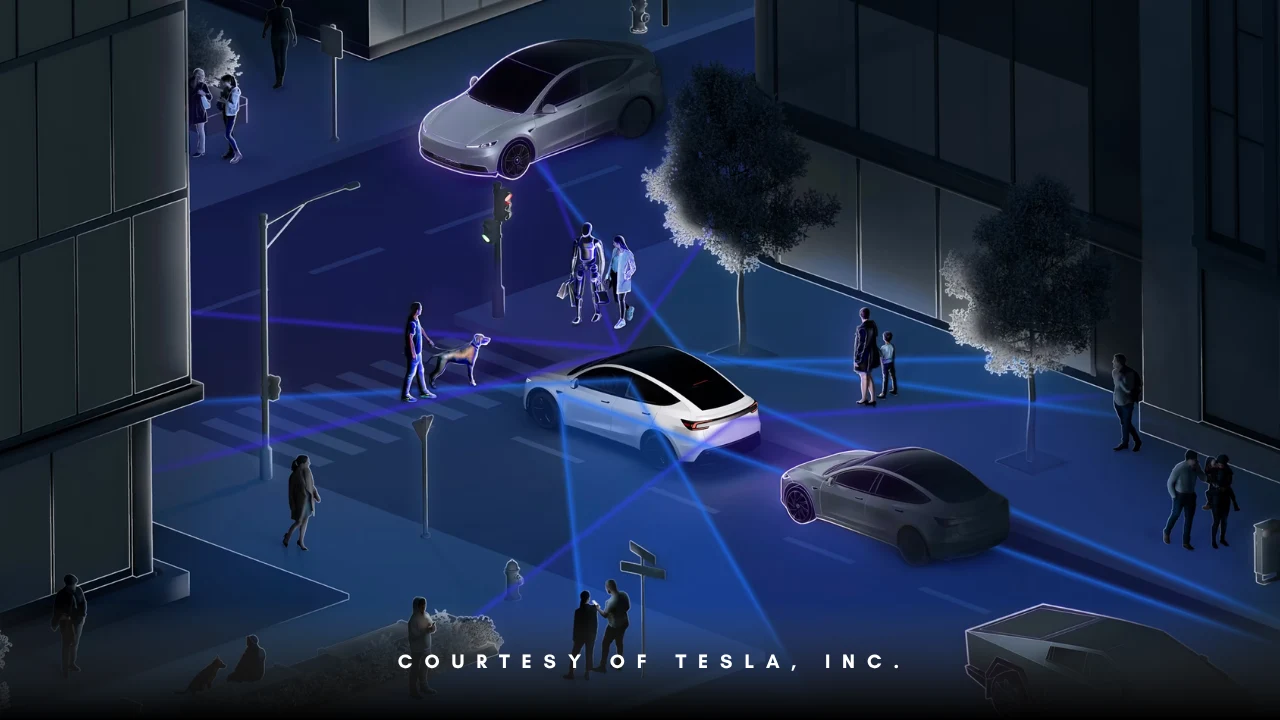
In 2026, one of the most significant developments is a new safety layer designed to allow FSD to intervene in certain dangerous situations—even while the driver is operating the vehicle manually—in an attempt to prevent or reduce the severity of a collision.
What “Full Self-Driving (Supervised)” Actually Means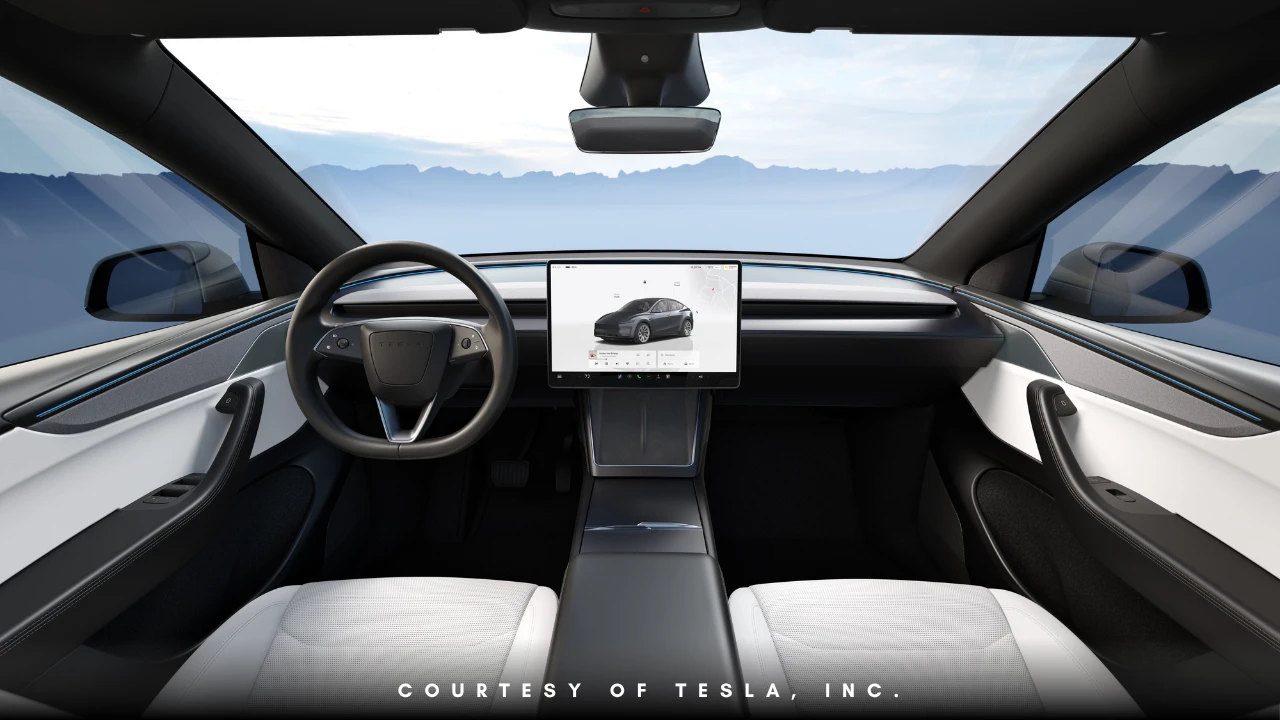
Despite the “Full Self-Driving” name, Tesla’s consumer FSD remains a supervised driver-assistance system rather than a fully autonomous driving system. It is generally classified as SAE Level 2 automation.
FSD can perform many of the tasks normally handled by a human driver, including steering, accelerating, braking, changing lanes, navigating intersections, following a planned route, and parking. However, the driver must continuously monitor the vehicle and surrounding traffic and be ready to intervene immediately when necessary.
In practical terms, the person behind the wheel remains responsible for operating the vehicle safely.
In the U.S., FSD has primarily been offered through a $99-per-month subscription, although Tesla’s pricing, purchase options, and availability can vary depending on the market and may change over time.
2026 Software Lineup: FSD v14.3.x on AI4 and “Lite” for HW3
As of September 2026, Tesla is rolling out newer FSD v14.3.x releases—particularly versions such as v14.3.8 and v14.3.9—to vehicles equipped with Hardware 4, also known as AI4. Older Hardware 3 vehicles, meanwhile, are receiving a separate and more limited “Lite” branch based on earlier v14 releases.
Core capabilities available under FSD (Supervised) include:
- Starting from a parked position and following a navigation route toward the selected destination
- Performing automatic lane changes, choosing appropriate forks, and making left or right turns at intersections
- Responding to stop signs and traffic lights, navigating around vehicles and other objects, and assisting with parking at the destination
- Providing detailed in-car visualizations, including the blue FSD driving path and “Self-Driving” status indicators, along with related information available through Tesla’s app
Together, these capabilities allow FSD to handle a substantial portion of everyday driving, but they do not remove the requirement for continuous driver supervision.
The Big 2026 Upgrade: Automatic Collision Evasion
One of the most notable FSD developments in late summer 2026 is a feature described as “Automatic Collision Evasion,” associated with FSD v14.3.9 and firmware in the 2026.27.x family. Unlike conventional driver-assistance features that mainly react by applying the brakes, this system is designed to use more of the vehicle’s available controls when it determines that a collision may be imminent. In certain situations, FSD may temporarily intervene even when the vehicle is being driven manually.
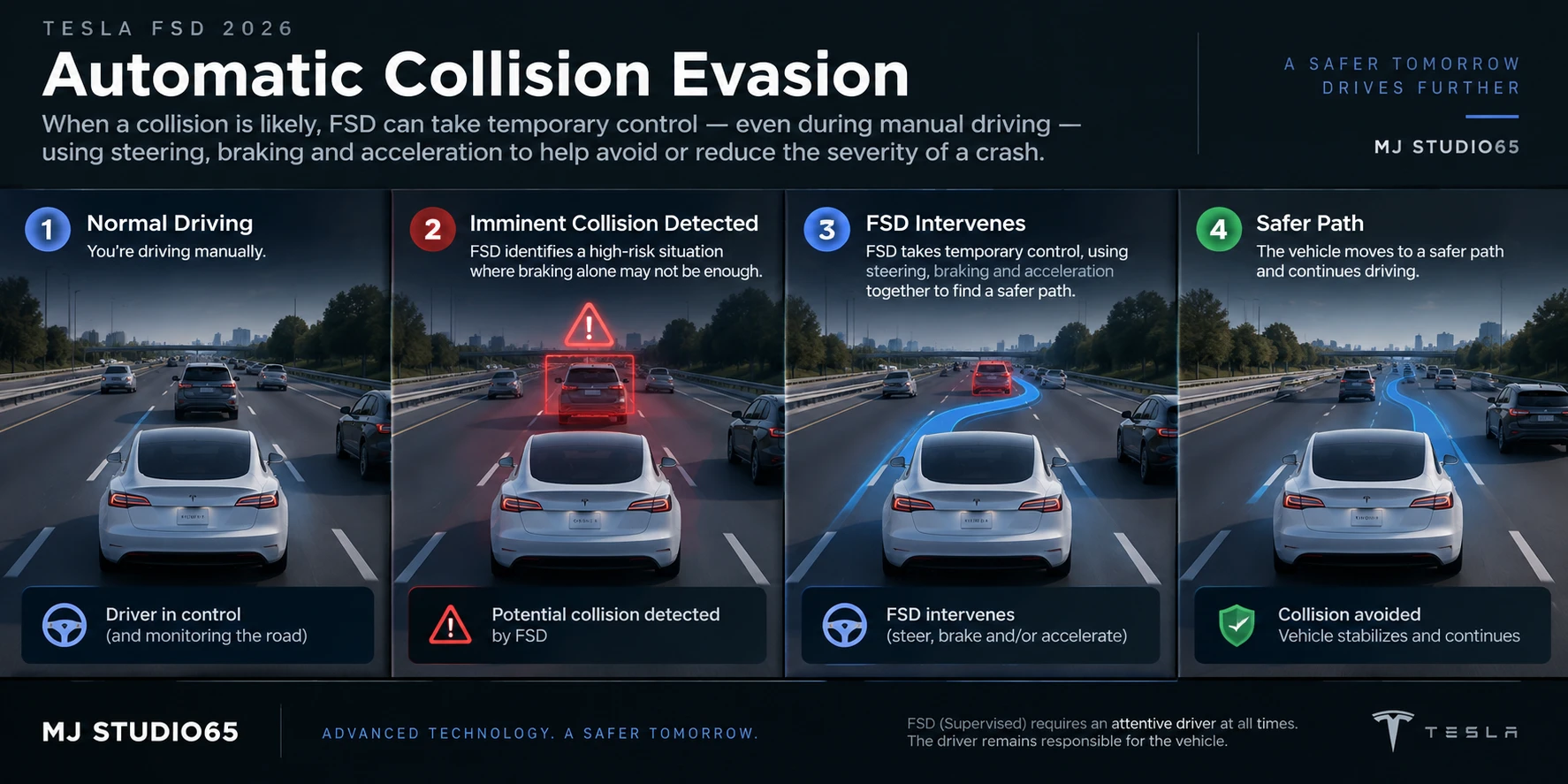 Tesla describes two important situations where this type of intervention may become relevant:
- During an imminent frontal or head-on collision where conventional Automatic Emergency Braking may not be enough, the system may combine steering, braking, and acceleration in an attempt to find a safer path.
- During certain situations involving significant driver distraction or an unintended FSD disengagement, the system may intervene in an attempt to maintain control of the vehicle and reduce the immediate danger.
The important difference is that the system is not limited to braking alone. By potentially combining braking with steering and acceleration, Tesla is attempting to give the vehicle more options for avoiding an impact when simply stopping may not be sufficient.
However, this additional safety capability should not be interpreted as making FSD autonomous. The driver is still expected to remain attentive and responsible for the vehicle.
Under the Hood: Vision, Reinforcement Learning, and a Faster AI Stack
Many of FSD’s improvements are happening behind the scenes.
Tesla’s 2026 software updates and technical descriptions point to continued improvements in the vision system, artificial intelligence models, training methods, and the software infrastructure used to run those models inside the vehicle.
Some of the key developments include:
- An upgraded vision encoder and expanded reinforcement-learning (RL) training intended to improve performance in unusual situations, low-visibility environments, complex road geometry, and traffic-sign interpretation
- A rewritten AI compiler and runtime based around MLIR, which Tesla says can improve reaction speed by roughly 20 percent while also allowing faster development and deployment of new AI models
- Improved parking-spot selection and better prediction of the intended parking location, including a parking destination or location pin displayed on the vehicle’s map
These improvements help explain why newer FSD versions can feel more natural in certain situations, particularly when positioning the vehicle within a lane, entering turns, adjusting speed, navigating city streets, and approaching parking areas.
The larger story is that FSD development is no longer simply about adding individual driving features. Tesla is increasingly relying on improvements to its AI models, training data, vision processing, and onboard computing stack to refine the overall driving behavior.
Safety Data, High-Profile Crashes, and Regulatory Pressure
Safety remains one of the most important—and most debated—parts of the FSD story. Tesla continues to argue that increased use of its driver-assistance technology can reduce crashes. In early September 2026, the company cited data suggesting that vehicles operating with FSD experienced approximately 4.1 times fewer collisions as European regulators considered wider approval of supervised FSD.
Such figures, however, need to be interpreted carefully. Comparing crash rates between assisted and unassisted driving can be complicated by differences in road type, driving conditions, vehicle population, driver behavior, mileage, and the way incidents are measured.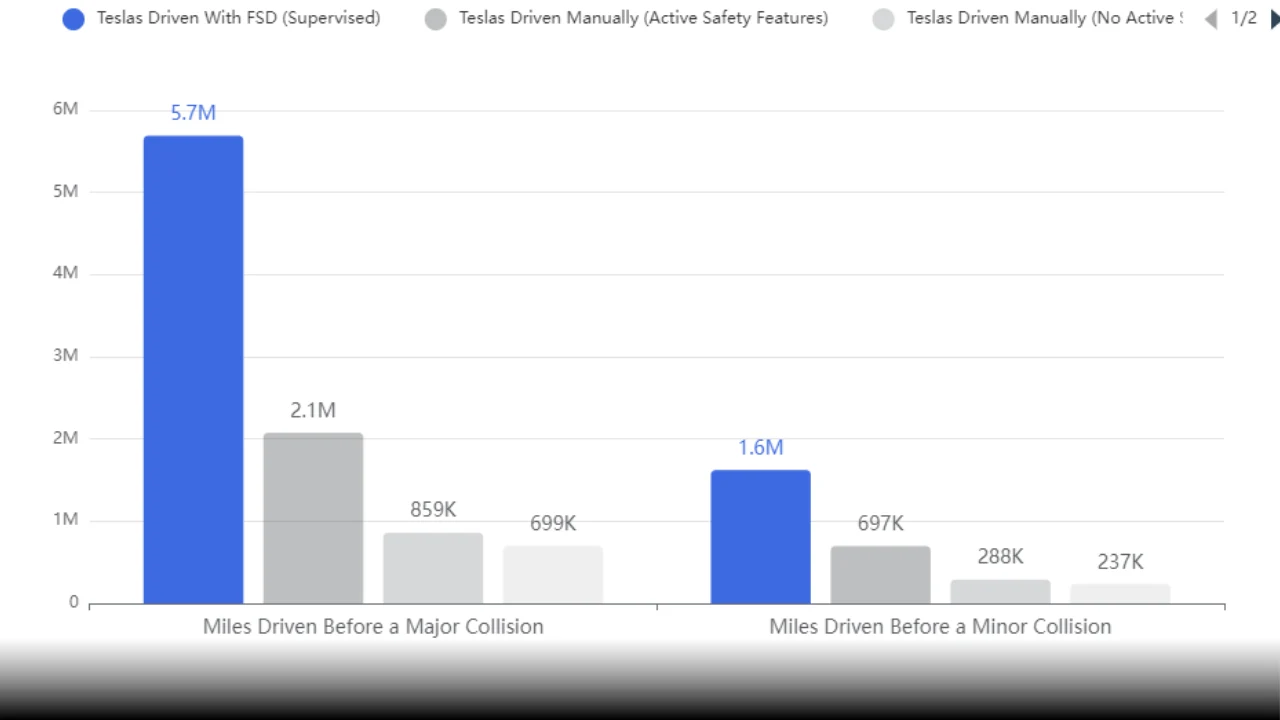
At the same time, serious crashes involving Tesla vehicles continue to attract regulatory and public scrutiny. In early September 2026, reports highlighted a fatal crash in Buena Vista, New Jersey, involving a Tesla Model 3 that reportedly traveled through a stop sign and struck an 82-year-old man. Tesla data associated with the incident reportedly indicated that a driver-assistance system was “Verified Engaged,” while the vehicle’s behavior raised questions about the use of city-street automated driving functionality.
Incidents such as this underline an important distinction in the FSD debate: a system can be technically advanced and capable of performing complex driving tasks while still requiring human supervision. Regardless of the “Full Self-Driving” branding, Tesla’s consumer system remains supervised, and the driver is expected to monitor its behavior and intervene whenever necessary.
Hardware 4 and the Road to FSD v15
Tesla’s next major target is FSD v15.
The company has indicated that its current AI4, or Hardware 4, computing platform has enough processing capability to support the next generation of FSD software. Tesla has described the upcoming version as potentially representing a significant “step-change” in capability.
Internal and public discussions around the platform have also raised the possibility that AI4 could eventually support some form of unsupervised operation.
That possibility, however, should be separated from what Tesla vehicles can legally and practically do today.
Tesla has made ambitious autonomy predictions in the past, and several timelines for widespread unsupervised self-driving have been delayed. Regulatory approval would also be required before autonomous operation could become broadly available to consumers.
As of September 2026, the FSD available to ordinary Tesla owners remains a supervised driver-assistance system.
How to Frame FSD in Your Coverage
For clear and responsible coverage, Tesla FSD should be presented as an increasingly sophisticated Level 2 driver-assistance system rather than a fully autonomous vehicle technology.
Several points are particularly important:
- Position FSD as a powerful Level 2 ADAS capable of handling much of an end-to-end journey, while clearly emphasizing that continuous driver supervision is still required.
- Highlight 2026’s Automatic Collision Evasion capability as an important development because it expands the system’s potential intervention beyond conventional emergency braking.
- Treat Tesla’s claimed 4.1× collision reduction as a company safety claim rather than definitive proof that FSD is four times safer in every driving situation.
- Add technical context through Tesla’s vision-encoder improvements, reinforcement-learning development, and MLIR-based AI software stack.
- Separate Tesla’s future ambitions for FSD v15 and unsupervised autonomy from the capabilities available to consumers today.
Comments
No comments yet. Be the first to comment.